


Legionella Risk Assessment
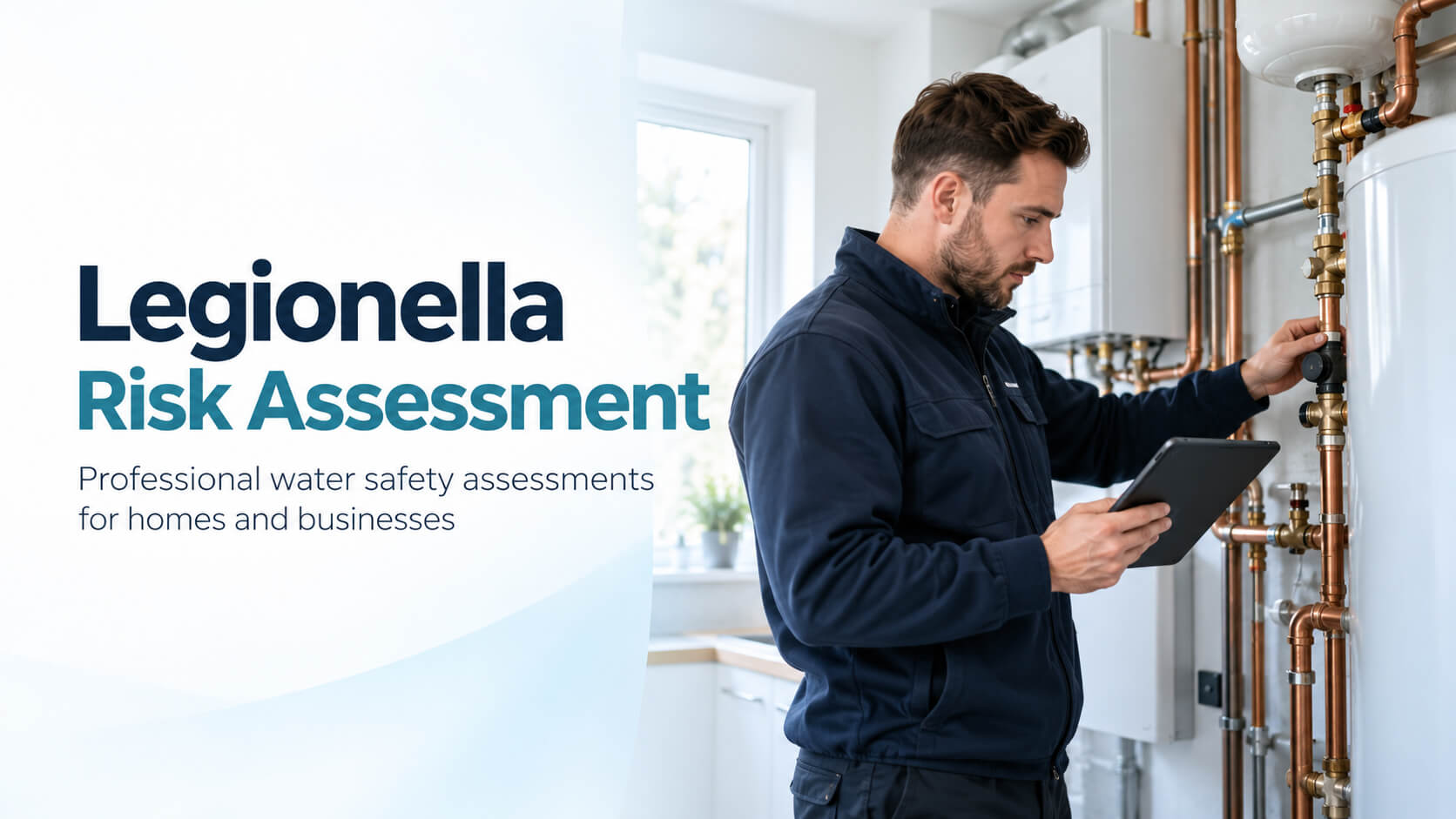
A Legionella Risk Assessment checks the hot and cold water systems of a property for conditions that allow Legionella bacteria to grow, and sets out what needs to be done to control the risk. It is a legal duty for landlords, employers and anyone who controls premises.
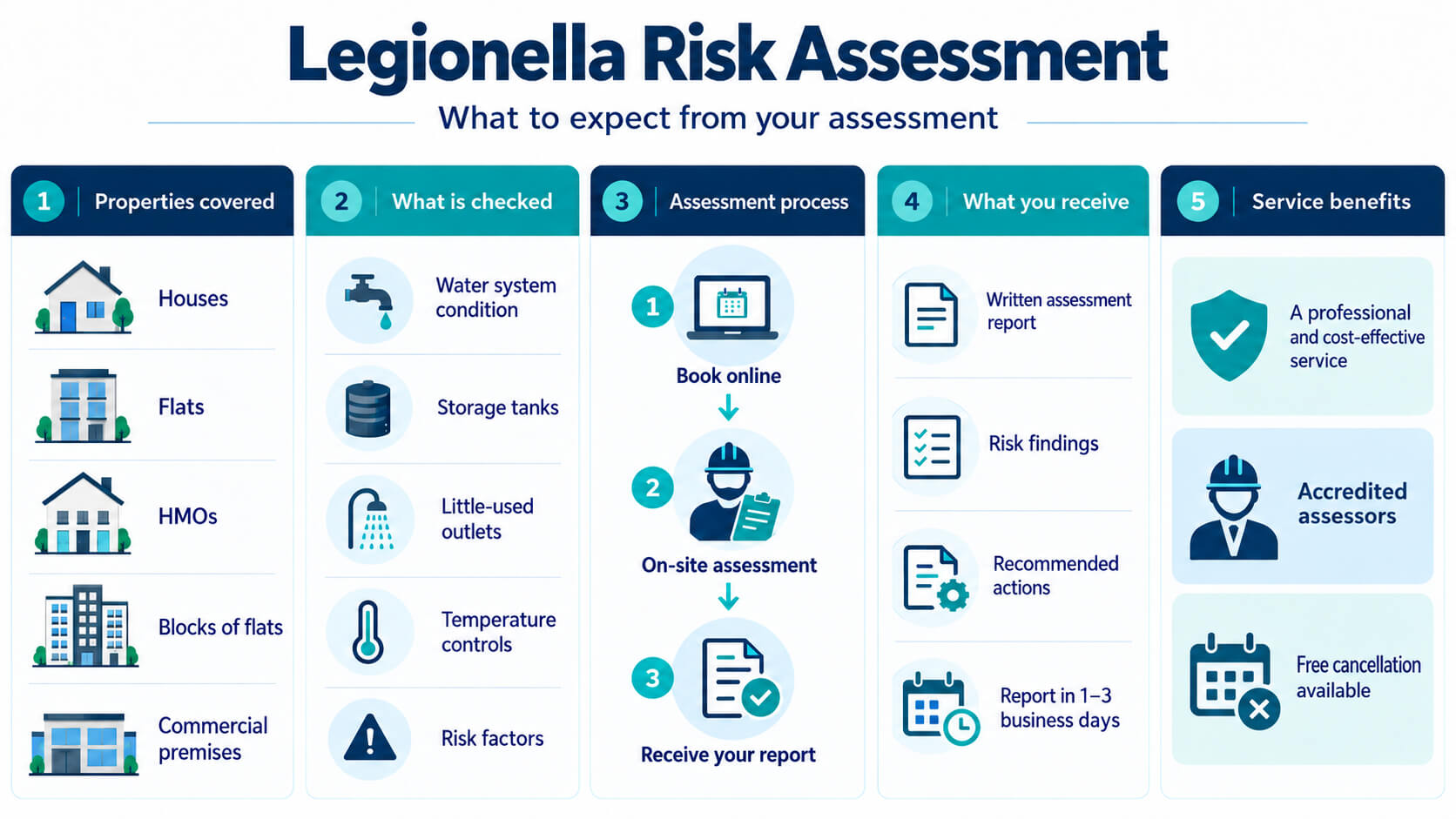
After the visit you receive a written risk assessment report with the risk rating, findings and recommended actions.
Book a Legionella Risk Assessment Online
- Fixed price shown before you book
- Houses, flats, HMOs, blocks of flats and commercial premises
- Written Legionella Risk Assessment report (HSE ACoP L8)
- Choose an appointment time that suits you
- Free cancellation
- Card, PayPal, Google Pay or Apple Pay

What type of property needs the Legionella Risk Assessment?


Recently booked jobs



Legionella Risk Assessment Services
A Legionella Risk Assessment identifies conditions in a property's water system that could allow Legionella bacteria to grow and expose people to infection. It examines how water is supplied, stored and used, along with the precautions needed to control the risk. Legionella bacteria can cause Legionnaires' disease when contaminated water droplets are inhaled.
MyConstructor offers on-site assessments for domestic and commercial properties, with accredited assessors and a written report following the visit. The service is designed around the building and its water system, so the inspection and recommendations reflect relevant risks rather than a generic checklist.
Residential property assessments
Residential assessments cover houses, flats and houses in multiple occupation (HMOs), including properties with stored or directly supplied hot and cold water. The assessor considers relevant tanks, cylinders, showers, taps and outlets that may be used infrequently. System complexity, occupancy and water turnover influence the risks identified during the visit.
A low-risk result does not mean that basic precautions can be abandoned. Hot and cold water systems still need suitable use and maintenance, and changes to a property may call for a fresh look at the original assessment.
Commercial and shared water systems
Commercial assessments cover workplaces and shared water installations where the system and its users can create different exposure risks. Offices, shops, restaurants, salons, workshops and blocks of flats may have multiple outlets, storage arrangements or communal plant. These features affect what must be examined and who is responsible for managing the findings.
Hotels, care homes, gyms and more complex properties may require a tailored scope. Before booking, it helps to identify the systems being managed, any shared facilities and the areas the assessor will need to access. A flat supplied by communal hot water, for example, differs from one with its own combi boiler.
For premises with specialist equipment, the agreed assessment scope should be checked before booking. The visit focuses on assessing relevant risks and documenting proportionate control recommendations for the system examined.
For employers and people in control of premises, Legionella risk assessment forms part of wider UK health and safety duties. These include the Health and Safety at Work etc. Act 1974 and, where applicable, the Management of Health and Safety at Work Regulations and COSHH. The HSE's Approved Code of Practice L8 provides guidance on assessing and controlling Legionella risks in water systems. Commissioning a professional assessment can support these duties, but responsibility for implementing and maintaining appropriate controls remains with the relevant dutyholder.
Legionella Risk Assessment for Landlords
A Legionella risk assessment for landlords should reflect the actual hot and cold water system in the rented property and the conditions in which it is used. A regularly occupied home with a straightforward installation will often have lower risks than a property with complex shared services or outlets left unused for long periods. The aim is to identify relevant hazards and apply proportionate controls, not to assume that every rented home needs the same detailed survey.
Landlord responsibilities cover rented houses, flats and rooms as well as properties with shared facilities. The important questions are whether water is stored or stagnates, how outlets are used and whether tenants could be exposed to contaminated droplets. These considerations also inform whether a landlord can assess the risks competently or needs specialist help.
Landlord Legionella Responsibilities
UK landlords have a legal responsibility to assess and control relevant Legionella risks, but that does not automatically mean commissioning an external assessor. HSE explains that many simple domestic systems present relatively low risk where water is regularly used and suitable precautions are maintained. A landlord with sufficient knowledge may undertake a proportionate assessment; someone who cannot do so competently should seek appropriate assistance. See the HSE guidance on landlords' Legionella responsibilities.
Tenants should be informed of relevant precautions and encouraged to report concerns such as poorly performing hot water or unused outlets. Properties left vacant for an extended period may need suitable measures to prevent stagnation before or during reoccupation. Routine laboratory water sampling, an official Legionella certificate and a fixed annual or two-year reassessment interval are not universal legal requirements for domestic landlords. The assessment should be reviewed when circumstances indicate that existing findings may no longer be valid.
When a Professional Assessment May Help
A professional on-site assessment may be useful when the water-system layout is unclear, responsibility is shared or the landlord lacks the knowledge to assess the risks confidently. This can include HMOs with more complex arrangements, blocks with communal hot water, properties with redundant pipework or homes that have been vacant for long periods. None of these features automatically proves a high Legionella risk; the actual installation and its use determine the scope of review.
Appropriate follow-up may involve ensuring suitable water turnover, reviewing unused outlets or advising occupants about showerhead cleaning and descaling. These are examples of controls to consider, not maintenance tasks supplied with a MyConstructor assessment. MyConstructor provides an on-site Legionella Risk Assessment and a written report of findings and recommendations; the landlord or relevant dutyholder remains responsible for arranging any necessary controls or remedial work.
Assessment Process and Water System Checks
The assessment process reviews the water installation, identifies potential sources of Legionella risk and records the controls needed to manage them. The assessor considers the water supply, equipment, water use and possible exposure to droplets. The process should be proportionate to the system, its condition and the people using the building.
The assessor surveys accessible water assets and outlets, checks relevant water temperatures and looks for stagnant sections, scale and little-used outlets. Where applicable, they also review available maintenance records, flushing arrangements and responsibilities for managing the system. The findings are evaluated together to establish the risk rating and recommend appropriate control measures.
Water system inspection
The inspection examines relevant hot and cold water components and the conditions in which Legionella may multiply. Depending on the installation, this can include cold water storage tanks, hot water cylinders, calorifiers, pipework, combi boilers, taps, showers and little-used outlets. The assessor looks for stagnant water, scale, debris, poorly maintained equipment and other system-specific concerns, including suspected dead legs and blind ends where accessible.
Temperature helps assess whether established controls are working. HSE guidance identifies 20°C to 45°C as a range favourable to bacterial growth; common control benchmarks for appropriate systems include hot water storage at 60°C or above, hot outlets reaching at least 50°C within one minute and cold water below 20°C. Any interpretation must account for the actual system and scalding precautions. For a fuller explanation of the temperature ranges and outlet targets, see our Legionella water temperature guide.
Access is an important practical requirement. If a tank, cupboard or plant room cannot be entered, the assessor may be unable to verify that part of the installation; such limitations should be recorded in the findings.
Risk identification and control measures
The assessor identifies where bacteria could grow, how people might be exposed and which measures are appropriate for the property. The review considers water turnover, storage, temperature control, aerosols and the vulnerability of building users. Risks are assessed in context: the needs of a regularly occupied flat differ from those of a large building with several shared systems.
Recommended measures may include flushing little-used outlets, descaling showerheads, reviewing temperature settings or addressing redundant pipework. These are recommendations documented in the assessment report, not work carried out during the appointment. The findings help the person responsible for the premises identify which actions need attention.
The customer or relevant dutyholder is responsible for arranging any necessary remedial work. MyConstructor's service is limited to carrying out the agreed assessment and providing the written risk report. Repairs, cleaning, disinfection and ongoing water-system management are not included.
Legionella Risk Assessment Prices
MyConstructor Legionella Risk Assessments start from £65, with the exact price based on the property and the scope selected. Customers can review the fixed price shown in the booking process before confirming an appointment. The starting price is not a universal charge for every building.
The Legionella risk assessment cost reflects differences between domestic properties, blocks of flats and commercial premises. Accurate property information matters because bedrooms, shared systems and relevant facilities can affect the service required. Complex installations may need a tailored quotation.
Prices for houses, flats and HMOs
The Legionella risk assessment price for a house, flat or HMO depends on the property details entered during booking, including the number of bedrooms. Houses and flats can differ in size, water storage and access arrangements, while HMOs may have a larger number of occupants and water outlets. The correct property selection helps establish the relevant quote.
For a building containing several flats, it is important to distinguish self-contained systems from shared water services. Where a communal installation serves multiple dwellings, the number of flats and the common system can affect the price and the necessary assessment scope.
Prices for commercial and shared systems
Commercial assessment pricing reflects the visit, written report and the number of relevant water facilities at the premises. Under the current booking structure, the quotation considers a base charge alongside facilities such as toilets, washrooms, kitchens and showers. A small office can therefore differ from a large workshop or a building with several communal areas.
The quoted fee covers the agreed on-site assessment and written risk report, not remedial work. MyConstructor does not undertake repairs, cleaning or disinfection as part of this service. Where a property has specialist equipment, extensive communal pipework or restricted access, confirm the assessment scope before booking.
Property type and bedroom count
Number of flats and communal facilities
Washrooms, kitchens, showers and assessment scope
Confirming these details before payment helps the quote reflect the intended visit. If the building has a complex or partly shared installation, contact the team so the service scope is clear before the assessment takes place.
Written Assessment Reports and Findings
A written Legionella Risk Assessment report is provided within 1–3 business days after the visit. It records the assessment findings, relevant risks and recommended actions, giving the responsible person a practical basis for managing the water system. It is not a government-issued Legionella certificate.
The report is useful to landlords, managing agents, employers and facilities managers who need to understand what was inspected and what requires attention. Its value lies in documenting the assessment and supporting decisions, not in guaranteeing that a property will remain free from risk indefinitely.
Findings included in the report
The report sets out the assessed system, the overall risk rating and the observations behind the assessor's conclusions. It identifies relevant conditions such as storage, water use, accessible equipment and any issues that need further attention. This helps readers distinguish routine precautions from concerns that require action.
Where appropriate, findings are accompanied by recommendations and priorities so the dutyholder can decide how to proceed. Any significant restrictions on inspection, such as inaccessible plant areas, should be understood when reviewing the report.
Read these findings together rather than relying on the overall rating alone. Where inspection access was restricted or an action needs follow-up, the report should make that clear to the person managing the property.
Using the report to manage risk
The report should guide the necessary control measures and any follow-up work rather than be treated as a substitute for them. A low-risk result still depends on suitable controls being maintained. Where a formal written scheme of control is needed, preparing and implementing it is a separate responsibility of the dutyholder, not part of MyConstructor's assessment service. Where a recommendation identifies an issue, the responsible person should decide who will address it and retain appropriate records of the action taken.
The assessment also needs review when there is reason to believe it may no longer reflect the installation or its use. HSE guidance does not impose a universal annual or two-year renewal interval for domestic landlords in England; the review arrangements depend on the circumstances and risks. The HSE risk assessment guidance explains the relevant considerations.
Online Booking and Appointments
You can book a Legionella Risk Assessment online by selecting the property details, reviewing the displayed price and choosing an available appointment. The booking journey is designed to make the service and price clear before confirmation. If the site is unusually complex, it is better to clarify the required scope before selecting a standard visit.
An appointment is most useful when the assessor can access the relevant water facilities and obtain a clear picture of how the system is used. Preparing access in advance can reduce delays and help avoid gaps in the inspection.
Selecting the property and appointment
Start by choosing the correct property type and entering the details that affect the assessment price. For domestic properties, check the bedroom information; for blocks and commercial premises, identify communal systems and relevant water facilities. For a property in London, enter the actual address to check the available booking options and price. Review the selected appointment before completing the booking.
MyConstructor offers accredited assessors and a written report following the visit. The booking process supports the payment methods shown at checkout, and free cancellation is available according to the booking terms. Customers with more complex installations can contact the team to establish a suitable service scope.
Preparing access for the assessor
Before the visit, arrange access to the water system and the rooms or plant areas included in the booked assessment. Depending on the building, this may include kitchens, bathrooms, airing cupboards, loft spaces, storage tanks and communal plant rooms. Where access depends on tenants, managing agents or site staff, coordinate it in advance.
Any available information about previous assessments, maintenance, unused outlets or recent changes to the installation can help explain how the system operates. After the visit, use the written findings to understand the recommended next steps and arrange any controls that are required.
- Enter accurate property and water-facility details.
- Review the displayed quote and choose an appointment.
- Arrange access to the relevant areas before the visit.
- Receive the written report within 1–3 business days.
After receiving the report, keep it with any subsequent maintenance or action records so that the next review can take account of what has already been checked and improved.
Official sources:
Legionella Risk Assessment FAQs


Legionella Risk Assessments at MyConstructor start from £65. The final price depends on the property type, size and agreed assessment scope. Houses, HMOs, blocks of flats and commercial premises may have different requirements. Enter your property details during booking to see the applicable price before confirming your appointment.
Landlords must assess and control relevant Legionella risks in their rented properties. However, the law does not automatically require every landlord to hire a professional assessor or obtain a certificate. A competent landlord may assess a straightforward domestic water system. The important requirement is that the risks are properly assessed and appropriate controls are maintained.
A Legionella Risk Assessment must be carried out by someone competent to assess the water system and its risks. This may be a suitably knowledgeable landlord for a simple domestic property or a specialist for a more complex installation. MyConstructor offers accredited assessors for customers who want a professional on-site assessment and written findings.
There is no universal legal requirement to renew a domestic landlord's Legionella Risk Assessment every two years. The assessment should be reviewed periodically and whenever there is reason to believe it is no longer valid, such as changes to the water system, building use or existing control measures. The appropriate review frequency depends on the property's risks.
The visit duration depends on the property and the complexity of its water system. A straightforward house or flat generally requires a less extensive inspection than a commercial building with multiple outlets or shared plant. Restricted access can also affect the appointment. Provide accurate property details when booking so the appropriate assessment can be arranged.
You receive a written Legionella Risk Assessment report within 1–3 business days after the visit. This documents the findings and recommended actions rather than serving as an official government-issued Legionella certificate. If a landlord, managing agent or another party requests a certificate, confirm whether the written assessment report meets their documentation requirements.
The written risk assessment report identifies the concern and recommends appropriate control measures. The customer or relevant dutyholder is responsible for arranging any necessary follow-up work with a suitable provider. MyConstructor carries out the assessment and supplies the report; repairs, cleaning, disinfection and ongoing water-system management are not included in the service.
Make sure the assessor can access the relevant water-system areas, including bathrooms, kitchens, storage tanks or communal plant rooms where applicable. Information about previous assessments, maintenance or changes to the installation can also be useful. If tenants or managing agents control access to particular areas, arrange this before the appointment to help avoid an incomplete inspection.