


Legionella Temperature Ranges and Water Safety Controls
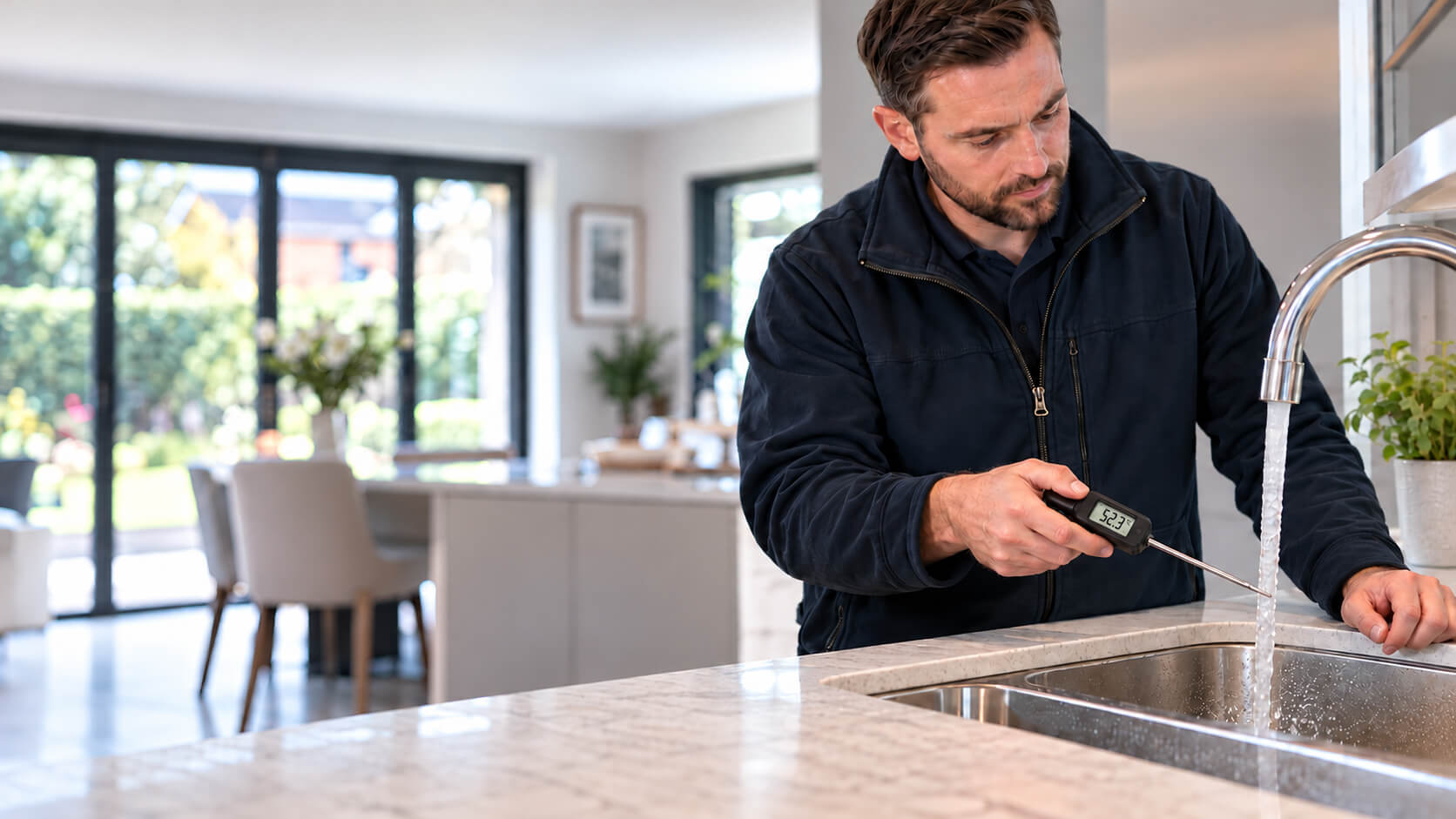
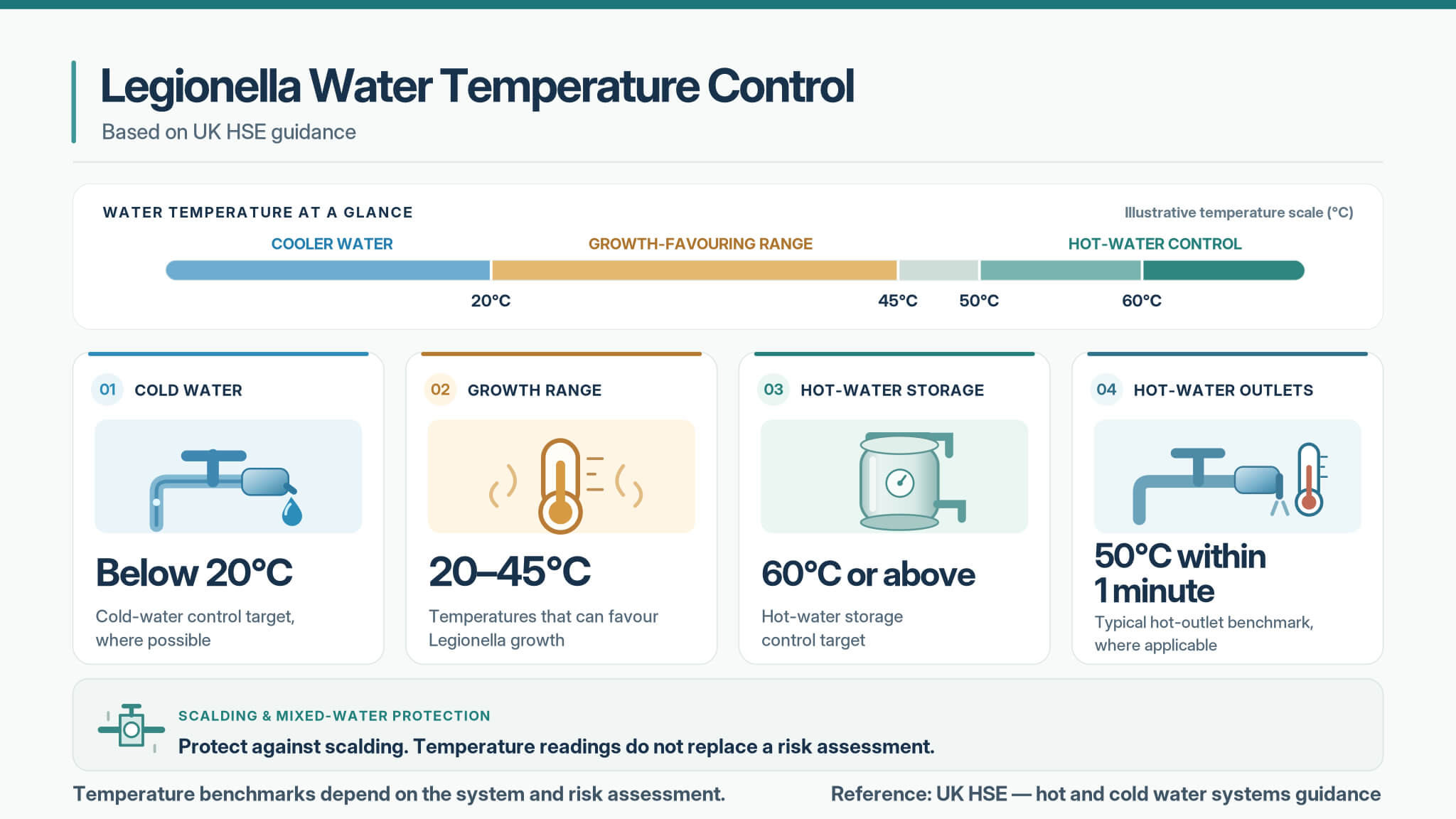
Legionella bacteria can multiply in water between 20°C and 45°C, particularly where water is stagnant. Temperature control helps reduce this risk by keeping cold water below 20°C where possible and maintaining suitable hot water temperatures.
This guide explains UK HSE benchmarks for storage, outlets and routine temperature checks. It also shows why unusual readings need investigation and why scalding precautions and the actual water-system design matter.
Legionella Temperature and Water Safety Guidance
- Understand the 20°C–45°C growth range
- Cold water control target below 20°C
- Hot water storage at 60°C or above
- Hot outlets: 50°C within one minute
- Understand scalding risks and precautions
- Know when professional assessment is appropriate

What type of property needs the Legionella Risk Assessment?


Recently booked jobs

Legionella Growth at Different Water Temperatures
Legionella bacteria can multiply in water between 20°C and 45°C, especially when water remains stagnant. Temperature is therefore an important part of managing the risk in hot and cold water systems. The numbers are useful control benchmarks, but they must be interpreted alongside the condition, use and design of the installation.
Temperature alone cannot establish whether a building is free from Legionella risk. Water turnover, deposits and outlets producing fine droplets also matter. This guide explains the HSE ranges without treating one reading as a complete assessment.
The 20°C to 45°C growth range
Water between approximately 20°C and 45°C provides conditions in which Legionella may grow. The risk is greater where suitable temperatures occur alongside stagnant water, scale, rust or biofilm. A little-used shower or an inadequately managed storage system can therefore require attention even if other parts of the building perform normally.
Temperatures vary across an installation. A cylinder, return pipe and distant tap can give different readings, while cold pipes may warm near hot services. Meaningful checks therefore consider relevant points rather than one convenient tap.
- Temperature: Identify parts of the system that remain in the growth-favourable range.
- Stagnation: Consider low-use outlets, redundant pipework and slow water turnover.
- Exposure: Consider whether showers, taps or equipment can create breathable water droplets.
These factors belong together. A reading in the growth range does not automatically prove contamination, and a reading outside it does not guarantee that every part of the water system is adequately controlled.
How higher temperatures reduce bacterial survival
Hot-water temperature control aims to keep relevant parts of the system outside the range that favours Legionella growth. In systems using temperature as a primary control, HSE guidance commonly specifies storage at 60°C or above and adequate hot-water distribution temperatures. The correct arrangements depend on the equipment and the assessed risks.
Cooler water restricts multiplication, while higher temperatures reduce survival. That is not an instruction to raise tap temperatures: storage, circulation, outlets and scalding precautions must work together.
Cold-water control target where practicable; not a guarantee of zero risk.
Temperature range that can favour growth, particularly where water stagnates.
Common hot-water storage benchmark when temperature is the control method.
These ranges are references, not a system-specific control plan. Water leaving a cylinder must be considered separately from water delivered safely at a tap or shower.
Hot Water Temperature Control
For suitable systems using temperature control, HSE guidance calls for hot water to be stored at 60°C or above and to reach at least 50°C at relevant outlets within one minute. These benchmarks help demonstrate that hot-water storage and distribution are working as intended. They do not remove the need to manage the separate risk of scalding.
Large buildings may have circulation loops, calorifiers and mixing valves, while homes may have simpler installations. Measurement points must therefore match the actual system and its risk assessment.
Hot water storage at 60°C or above
A hot-water cylinder or calorifier is generally maintained at 60°C or higher where temperature is used to control Legionella. This is a storage benchmark, not a recommended temperature for direct contact with skin. It helps limit conditions that allow bacteria to survive and multiply within stored hot water.
Storage readings do not prove that distant branches reach suitable temperatures. Where applicable, flow, return, insulation and circulation also affect system performance.
Hot outlet temperatures and the one-minute benchmark
For typical hot-water systems, the HSE benchmark is at least 50°C within one minute at relevant outlets. This is a check of how hot water is distributed, rather than a requirement to expose users to water at that temperature. Healthcare premises and specialist systems can have different controls or higher distribution benchmarks.
A lower mixed outlet temperature may be deliberate scald protection. Where a thermostatic mixing valve is fitted, the relevant hot-water check may be at its inlet, before blending.
These readings serve different purposes. Unexpected results should be checked against the building's control arrangements before anyone changes equipment settings.
Scalding risks and thermostatic mixing valves
Legionella temperature controls must be balanced against the risk of burns from hot water. This is especially important for young children, older people and others who may be vulnerable to scalding. Thermostatic mixing valves can blend hot and cold water near an outlet so that users receive water at a safer temperature.
Mixed water may be within the growth-favourable range, so valve location and maintenance matter. Never bypass a protective valve or raise shower temperatures based on general guidance.
Cold Water Temperature Control
Cold water should generally be kept below 20°C where reasonably practicable to discourage Legionella growth. This applies to appropriate storage and distribution arrangements, not simply the number seen when a tap is first opened. The condition of tanks, surrounding temperatures and water movement all influence whether a cold system stays within its control target.
Cold water can warm near hot pipework, in service cupboards or during summer heat. A low reading at one tap does not describe every branch; checking arrangements should reflect the system's risks.
Keeping cold water below 20°C
The cold-water control target is below 20°C, with particular attention to stored water and relevant outlets. HSE guidance explains that measurements may need to account for water movement through a pipe rather than only the initial temperature. A reading taken immediately after opening a tap can differ from the temperature after the supply has run.
In larger managed systems, representative outlets and storage points are selected through the risk assessment. A competent person should set monitoring arrangements rather than apply one schedule to every household.
Heat gain, storage and little-used outlets
Warm surroundings, insufficient insulation and poor water turnover can undermine cold-water temperature control. Cold pipes placed close to heating equipment may pick up heat, and water held for long periods in tanks or unused branches can lose the benefit of regular replenishment. These conditions should be considered together rather than as isolated defects.
The right response depends on the installation. A building manager may investigate heat transfer or redundant pipework, while a tenant should report concerns to the landlord or managing agent.
- Check whether cold-water pipes and tanks are exposed to avoidable heat sources.
- Identify outlets or branches that see very little water use.
- Review whether insulation and water turnover remain appropriate for the system.
The aim is to address why cold water becomes warm. Running a tap once will not resolve an underlying pipework or circulation problem.
Temperature Checks and Out-of-Range Readings
Temperature checks help show whether a water system is meeting its chosen Legionella control targets. They are useful observations, but the meaning of a result depends on where it was taken, how the system was operating and what controls were expected. A single number cannot establish the overall risk.
The responsible person should use the risk assessment and HSE guidance to determine suitable checks and records. Communal systems or vulnerable users may require more detailed arrangements.
Understanding water temperature measurements
A meaningful reading needs a clear location, a suitable method and an understanding of the expected control target. A storage cylinder reading, a hot outlet reading and a cold tap reading answer different questions. Documenting the location and the relevant operating conditions makes later comparisons more useful.
Managed systems may use representative or sentinel outlets, with records set by the risk assessment. HSE monitoring examples should not be applied mechanically to simple homes or readings affected by mixing valves.
Responding to readings outside control targets
An unexpected temperature reading should prompt a proportionate review of the system and its controls. The first question is whether the measurement was taken at the correct point under suitable conditions. Repeated failures, warm cold-water sections or inadequate hot-water distribution may indicate an issue that needs investigation by someone competent.
For property managers, a practical response is to record the concern, establish who is responsible and arrange the appropriate investigation or corrective work. Occupiers should report recurring issues rather than attempting technical changes themselves. Never raise hot-water delivery temperatures or alter protective mixing valves solely on the basis of a general guide.
- Record the reading, location and relevant system conditions.
- Compare it with the applicable control target and existing risk assessment.
- Escalate unexpected or repeated results to the responsible competent person.
- Document agreed follow-up actions and review the outcome.
This is a management framework, not a specialist procedure. Complex buildings or vulnerable occupants may require different priorities and controls.
Why temperature readings do not replace a risk assessment
Temperature data is only one part of a Legionella risk assessment. A proper review also considers system layout, stored water, use patterns, maintenance, the potential for water droplets and the people who may be exposed. Even well-controlled temperatures do not remove the need to consider those other factors.
Where an independent review is appropriate, MyConstructor provides an on-site Legionella Risk Assessment and a written report with findings and recommended control measures. The customer or dutyholder remains responsible for arranging any necessary remedial work; the service does not include repairs, cleaning, disinfection or ongoing system management.
Official sources:
Legionella Temperature FAQs


No, 50°C is not an instant or guaranteed Legionella kill temperature. HSE uses at least 50°C within one minute at relevant hot outlets as a distribution-control benchmark, while hot water is generally stored at 60°C or above where temperature is the control method. Temperature, exposure time and the wider water system must be considered together.
A combi boiler generally presents a lower Legionella risk because it heats water on demand rather than storing large volumes of hot water. HSE identifies instantaneous water heaters as lower risk where water is not stored. However, little-used outlets, pipework and showerheads can still present concerns. The risk assessment should consider the whole installation, not only the boiler type.
No, the one-minute benchmark is a temperature performance check, not a universal instruction for making tap water safe. It describes how quickly hot water should reach the relevant control temperature at selected outlets in suitable systems. Meeting it does not prove that the entire installation is free from Legionella risk, and user precautions depend on the building and its controls.
There is no single temperature-checking schedule suitable for every building. The frequency and measurement points should follow the system's risk assessment and control arrangements. HSE guidance includes monthly checks at selected outlets in managed systems, but this should not be interpreted as a blanket monthly requirement for every small domestic property. Record relevant findings and follow-up actions as appropriate.