


Legionella Dead Legs and Blind Ends Explained
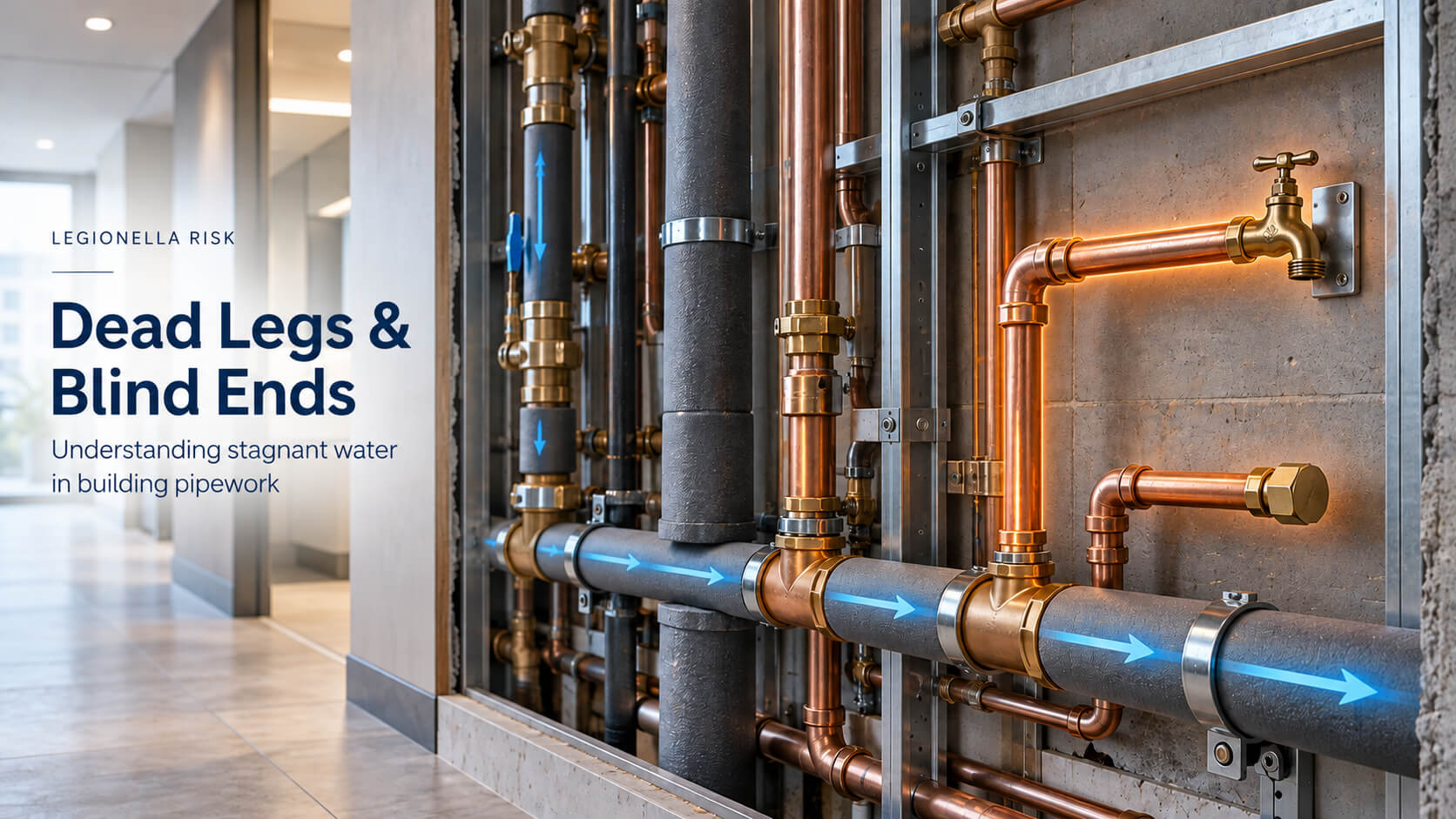
Legionella dead legs are pipe branches serving unused or rarely used outlets, where water may stagnate between draw-offs. Unlike a dead leg, a dead end or blind end is closed and has no normal through-flow.
This UK guide explains where stagnant pipework occurs, how to recognise possible problem branches and when a risk-based flushing regime or competent plumbing review may be appropriate. It is not a substitute for a property-specific Legionella risk assessment.
Dead Legs and Blind Ends: UK Water-System Guidance
- Distinguish dead legs from blind ends
- Spot little-used taps and shower branches
- Recognise capped and redundant pipework
- Understand why stagnant water matters
- Learn when flushing may help
- Know when a professional review is needed

What type of property needs the Legionella Risk Assessment?


Recently booked jobs

Dead Legs and Blind Ends in Water Systems
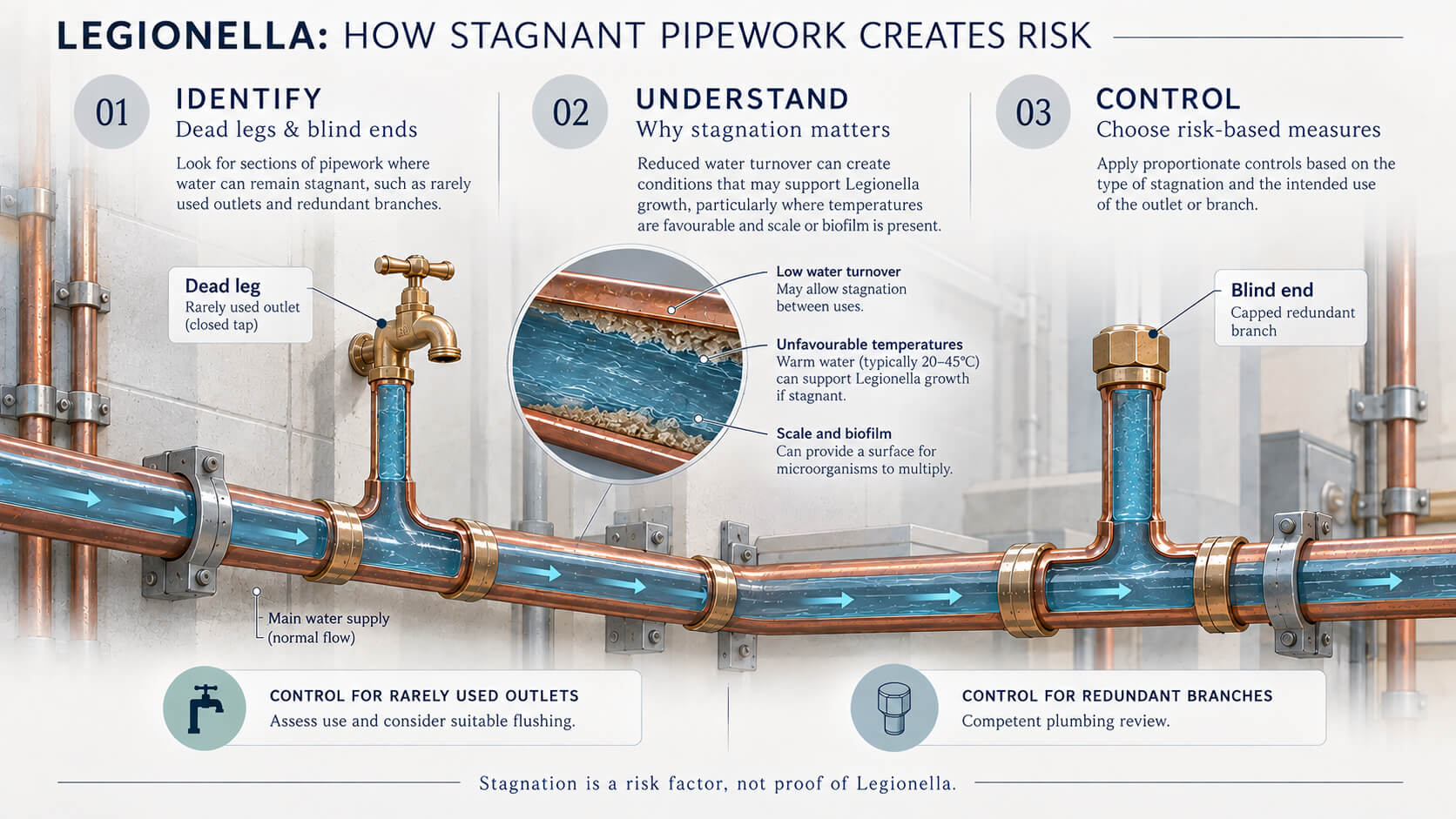
Legionella dead legs are pipe branches supplying outlets that are unused or rarely used, allowing water to remain in those branches for long periods. Each branch remains connected to the water system, and water can flow through it when someone opens the outlet, but normal use may not provide enough turnover. The term describes how the branch is used, not simply whether the pipe looks old.
Dead ends and blind ends are different: they are redundant sections closed at one end, through which water does not normally pass. Both arrangements deserve attention because stagnant water may remain in the branches, but the way to manage each is not necessarily the same. The HSE distinguishes these features when explaining how to understand a hot and cold water installation.
What makes a branch a dead leg
Dead legs in plumbing can still supply functioning taps or showers that are rarely used. Examples may include a basin in a seldom-used room, an outside tap or a shower in accommodation that remains unoccupied for long periods. Water only moves through the branch when that particular outlet is used, so frequent use elsewhere in the building may leave it unchanged.
Identifying the branch requires knowing where its supply starts and how it is normally used. Its length, temperature, connection to other pipework and actual usage all matter. A short, regularly used connection should not be labelled as a significant Legionella hazard merely because it branches away from a main pipe.
How a blind end differs from a rarely used outlet
A dead or blind end is a closed section of redundant pipework with no ordinary outlet through which its water can be drawn off. It may remain after a basin, tank or appliance has been removed while part of its supply pipe has been left connected. Capping the old branch at its far end does not give the water inside that section a normal route to drain.
For that reason, opening a different tap cannot be assumed to clear a blind end. HSE guidance advises removal of dead ends and blind ends, while dead legs serving real outlets may instead require regular flushing or other risk-based controls. The practical distinction is whether the branch has a usable outlet and can achieve meaningful water turnover.
Pipe serving an unused or rarely used outlet; water moves mainly when that outlet is opened.
Closed redundant branch with no normal through-flow; flushing another outlet may not renew its water.
The label is useful because it informs the next step, not because every instance carries the same risk. Where the pipe layout is uncertain, a competent review should establish what is connected, whether water can circulate and which action is appropriate.
Why Stagnant Pipework Creates Legionella Concerns
Poor water turnover can allow conditions favourable to Legionella bacteria to develop in parts of a hot or cold water installation. Water remaining in an isolated or little-used branch may be affected by its surroundings, while scale, sediment and biofilm can make effective control more difficult. Stagnation is a relevant risk factor; it is not proof that Legionella bacteria are present.
The consequences depend on the complete system and the people exposed to it. Water temperatures, branch configuration, how long outlets remain unused and whether fittings produce inhalable droplets all influence the assessment. A rarely used domestic tap and a remote shower in a care setting should not automatically receive identical controls.
Water turnover, temperature and deposits
A dead leg may hold water long enough for its temperature to depart from the conditions maintained in the main distribution pipework. Cold water can gain heat in warm plant spaces, while little-used hot-water branches may cool between draw-offs. Conditions within a branch should therefore be considered alongside the system's wider temperature and maintenance arrangements.
Deposits, poor circulation and biofilm may add to the problem, especially where a branch is difficult to inspect or clean. Conversely, a single unusual temperature reading does not identify the precise cause of a fault. A suitable review should consider the location, pattern of use, surrounding pipework and any previous observations before recommending action.
Where little-used and redundant branches can occur
Dead legs and blind ends often become relevant when the layout or use of a building has changed. A room may stop being occupied, a fitting may be disconnected, or refurbishment may leave behind a capped section of pipe. Original drawings may not show later alterations, so relying on a plan alone can miss a problem branch.
Checks may be warranted at little-used outlets or redundant branches in situations such as these, depending on the installation:
- Removed equipment: Old basin, appliance or tank connections that may still be linked to the supply.
- Vacant rooms: Guest bathrooms or washrooms whose outlets receive little use.
- Previous alterations: Capped spurs or branches left after plumbing changes.
- Intermittent facilities: Seasonal buildings, remote showers or seldom-used service areas.
These are prompts for investigation, not a finding that every pipe in such a location is defective. The dutyholder should establish what the branch serves and whether the water is genuinely renewed during normal use.
Identifying and Recording Problem Pipework
Finding a Legionella dead leg involves understanding the water-system layout and identifying outlets or branches with little or no normal water movement. A competent reviewer may use available drawings, knowledge of previous alterations, observations of connected fittings and information from people who manage or use the building. The purpose is to locate likely stagnation, not to guess from a pipe's appearance alone.
What can be checked safely depends on access and the building's complexity. Concealed pipework, shared services and specialist equipment may need a more detailed investigation. Tenants and building users should report suspected redundant fittings rather than dismantle pipework or protective valves themselves.
Tracing outlets and reviewing past alterations
A useful survey checks how the supply reaches each relevant outlet and whether that outlet is actually used. The reviewer should distinguish dead leg pipework serving a working but rarely used outlet from a pipe that has been capped or disconnected. Changes to kitchens, bathrooms, hot-water plant and communal areas may provide clues about where abandoned connections remain.
Maintenance personnel or managing agents may know of rooms that are closed, appliances that were removed or branches that were retained for future use. If the installation cannot be traced confidently, the limitation should be recorded and referred for competent investigation. Unauthorised opening of pipes can introduce separate water-safety and scalding hazards.
Recording findings and deciding what needs review
Records should identify the suspected branch, its location, how it is used and what further action has been recommended. A finding is more useful when someone can locate the same section later and determine whether a control has actually been carried out. Where relevant, record the associated outlet, access limitations, unusual conditions and responsibility for the next action.
Risk ranking should reflect more than the existence of a branch. The amount and duration of stagnation, system conditions, potential aerosol exposure and susceptibility of the users can all affect priority. A competent person should decide whether the evidence supports regular use, monitoring, further investigation or physical correction.
This is an illustrative record structure, not a statutory template for every building. Where a problem is suspected, the resulting decision should be proportionate and traceable to the water-system risk assessment.
Controlling Dead Legs and Correcting Blind Ends
The appropriate response depends on whether the pipe serves a necessary but rarely used outlet or is a redundant closed branch. Regular use or an agreed flushing arrangement may help control stagnation at a functioning outlet. A blind end with no useful draw-off normally calls for consideration of suitable physical alteration by a competent plumbing professional.
HSE guidance does not make every outlet subject to the same routine or make a short flushing exercise a substitute for correcting redundant pipework. The person responsible for the premises should consider the assessment findings, practical access and any higher-risk users before choosing and documenting control measures.
When regular use or flushing may help
For a necessary dead leg feeding a rarely used outlet, a suitable flushing programme may help renew the water in that branch. The frequency and safe method need to reflect the risk assessment, the actual supply arrangements and precautions against aerosols or scalding. HSE commonly refers to weekly flushing for infrequently used outlets in suitable managed systems, although higher-risk premises may require different arrangements.
Flushing does not remove a capped blind end or guarantee that the water system is free from Legionella. It should be sustained, reviewed and recorded where required by the management programme. Our Legionella flushing guide covers the distinct questions of how often to flush and why no universal number of minutes applies to every outlet.
When removal or plumbing alteration needs consideration
A redundant dead end or blind end should be referred for competent assessment of appropriate removal or reconfiguration. Simply closing the end of a pipe can leave water trapped in the remaining branch, and repeatedly opening a nearby tap may not create flow through it. HSE advises removing dead ends and blind ends, with alterations chosen to suit the actual system.
Any work affecting hot and cold water distribution must be planned and carried out by a suitably competent person. The dutyholder should consider isolation, safe commissioning, the effect on other outlets and any necessary updates to the water-system records. This page does not provide instructions for cutting, capping or disinfecting pipework.
How the risk assessment guides follow-up
A Legionella risk assessment helps establish whether a suspected dead leg presents a relevant hazard and which control recommendations should be prioritised. It places the branch in context with temperatures, water turnover, accessible equipment and potential exposure. This avoids treating every isolated fitting as either automatically safe or automatically in need of identical remedial work.
Where independent review is appropriate, MyConstructor offers an on-site Legionella Risk Assessment with a written report of findings and recommended control measures. The service does not include pipework removal, repairs, flushing visits, cleaning, disinfection, water sampling or ongoing management. The customer or relevant dutyholder arranges any recommended remedial work.
The practical aim is to recognise parts of a water system where water does not move as intended, assess their significance and act on justified recommendations. A documented decision about the actual pipe layout is more useful than relying on the terms “dead leg” or “blind end” alone.
Legionella Dead Legs FAQs


Yes, a capped pipe may still contain stagnant water if its unused branch remains connected to the water system. Closing the outlet end does not necessarily remove the redundant pipework. The responsible person should have the configuration assessed and consider suitable removal or reconfiguration by a competent professional, rather than assume the cap has eliminated the concern.
Running a nearby tap does not necessarily renew water trapped in a blind end. A closed branch has no normal flow-through path, so drawing water from another outlet may leave the stagnant section largely unaffected. HSE advises removing dead ends and blind ends. The correct response depends on the layout and should be determined through competent review.
They can matter, but the level of risk depends on the actual water system and how the property is used. Many straightforward occupied homes are relatively low risk because water turns over regularly. An unused shower, abandoned branch or long vacancy can change that picture. Landlords should assess relevant risks proportionately and arrange further advice where needed.
The person responsible for managing the premises and its water system must ensure relevant risks are assessed and controlled. In a managed building this may involve the appointed responsible person; in rented accommodation the landlord has legal duties. A competent plumber may be needed for physical alterations. MyConstructor provides assessment findings and recommendations, not remedial plumbing or flushing work.