


Legionella Flushing: How Long and How Often to Run Taps
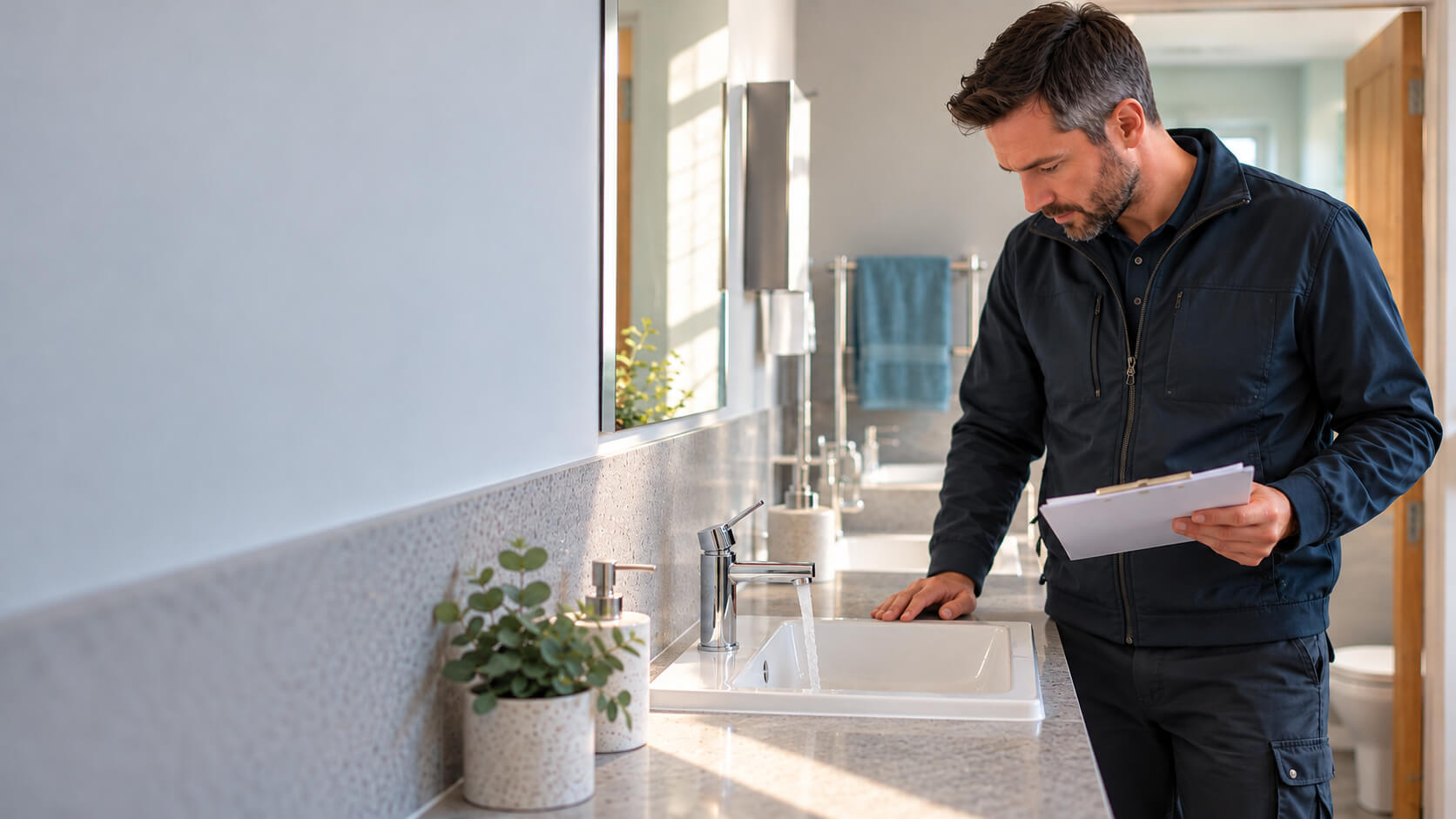
Legionella flushing helps reduce stagnation in little-used taps and showers. In suitable managed systems, weekly flushing may be appropriate, depending on the water-system risk assessment.
This guide explains how often to flush, how long to run taps and how to limit aerosols. Flushing is one control measure, not a substitute for a Legionella risk assessment.
Legionella Flushing and Water Safety Guidance
- Understand why little-used outlets need attention
- Learn when weekly flushing may be appropriate
- Understand why flushing duration varies
- Consider aerosol and scalding precautions
- Know when to record or escalate concerns
- Recognise when professional assessment may help

What type of property needs the Legionella Risk Assessment?


Recently booked jobs

Why Little-Used Outlets Need Flushing
Legionella flushing helps replace water that has remained in little-used taps, showers and their supply pipework. When water stands for long periods, it can lose the benefits of regular turnover and provide conditions in which microorganisms may multiply. Flushing is one practical control in an appropriate hot and cold water management programme, but it does not confirm that the system is free from Legionella.
The significance of an unused outlet depends on its water supply, the length of the pipe branch, its temperature and who could be exposed to water droplets. A rarely opened washroom tap in an office may need different arrangements from a regularly used bathroom in a small home. These differences should guide what is checked and how frequently.
What water stagnation changes
Stagnant water can create favourable conditions for Legionella, especially where temperatures, scale or biofilm also support growth. Water that is not moving may warm in poorly insulated cold pipework or cool in an unused hot-water branch. Deposits and the condition of fittings can add to the concern, particularly where an outlet produces fine droplets that people might inhale.
Running a little-used outlet can help renew the water in its branch, but it does not remove established deposits, repair faulty circulation or deal with every hidden section of pipework. The aim is to control stagnation within a wider system plan rather than assume a short run of water solves all the risks.
Which taps and showers count as little-used
HSE technical guidance includes outlets not used for seven days or longer in the category that should be considered for a flushing regime. These may be taps in guest bathrooms, unoccupied rooms, cleaners' cupboards or seasonal facilities, as well as showers that remain unused between occupants. The important question is actual use, not whether the fixture appears modern or clean.
A building survey should also distinguish an infrequently used working outlet from dead legs and redundant pipework. A little-used tap may be managed through regular use or flushing; a capped dead end may require a plumbing review because running another tap will not necessarily turn over water trapped inside it.
- Low-use rooms: Check spare bathrooms, unused workspaces and seasonal areas.
- Intermittent occupancy: Consider accommodation, offices or facilities left empty for several days.
- Hidden branches: Flag redundant fittings and pipe sections for competent review.
Identifying the correct outlets matters more than applying the same routine to every fixture in the building. A useful schedule names the actual outlets that need attention and is reviewed as room use or pipework changes.
How Often Should Taps Be Flushed for Legionella?
Weekly flushing is the usual HSE reference for infrequently used outlets in managed hot and cold water systems, unless the risk assessment specifies another interval. This helps maintain water movement in branches that do not receive regular use. It is a starting point for a suitable control regime, not a universal statutory instruction to flush every household tap every week.
Frequency must reflect the building, its occupants and the actual water-system arrangements. Where outlets are used normally and water turnover is adequate, a separate flushing task may not be needed. More complex premises and people at greater risk may require closer management by the responsible person.
Weekly flushing and the role of the risk assessment
A weekly flushing schedule is commonly appropriate where an outlet is not otherwise used at least once during that period. HSG274 Part 2 advises that a flushing regime should be sustained and logged once introduced. The responsible person should specify which outlets are included, who completes the checks and what happens if a planned visit is missed.
Healthcare settings, care homes and other higher-risk environments may need a different frequency or specialist procedure. Conversely, a straightforward occupied home with regularly used taps should not automatically be treated like a large managed building. The assessment of actual use and exposure provides the distinction.
Normal use may provide sufficient turnover; check the system-specific risks.
Consider weekly flushing, or the interval stated in the risk assessment.
Follow the approved, potentially more frequent water-safety programme.
These are different management situations, not three universal rules. Any flushing programme should identify its responsible person and be reviewed when occupancy, equipment or the water supply changes.
Empty properties and extended shutdowns
Properties left unoccupied need particular attention because unused water systems can develop prolonged stagnation. HSE advises landlords to consider suitable flushing arrangements or other measures during non-occupancy, especially where accommodation is vacant for an extended period. The appropriate response depends on how long the building is empty and the system involved.
Before a property returns to use, the responsible landlord or manager should consider whether the existing precautions remain suitable. A lengthy shutdown, an altered water installation or concerns about water quality may justify a competent review rather than simply opening every shower or tap without a plan. Scalding and aerosol precautions remain relevant during recommissioning.
How Long Should You Run a Tap?
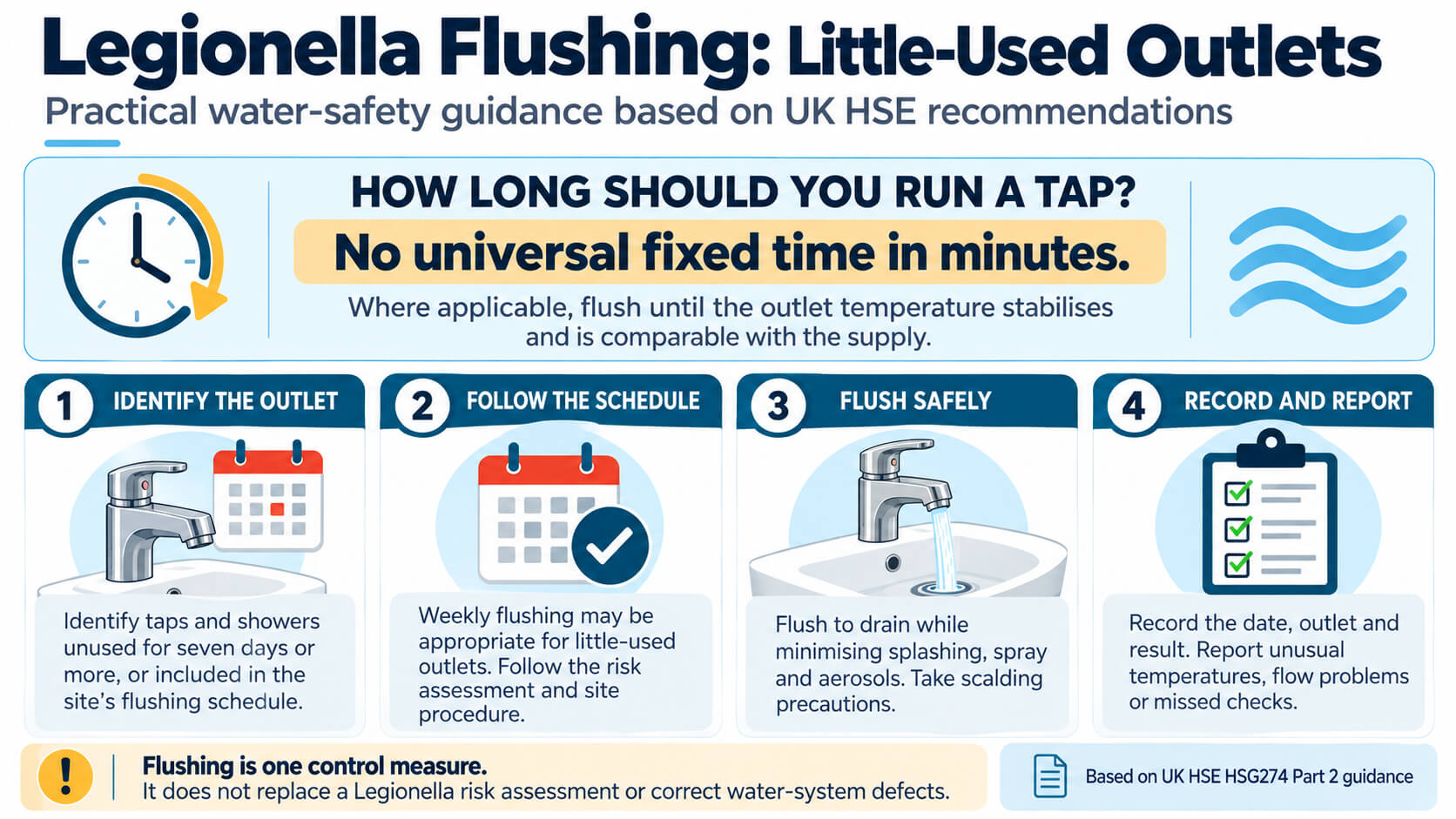
There is no single flushing time in minutes that is correct for every tap or shower. HSG274 Part 2 describes flushing until the outlet temperature stabilises and becomes comparable with the supply water, with the displaced water discharged to drain. The time needed can vary with branch length, flow, water temperature and the amount of stagnant water in the pipework.
A short branch close to a frequently used supply may behave differently from a distant outlet at the end of a long pipe run. A site-specific procedure should therefore explain the intended result and how to check it, rather than rely on a guessed duration. Always follow any established water-safety plan for the premises.
Why there is no universal number of minutes
Flushing duration depends on how long it takes to replace the water in the relevant outlet branch. HSE guidance uses stabilisation against supply-water temperature as a practical reference in managed systems. A timer alone may not reveal an unusually long branch, trapped water or a change to the normal supply conditions.
Do not confuse flushing duration with the HSE temperature-monitoring benchmarks used at selected outlets. The one-minute hot-water and two-minute cold-water checks serve different monitoring purposes; they are not blanket instructions for how long every outlet must be flushed. Thermostatic mixing valves can also affect what a temperature reading means. For a fuller explanation of these monitoring benchmarks, see our Legionella water temperature guide.
Flushing safely without creating aerosols
Flushing should move water to the drain while avoiding the release of fine water droplets that could be inhaled. HSE specifically highlights the need to purge to drain without generating aerosols. This matters for showers, spray taps and any outlet where splashing or mist could occur. Hot water also creates a potential scalding hazard during a control activity.
In managed premises, a competent person should define the safe method, appropriate access controls and any precautions for vulnerable users. Occupiers should not dismantle safety devices, bypass thermostatic mixing valves or improvise procedures for unfamiliar plant or high-risk installations.
- Check the approved procedure: Confirm the outlet, responsibility and any access restrictions.
- Control exposure: Use the specified method to discharge water to drain without avoidable spray.
- Observe the result: Note whether the expected supply conditions are reached, without using a universal time limit.
- Record exceptions: Report abnormal conditions and any incomplete check to the responsible person.
These are management principles, not a replacement for site-specific safe working instructions. If there is uncertainty about the water system, the correct action is to seek competent advice before attempting potentially hazardous work.
What to do if normal conditions do not return
An outlet that does not return to its expected supply conditions may indicate a problem that flushing alone cannot resolve. Examples include consistently warm cold water, poor hot-water delivery, a persistent lack of flow or concerns about deposits and disused pipework. The responsible person should consider the reading in the context of the system and its existing controls.
Record the location and what was observed, then arrange the appropriate investigation. Repeating an ineffective flushing routine without addressing the cause can leave a long-term issue unresolved. Where scale or deposits affect a shower fitting, showerhead cleaning and descaling are separate maintenance tasks; flushing the outlet does not remove them. Tenants should raise concerns with their landlord or managing agent rather than adjust heating controls or protective valves themselves.
Flushing Records and Wider Water-System Controls
A flushing record helps demonstrate that an agreed water-safety routine is being carried out and that problems are followed up. In managed systems, the written programme should identify the relevant outlets, frequency, responsibility and escalation route. Documentation supports consistency when staff change, an outlet is inaccessible or the building's use is altered.
Records should be proportionate to the building and should not become a substitute for practical action. A completed form does not show that the water system is adequately controlled if the outlet remains unused for long periods, a temperature problem persists or necessary maintenance is missed.
What a useful flushing record should capture
A flushing record sheet or log identifies the outlet, date, responsible person and whether the agreed procedure was completed. It should also capture unusual observations, missed checks and any action requested, so that repeated problems are visible. The detail required depends on the risk assessment and whether the property is a small rental or a larger managed site.
Where the site's procedure calls for temperature observations, record them with enough context to make the result meaningful. A simple statement that every tap was checked may be insufficient if the agreed programme names particular low-use outlets.
This is an example of the information a record might contain, not a mandatory universal template. The dutyholder should agree the format and retention arrangements appropriate to the actual system.
How flushing differs from temperature monitoring
Flushing and temperature monitoring are related controls, but they answer different questions. Flushing helps renew water in outlets that are rarely used; temperature checks help assess whether the storage and distribution system is meeting its chosen hot and cold water targets. One activity does not automatically replace the other.
Monitoring records should make clear which activity was carried out and what result was expected. Measurements and flushing schedules should both reflect the building's risk assessment, especially where mixing valves, storage tanks or shared pipework are involved.
When flushing is not enough
Regular flushing cannot compensate for every water-system defect or replace a suitable Legionella risk assessment. Problems such as redundant pipework, unmanaged storage, deposits, unsuitable temperatures or poorly maintained outlets may need further investigation and corrective action. A responsible person should review recurring concerns rather than assume that increasing the flushing frequency will solve them.
Where a professional review is appropriate, MyConstructor provides an on-site Legionella Risk Assessment with a written report of findings and recommended controls. The service does not include flushing visits, water sampling, laboratory testing, repairs, cleaning, disinfection or ongoing water-system management; the customer or relevant dutyholder arranges any remedial work.
The practical goal is to keep water moving where needed, recognise when controls are not working and act on the wider risks. Flushing is most valuable when it forms part of a proportionate, maintained programme rather than being treated as a guarantee of water safety.
Official sources:
Legionella Flushing FAQs


There is no universal number of minutes for flushing a tap to manage Legionella risk. In appropriate managed systems, the outlet is flushed until the water temperature stabilises and is comparable with the supply. The time depends on pipe length, flow and system conditions. Follow the site's approved procedure, avoid aerosols and do not treat flushing as proof of safety.
Little-used outlets are commonly flushed weekly when they have not otherwise been used for seven days or more. HSE technical guidance describes this as part of managing stagnation in suitable water systems. The actual interval should follow the risk assessment and water-safety arrangements. It is not a blanket legal requirement to flush every tap in every occupied home weekly.
An unused shower may require flushing as part of the property's water-safety arrangements. Showerheads can create fine droplets, so reducing aerosol exposure is essential. In managed buildings, the responsible person should specify a suitable procedure and any restrictions before use. Do not simply run an unfamiliar shower at full spray or bypass temperature and scalding controls.
Flushing does not kill all Legionella bacteria or guarantee that water is safe. It helps replace stagnant water at little-used outlets, but it cannot correct defective circulation, dead-end pipework, scale or established biofilm. Persistent concerns need investigation and appropriate controls. Where a wider review is necessary, a competent risk assessment can identify what requires attention.