


UK House Spiders: Identification and Common Types
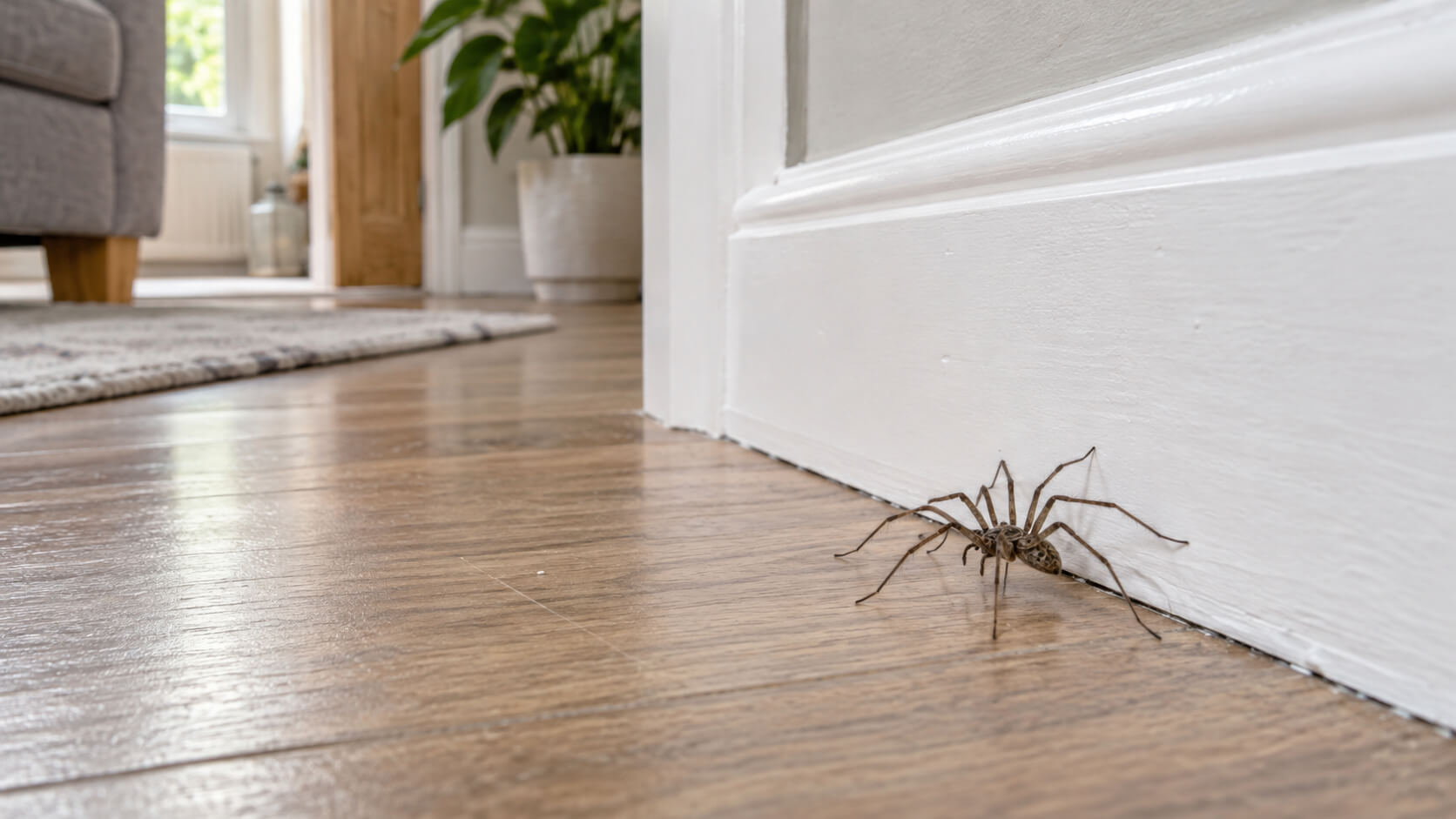
UK house spiders include several species commonly seen around homes, from giant house spiders to smaller zebra and lace web spiders.
This guide explains how to identify common types, what their size, colour, webs and egg sacs can reveal, how long house spiders live and when spider season in the UK occurs.
Spider Identification & Pest Control Support
- Describe the Spider or Signs You Have Seen
- Book an inspection if you are unsure what pest is present
- Choose from available appointment times in your area, with free cancelation
- The £50 inspection fee is deducted if you proceed with the quoted treatment
- Pay us by Card, PayPal, Google Pay, Apple Pay or Pay on-site



Who will come to my home?
A certified pest control technician from our vetted network, on the day and time you choose. You get a confirmation by email as soon as you book.
Is the treatment safe for children and pets?
Yes. Technicians use HSE-approved products and methods: tamper-resistant bait stations for rodents, and sprays or gels that are safe for children and pets once dry. You are told before the visit if a room needs to stay clear for a few hours.
What if the pests come back?
Follow-up visits are included where the treatment lists them, so if activity continues after the first visit, the next one is already covered at no extra charge. The price you see is the full price for the whole treatment cycle.
Do I need to prepare anything or be at home?
Someone needs to be at the property to let the technician in. Preparation is minimal and depends on the pest; the technician confirms anything needed by SMS and email after you book.
Do I pay now?
No. You see the price, then pick a date and time. Payment is only confirmed at checkout, and cancellation is free.
Is the £50 inspection fee deducted from the treatment?
Yes. If you are not sure what the pest is, you can book a £50 inspection visit. The technician identifies the pest and quotes the treatment on site, and if you go ahead the £50 is deducted from that treatment price.
Recently booked jobs



Common House Spiders in the UK
Common house spiders in the UK range from large web-building species to small active hunters. The sections below compare the main types covered by this guide and the household contexts in which they may be noticed.
| Spider | Useful identification clue | Where it may be noticed |
|---|---|---|
| Giant house spider | Large brown house spider with long legs and fast movement | Rooms, floors, sheds, garages and other sheltered areas |
| Zebra spider | Small black-and-white jumping spider | Walls, windows and sunny surfaces |
| Lace web spider | Brown to dark spider associated with a woolly-looking lace web | Wall gaps, window frames, fences and buildings |
| Spitting spider | Small, slow-moving spider associated with houses and heated buildings | Indoor walls, sheltered corners and other heated spaces |
| Missing sector orb weaver | Orb web with a noticeable section of the spiral missing | Windows, frames and the outside of buildings |
The table is a quick comparison rather than a diagnostic key. Use the surrounding web, behaviour and location to support what you can see on the spider itself.
Giant House Spider
Giant house spiders are among the large brown spiders most likely to attract attention indoors. They belong to the house-spider group associated with Eratigena, and adult males become especially noticeable when they leave established webs and move around in search of females.
Their brown colouring, long legs and speed can make them appear more dramatic than smaller household spiders. Their webs are generally sheet-like and lead into a sheltered tubular retreat, often in quieter places such as garages, sheds, lofts, wall spaces and other protected parts of buildings.
Fast movement is particularly noticeable when a male is wandering away from its web, but speed is not a reliable identification feature by itself. A large brown spider that runs across an open floor should still be assessed by its body pattern, proportions and the type of web or retreat found nearby.
Giant House Spider Size and Appearance
Size is a useful clue, but it is not enough on its own. Giant house spiders have a brown body with visible patterning, while their long legs make the overall spider appear much larger than the body itself.
Large brown spiders found indoors can belong to more than one closely related house-spider species, so identification should use several features together. Body pattern, leg proportions, web type and location are more useful as a group than a single measurement or colour description.
Male and Female Giant House Spiders
Adult males are often the giant house spiders people notice wandering across floors. During the mating period, males leave their webs and search for females, while females are more likely to remain associated with an established web and retreat.
This difference in behaviour helps explain why a large spider can suddenly appear in an open room even when no obvious web has been noticed there. A wandering male may have moved from a quieter part of the building rather than living in the centre of the room.
Zebra Spider
Zebra spiders are small black-and-white jumping spiders often seen on walls, windows and other surfaces around buildings. The common species Salticus scenicus has contrasting markings and the short, jerky movement associated with jumping spiders.
Unlike web-building house spiders, zebra spiders actively hunt small prey rather than depending on a capture web. They are frequently seen outside on sunny walls but can also enter through open windows and doors, so an indoor sighting does not necessarily mean the spider spends its whole life inside.
The combination of small size, contrasting markings and short jumping movements makes a zebra spider very different from a giant house spider. It may pause, turn towards movement and make short jumps while hunting, so behaviour can be just as useful as colour when narrowing the identification.
Black-and-white patterning alone is still not enough to confirm a zebra spider. Check whether the spider has the compact appearance and active jumping behaviour expected of a jumping spider rather than using one photograph, stripe or colour patch as the only clue.
Lace Web Spider
Lace web spiders are medium-sized brown or dark spiders recognised partly by the texture and position of their webs. UK species in the genus Amaurobius make woolly-looking silk around a tubular retreat, often in cracks or gaps in walls, fences, window frames and other sheltered structures.
The web can be a stronger identification clue than colour alone because individual spiders may vary in shade and markings. Dark lace web spiders can also be confused at a glance with other rounded, dark spiders; the dedicated guide to false widow spiders covers that separate identification family in more depth.
Lace web spiders usually remain associated with a sheltered crevice and the web around it, but males can become more noticeable when they wander. When a dark spider is found near dense woolly-looking silk around a crack or frame, that web context is more informative than simply describing the spider as black or brown.
This is also why a photograph of the spider without its surroundings can be misleading. If possible, note the web, the retreat and the exact place where the spider was found before comparing appearance with a species guide.
Spitting Spider
The spitting spider, Scytodes thoracica, is a small species strongly associated with houses and other heated buildings in Britain. It moves slowly and catches small prey using a distinctive spitting method rather than relying on a conventional capture web.
Its household context and hunting behaviour make it different from the much larger long-legged house spiders. Because it is a smaller supporting species in this cluster, it is covered here rather than given a separate URL.
A spitting spider is also less likely to be confused with a giant house spider once scale and movement are considered together. Its small size, slow movement and lack of a large sheet-web retreat make the overall identification context quite different.
Missing Sector Orb Weaver
The missing sector orb weaver is best recognised by its distinctive orb web. The web resembles the familiar circular pattern of an orb web, but part of the spiral is absent, creating the “missing sector” that gives Zygiella x-notata its common name.
These spiders are particularly associated with windows, frames and the outside of buildings, although they may also be noticed indoors. Web structure and location are therefore more useful clues than colour alone.
Another much smaller house-associated species is the Pink Prowler, Oonops domesticus. It has a much narrower search and identification footprint, so it is included as supporting context rather than treated as a separate major house-spider type.
If a very large brown spider does not fit the typical giant-house-spider pattern, the separate guide to the Cardinal Spider covers that named species and its comparison with other large house spiders.
House Spider Identification
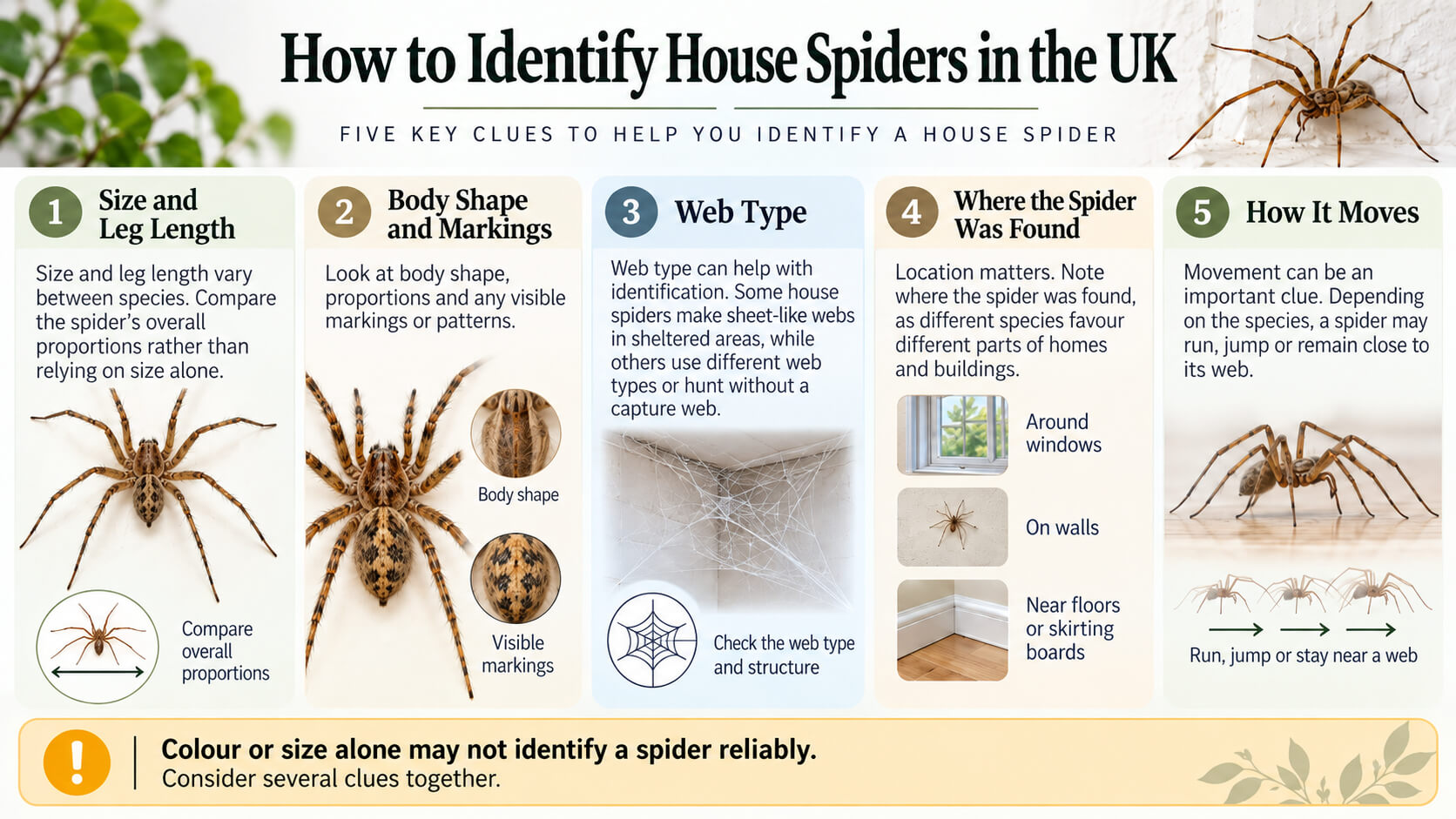
Reliable house spider identification usually requires several clues together. Brown, black, reddish or pale spiders can belong to different groups, and lighting can make colour and markings look different in photographs or indoor conditions.
A better approach is to combine visible features with behaviour, web structure and location. Use the following checklist as a practical starting point:
- Overall size and leg length — compare proportions rather than relying on size alone
- Body shape and markings — note the abdomen shape and any visible patterning
- Web structure — look for a sheet, lace-like web, orb web or no capture web
- Where the spider was found — floors, windows, walls, sheltered gaps or outbuildings can all add context
- How it moves — some spiders run, some jump and others remain close to a web
No single clue in the checklist should be treated as proof of a species. The strongest identification comes from combining several features that point in the same direction, then using a species-specific guide where a named spider has its own distinct search intent.
Black, Brown, Red and Small House Spiders
Colour can narrow the possibilities, but it rarely identifies a house spider by itself. Searches for a black house spider, brown house spider or small house spider can describe several different species, and very dark individuals may appear almost black depending on lighting, age and viewing angle.
Red or reddish spiders seen in the house can also belong to different groups. Use body shape, markings, web type and location to narrow the possibilities rather than treating colour as a species name.
Small spiders seen around windows or walls can include zebra spiders and other species that use buildings without being permanent indoor residents. Their size, movement and surrounding context can help distinguish them from larger web-building house spiders.
Very long, fine legs point toward a different identification task from the sturdier legs of giant house spiders. For that type of indoor spider, see the separate guide to cellar spiders and daddy long legs spiders.
House Spider Size, Webs and Egg Sacs
Spider size becomes more useful when it is considered alongside body shape and web type. House spiders in the Tegenaria and Eratigena groups can look large because of their leg span, while zebra, spitting and other household species are much smaller.
Web structure can be especially informative. House spiders make sheet-like webs leading to a retreat, lace web spiders make woollier silk around sheltered crevices, and missing sector orb weavers produce a recognisable orb web with part of the spiral missing.
Egg sacs also vary between spider groups and are usually associated with the female's normal retreat or web. An egg sac on its own is rarely enough for confident identification, so consider the surrounding silk, the adult spider and the location together.
People sometimes use the phrase “spider nest” for a webbed retreat, egg-sac area or a place where a spider repeatedly shelters. For house-spider identification, it is more useful to describe what is actually present — for example a sheet web, a tubular retreat or an egg sac — than to assume that every concentration of silk is the same kind of nest.
How Long Do House Spiders Live?
There is no single lifespan that applies to every house spider found in the UK. Different species develop at different rates, and males and females can also have different adult lifespans.
For typical house spiders, young spiders can reach maturity within roughly a year. Adult males often die after the autumn mating period, while females can survive into another year, so one fixed lifespan should not be applied to every spider found indoors.
Questions about a mark on the skin or what to do after a suspected bite are a separate task from identifying the spider itself. The guide to spider bites in the UK covers that post-bite information without trying to diagnose a cause from a skin mark alone.
When Is Spider Season in the UK?
Spider season in the UK is most noticeable from late summer into autumn, although spiders are present throughout the year. The rise in household sightings does not necessarily mean spiders have suddenly appeared in much greater numbers; adult males become more visible when they leave their webs and search for females.
House-spider activity is often especially noticeable from August into October. During this period, wandering males cross more open areas of the home, which makes them easier to see than spiders that remain close to sheltered webs or retreats.
Mild, dry autumn conditions can extend the period when spiders are noticeable. Open windows and doors can also allow outdoor or building-associated species to move inside, so not every spider seen during “spider season” is a permanent indoor resident.
Some spiders can remain around buildings throughout the year, while others are mainly noticed indoors when they wander from windows, external walls, sheds, garages or other sheltered areas. That is why season, location and behaviour should be used together rather than treating every autumn sighting as the same species or situation.
Seeing more spiders for a few weeks therefore does not by itself show that a home has developed a new spider problem. Seasonal visibility, wandering males and easier access through open parts of the building can all affect how often spiders are noticed.
If repeated spider sightings are causing concern and you are not sure what pest is present, you can check pest inspection and control options through MyConstructor. This route can also be used when you need an inspection but have not identified the spider or other pest with confidence.
Frequently Asked Questions


House spiders do not build communal nests like social insects. Typical house spiders make a sheet-like web that leads into a tubular retreat, where the spider can shelter. Females may also produce egg sacs associated with the web or retreat.
House spiders mainly eat insects and other small prey they can catch. Their webs help them detect prey moving across the silk, while other spiders found around homes, such as zebra spiders, hunt actively rather than relying on a capture web.
Typical Tegenaria and Eratigena house spiders have eight eyes. Eye arrangement can be useful to specialists, but the eyes are small and are not usually the easiest feature for identifying a spider found in a home.
House spider droppings can appear as small dark or brownish spots on surfaces below resting or web areas. They may sometimes include a lighter residue, but droppings alone are not a reliable way to identify which spider species is present.