


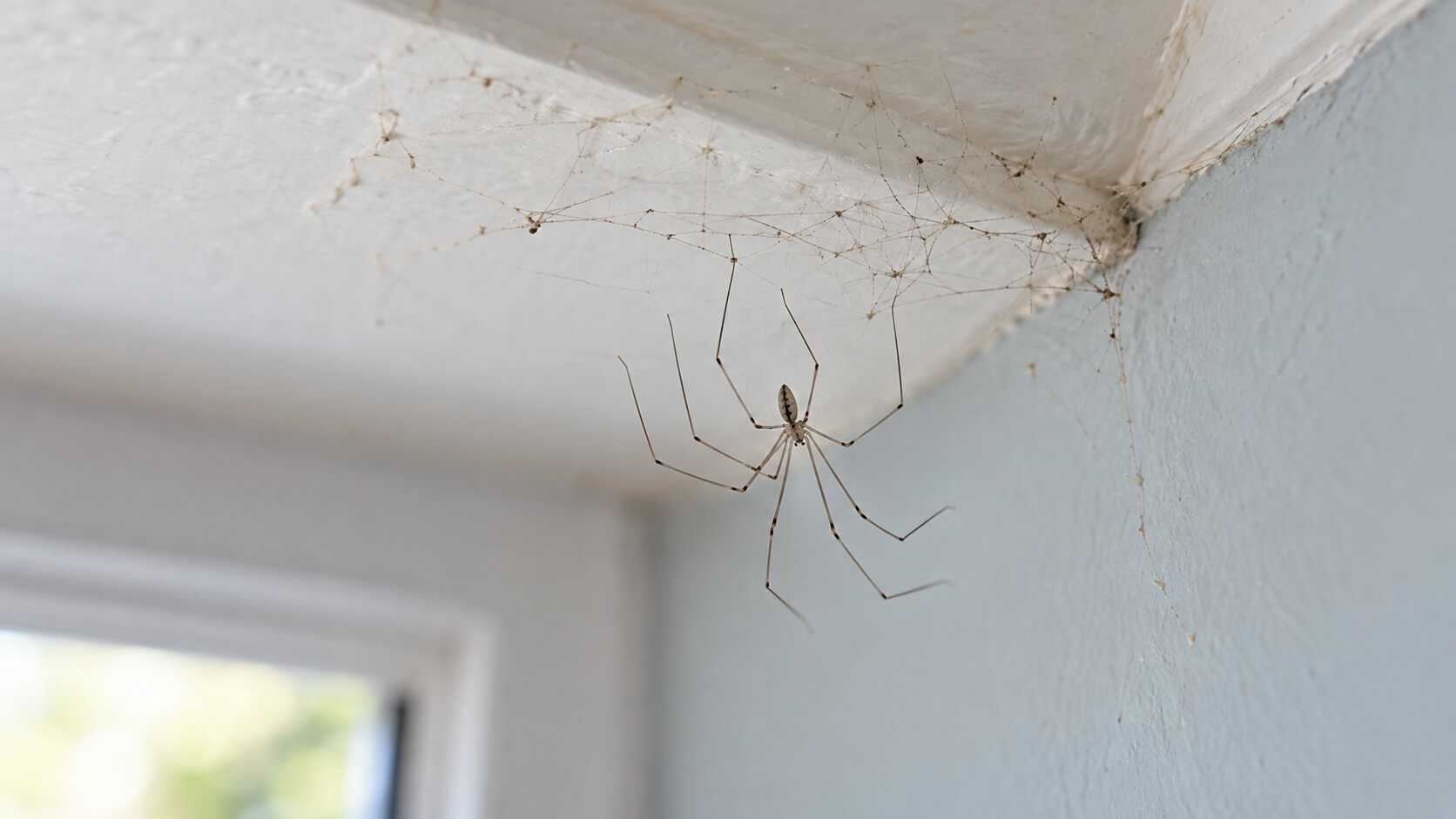
The cellar spider, Pholcus phalangioides, is a long-legged spider commonly found inside buildings, where it often rests in loose, tangled webs in corners and sheltered spaces.
This guide explains how to identify a cellar spider in the UK, why it is also called a daddy long legs spider, what its web looks like and where it is commonly found around homes.
Recently booked jobs


How to Identify a Cellar Spider
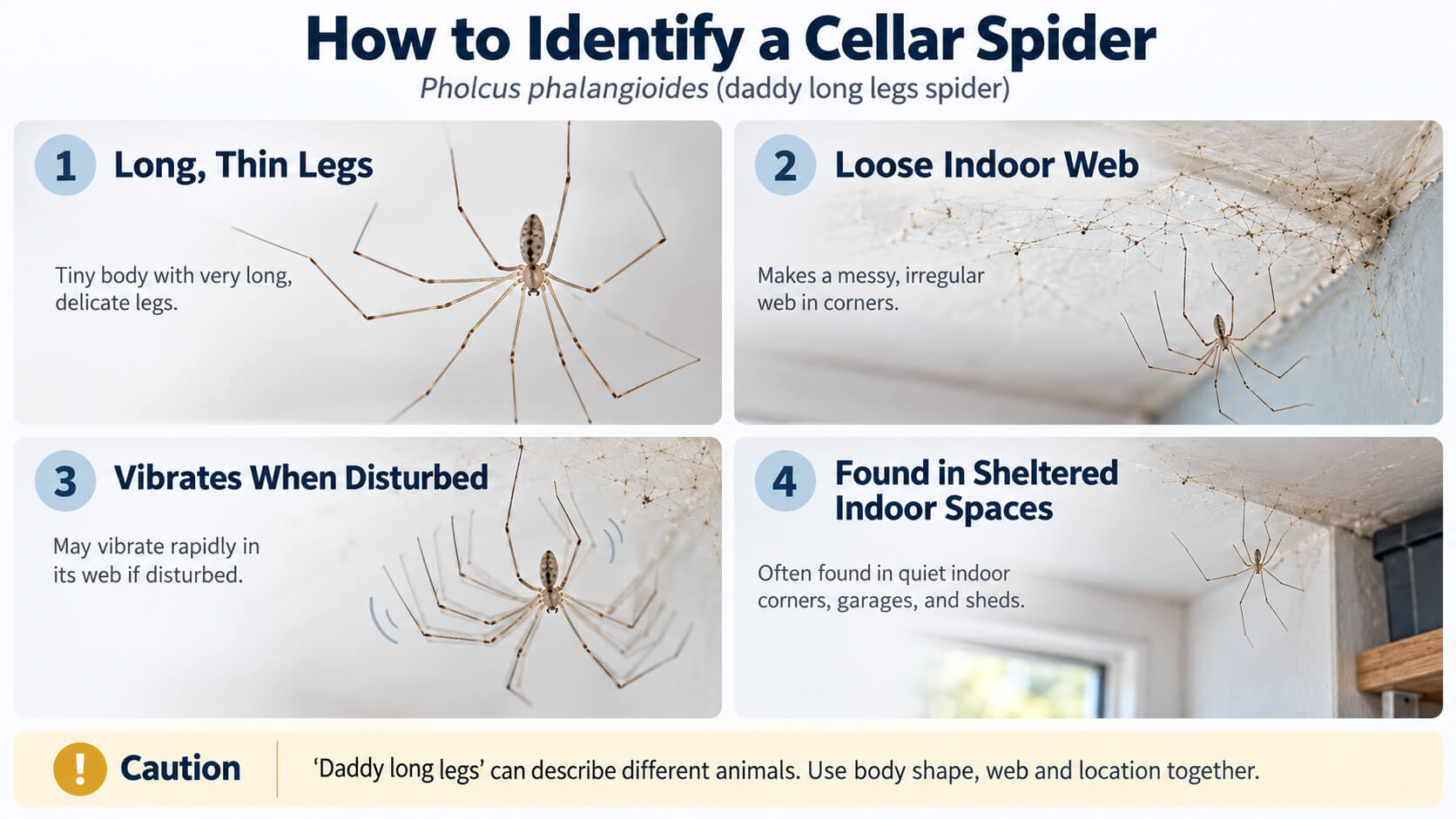
The cellar spider, Pholcus phalangioides, is easy to recognise once several features are considered together. It has a very small, pale to greyish body compared with its extremely long, thin legs, and it is usually encountered indoors rather than in exposed outdoor places.
A cellar spider is often seen hanging upside down beneath loose strands of silk. Its proportions are more useful for identification than colour alone, because the long legs and relatively tiny body create a very different outline from the sturdier build of many other spiders found around homes.
Cellar Spider Size and Appearance
Cellar spiders have a small body, typically around 7–10 mm long, while the legs make the spider look much larger overall. The body is usually yellowish-grey, with a long abdomen that may show darker markings, and the legs are narrow and delicate with visible darker bands around some joints.
Size should still be used with other clues. A photograph taken close to the spider can exaggerate leg span, so compare body proportions, leg thickness, web type and where the spider was found rather than relying on apparent size alone.
Is a Daddy Long Legs Spider the Same as a Cellar Spider?
In the UK, the cellar spider is also commonly called the daddy long legs spider. That name is useful when it clearly refers to a spider, but the shorter phrase “daddy long legs” can also describe craneflies and harvestmen, so the common name is not always precise.
The scientific name Pholcus phalangioides removes that ambiguity. A true cellar spider has a spider body plan, extremely long slender legs and an indoor web, while a cranefly is a winged insect and a harvestman is a different kind of arachnid.
Cellar Spider Webs and Vibrating Behaviour
Cellar spiders make loose, untidy webs, often high in room corners where a wall meets the ceiling or in other quiet parts of a building. They commonly hang upside down beneath the web and remain still for long periods.
When disturbed, some cellar spiders vibrate or bounce rapidly in the silk, making the spider difficult to see clearly for a moment. This behaviour, together with the messy web and very long legs, can be a useful identification clue.
Cellar Spiders in UK Homes
Cellar spiders are found throughout the UK and are strongly associated with buildings, where warm and relatively stable conditions suit them. They can remain indoors throughout the year and may be found in rooms, garages, sheds and other sheltered spaces.
If a long-legged spider does not fit this pattern, our wider UK house spider guide covers other common household species and the different web, body-shape and behaviour clues that can help separate them.
Where Cellar Spiders Live
Inside buildings, cellar spiders often choose undisturbed corners, ceilings and sheltered areas where their loose web can remain in place. They are especially familiar in houses and outbuildings, and records now extend across the UK even though the species was introduced historically.
Their indoor association is an important part of identification. A long-legged animal found outside in vegetation or flying around a light may belong to a different group, so location should be considered alongside appearance.
What Do Cellar Spiders Eat?
Cellar spiders feed on insects and other small animals that become available around their webs. They can also catch other spiders, including house spiders that appear much larger than the cellar spider itself.
Rather than relying on a strong-looking body, the spider uses its long legs and silk to keep some distance from struggling prey and wrap it. The presence of insect remains or other spiders around an established web can therefore fit normal cellar-spider behaviour.
Cellar Spider Eggs and Spiderlings
Female cellar spiders carry their eggs in a loose bundle held at the front of the body rather than hiding them inside a dense, enclosed egg sac. A female carrying eggs can therefore look as though she is holding a small cluster beneath her mouthparts.
After hatching, young spiders stay around the mother’s web for a period before spreading out as they grow. This behaviour means several small cellar spiders may sometimes be seen around an established indoor web without indicating a separate spider species.
Sources: British Arachnological Society - Daddy-long-legs Spider | Natural History Museum - Daddy Long Legs Spider | The Wildlife Trusts - Cellar Spider
Frequently Asked Questions


Cellar spiders are not considered a significant biting risk to people, and human bites are very uncommon. They use their jaws and venom to subdue small prey, but their presence in a home should not be treated in the same way as a known biting-pest problem.
Cellar spiders can live for up to around three years under suitable conditions. Warm, stable indoor environments can allow them to remain active for long periods, and they may be seen inside UK buildings throughout the year.
Cellar spiders in the UK are mainly indoor spiders, although they may sometimes persist outdoors in mild sheltered locations. They favour the stable temperatures of houses, garages and sheds, and cold winter conditions limit their ability to survive outdoors.
Several cellar spiders can live in the same property when warm shelter, suitable web sites and enough prey are available. Larger numbers do not mean they are damaging the structure of the building, but repeated sightings can indicate that indoor conditions are supporting an established population.