


False Widow Spiders in the UK: Identification, Types and Bites
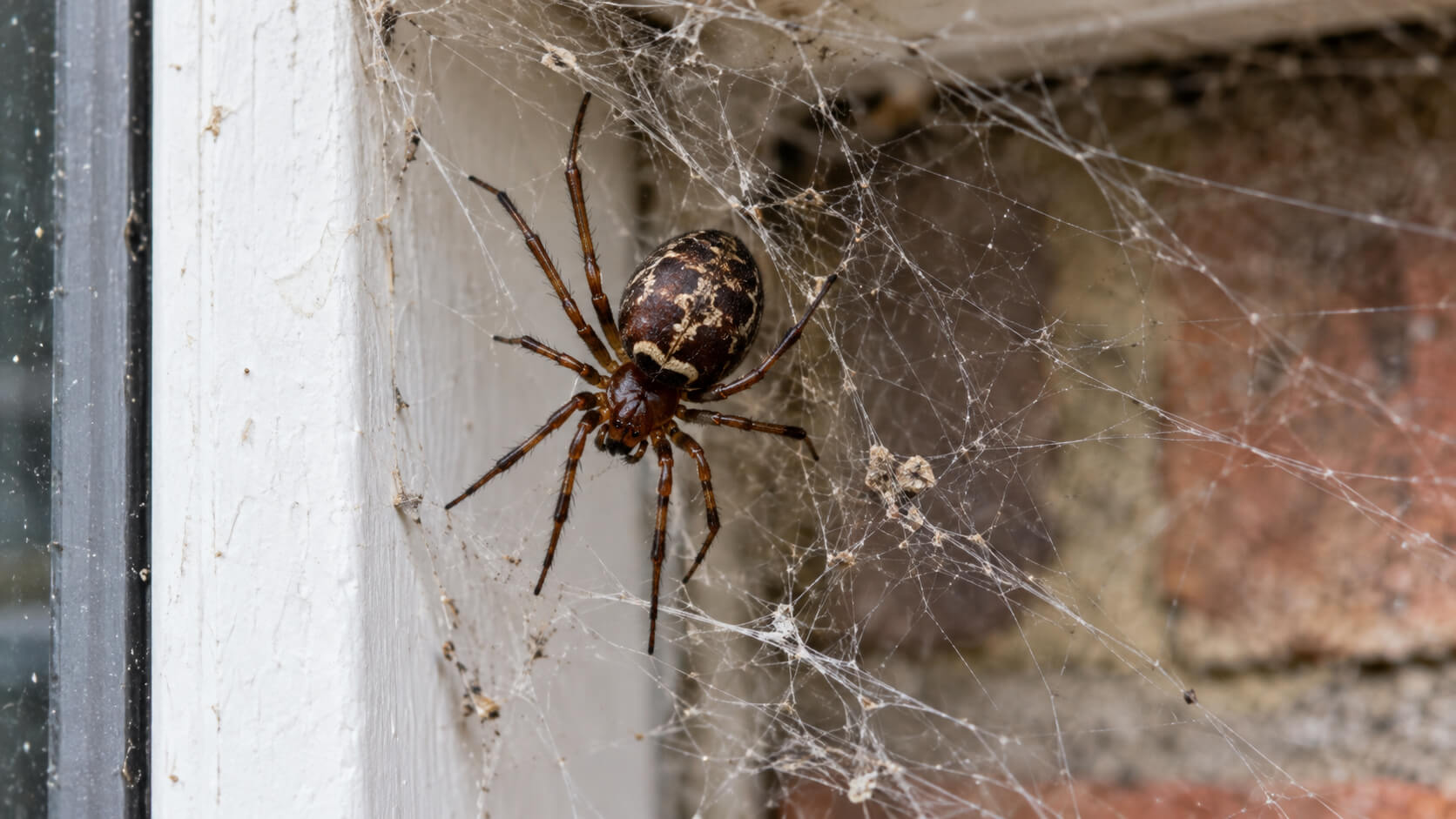
False widow spiders in the UK are members of the Steatoda group, with the noble false widow, Steatoda nobilis, being the species most often associated with public interest and identification searches.
This guide explains how to identify false widow spiders, recognise common UK types and lookalikes, understand their webs and habitat, and distinguish species-specific bite information from general spider-bite guidance.
False Widow Spider: What to Look For
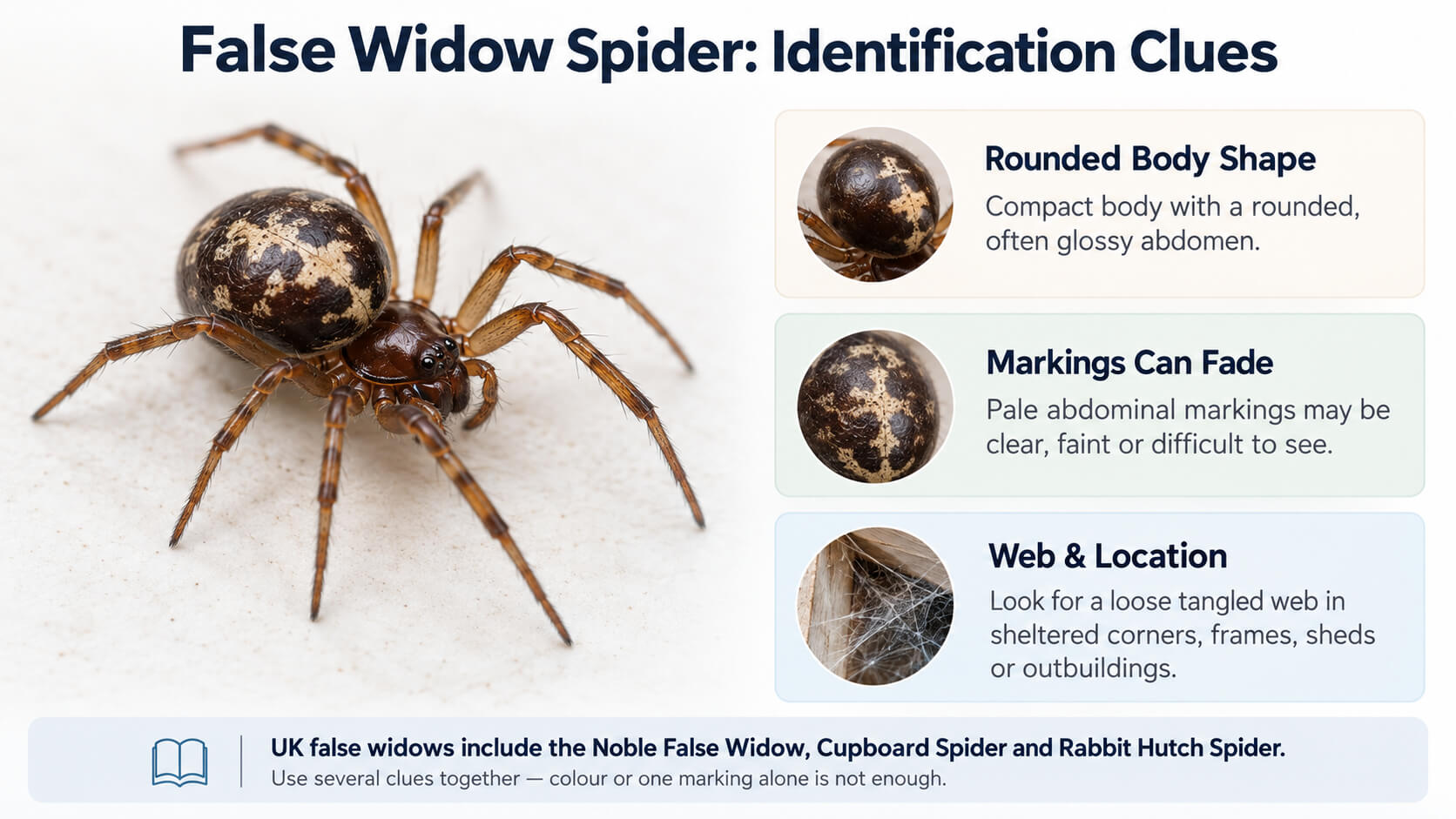
- Dark, rounded and often shiny abdomen
- Abdominal markings can vary, fade or become difficult to see
- Loose, tangled web rather than a regular circular orb web
- UK false widows include the noble false widow, cupboard spider and rabbit hutch spider
- Use body shape, markings, web and location together rather than relying on one feature


Who will come to my home?
A certified pest control technician from our vetted network, on the day and time you choose. You get a confirmation by email as soon as you book.
Is the treatment safe for children and pets?
Yes. Technicians use HSE-approved products and methods: tamper-resistant bait stations for rodents, and sprays or gels that are safe for children and pets once dry. You are told before the visit if a room needs to stay clear for a few hours.
What if the pests come back?
Follow-up visits are included where the treatment lists them, so if activity continues after the first visit, the next one is already covered at no extra charge. The price you see is the full price for the whole treatment cycle.
Do I need to prepare anything or be at home?
Someone needs to be at the property to let the technician in. Preparation is minimal and depends on the pest; the technician confirms anything needed by SMS and email after you book.
Do I pay now?
No. You see the price, then pick a date and time. Payment is only confirmed at checkout, and cancellation is free.
Is the £50 inspection fee deducted from the treatment?
Yes. If you are not sure what the pest is, you can book a £50 inspection visit. The technician identifies the pest and quotes the treatment on site, and if you go ahead the £50 is deducted from that treatment price.
Recently booked jobs



How to Identify a False Widow Spider
False widow spiders are small to medium-sized, dark spiders with rounded abdomens and loose, tangled webs. In the UK, the name covers several related species in the Steatoda group, so identification is strongest when body shape, markings, web structure and location all support the same conclusion rather than relying on colour alone.
False Widow Spider Size and Appearance
Adult false widows have compact bodies with a noticeably rounded abdomen, while females are generally more globular than males. The noble false widow, Steatoda nobilis, is the largest of the commonly encountered UK species, with adult females reaching roughly 8.5–14 mm in body length and males around 7–10 mm.
Colour ranges from brown to very dark brown or blackish, and the abdomen may carry pale cream markings. Those markings are not fixed: they can be clearer in males and younger spiders, while mature females may look much plainer. A faded pattern therefore does not rule out a false widow.
Types of False Widow Spiders in the UK
The three false widows most often associated with UK buildings and gardens are the noble false widow, cupboard spider and rabbit hutch spider. The noble false widow is usually the largest and is now well established in parts of Britain. The cupboard spider, Steatoda grossa, is typically darker and often occupies low, hidden indoor areas, while the smaller rabbit hutch spider, Steatoda bipunctata, is common around sheds, outbuildings and garden structures.
These are related species rather than different life stages of one spider. Their markings and preferred locations vary, so the scientific species name is useful when a more exact identification is possible.
False Widow vs Lace Web Spider and Other Lookalikes
Lace web spiders and missing sector orb weavers are two UK spiders commonly mistaken for false widows. Lace web spiders tend to have a more matt, hairy and oval abdomen, while false widows usually look smoother, shinier and more rounded. Missing sector orb weavers build a recognisable orb web with radiating spokes and curved silk lines, unlike the loose three-dimensional tangle made by a false widow.
True black widow spiders are a different group and are not established in the UK. A dark spider should not be labelled a false widow from colour alone; body proportions, web structure and habitat provide more useful context.
False Widow Spider Bites
False widow spiders can bite, but bites are uncommon and usually happen when a spider is trapped or pressed against the skin. The bite family on this page refers specifically to identified or strongly suspected false widows; a skin mark alone cannot reliably show which spider caused it.
What Can a False Widow Bite Feel Like?
A false widow bite can cause local pain and may also cause some swelling or discomfort around the bite area. The Natural History Museum notes that symptoms are usually limited and are often compared with a wasp sting, although individual reactions can vary. Because symptoms alone cannot identify the species, compare the spider itself with our guide to spiders commonly found in UK homes if identification is uncertain.
This page does not use photographs of skin marks to diagnose a false widow bite and does not provide a generic spider-bite treatment pathway. If symptoms are more severe than expected or you are concerned about a reaction, seek appropriate medical advice.
Are False Widow Spiders Dangerous?
False widows are not considered as dangerous as true black widow spiders, and severe effects are unusual. They do possess venom for subduing prey, but the UK species are not the deadly spiders suggested by some sensational reports. Most encounters do not result in a bite at all.
Risk should therefore be described proportionately: avoid handling or trapping the spider against bare skin, but do not assume that finding one in a building means someone is likely to be bitten.
Where Are False Widow Spiders Found in the UK?
False widow spiders can be found in and around UK buildings, although the preferred location varies by species. Noble false widows are strongly associated with houses and other buildings and often use elevated sheltered positions, while cupboard spiders favour darker, lower corners and rabbit hutch spiders are especially common around sheds and outbuildings.
False Widow Webs and Sheltered Habitats
False widow webs are loose, irregular tangles of criss-crossing silk rather than circular orb webs. They may be built in room corners, conservatories, garages, sheds, wall gaps or other sheltered places. Noble false widows often hide in a denser silken retreat by day and become more active around the web after dark.
Web type is useful but not diagnostic by itself. Combining the web with the spider’s rounded abdomen, variable markings, size and exact location gives a stronger identification than any single feature on its own.
Frequently Asked Questions


There is usually no need to kill a false widow spider simply because it has been found indoors. Avoid handling it directly, particularly if identification is uncertain, and focus first on confirming whether the spider is actually a false widow rather than reacting to appearance alone.
False widow spiders do not make communal nests, but they build irregular tangled webs with sheltered retreats where they rest and reproduce. Females place their eggs inside silk egg sacs close to the web, so an undisturbed web area may contain both the spider and one or more egg sacs.
Several false widow spiders can be present in the same property when suitable sheltered web sites and enough prey are available. They do not form organised colonies, but repeated sightings in different parts of a building can indicate that conditions are supporting an established local population.
False widow spiders may live inside houses because buildings provide sheltered web sites, stable temperatures and access to small insect prey. They are often associated with undisturbed corners, window frames, garages, sheds and other protected spaces rather than open living areas.
False widow eggs are enclosed inside silk egg sacs rather than being left exposed individually. The sacs are usually kept within or close to a sheltered web retreat, so finding an egg sac alone is not enough to confirm the spider species without also examining the adult spider or other identifying features.