



Carpet beetles do not bite people. However, hairs from carpet beetle larvae can cause itchy skin reactions or dermatitis in some people, which may be mistaken for insect bites.
This guide explains carpet beetle rash and skin reactions, whether carpet beetles are dangerous and how carpet beetles differ from bed bugs.
Recently booked jobs


Do Carpet Beetles Bite?
No, carpet beetles do not bite people. Adults do not feed on humans, and carpet beetle larvae do not bite either. The confusion comes from the fact that larval hairs can cause itchy, bite-like skin reactions in some people.
The search phrase “carpet beetle bites” does not describe a true bite. If carpet beetles are present in a home, the insects and their physical evidence are more useful for identification than a skin mark alone.
Are Carpet Beetles Dangerous?
Carpet beetles are not generally considered dangerous to people, but larval hairs can cause dermatitis or hypersensitivity reactions in susceptible individuals. Adults are not associated with biting, while the immature stage is the one linked to these reactions.
Not everyone exposed to carpet beetle larvae will develop symptoms, and reactions can vary, so symptoms alone do not prove that carpet beetles are responsible.
Carpet Beetle Rash and Skin Reactions
Carpet beetle dermatitis, often described as a carpet beetle rash, is a skin reaction linked to hairs from the larvae rather than a bite. Medical and entomological reports describe these hairs as capable of causing dermatitis or hypersensitivity when they contact the skin.
The resulting marks may be itchy and can resemble reactions caused by other household pests. Because appearance alone is not specific, confirming the insect or finding supporting evidence is more reliable than trying to identify the cause from a rash. For identification of the hairy immature stage, see our guide to carpet beetle larvae.
How Larval Hairs Can Cause Skin Reactions
Fine hairs on carpet beetle larvae can become detached and come into contact with skin. In susceptible people, these hairs can trigger a hypersensitivity reaction and produce itching or raised skin lesions that may be mistaken for bites.
The reaction is linked to the larval stage, not to the adult beetle feeding on a person. This is why the search term “carpet beetle bite” should not be interpreted as evidence that carpet beetles actually bite.
Why a Rash Alone Cannot Confirm Carpet Beetles
A rash by itself cannot reliably confirm that carpet beetles are the cause. Similar-looking skin reactions can have many possible causes, and even bite-like marks do not identify the insect responsible without other evidence.
Carpet beetle identification is stronger when an adult or larva is found and matched with the correct household context. For species, appearance and general identification, see our guide to carpet beetles in UK homes.
Carpet Beetles vs Bed Bugs
The main difference is that bed bugs bite and feed on blood, while carpet beetles do not bite people. Carpet beetle skin reactions are associated with larval hairs, so a bite-like rash does not make the two pests biologically equivalent.
The insects themselves also look very different. If you are checking a bed or mattress for physical evidence, use our separate guide to the signs of bed bugs rather than trying to decide from a rash alone.
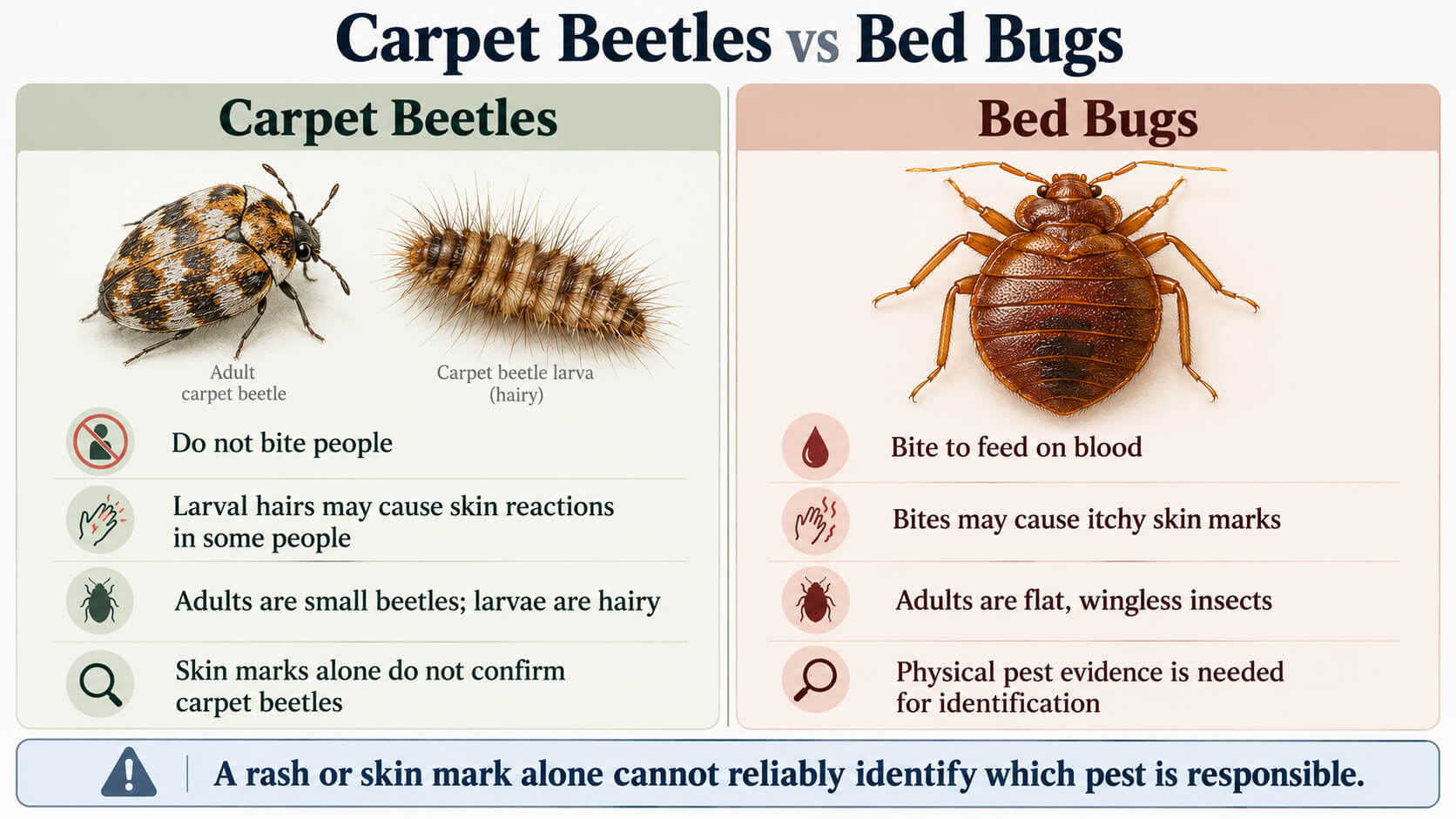
Key Differences Between Carpet Beetles and Bed Bugs
Adult carpet beetles are small beetles, and their larvae are hairy, while bed bugs are flattened, wingless insects adapted to feeding on blood. Carpet beetle adults may be found away from sleeping areas, whereas bed bug evidence is commonly associated with places where people rest or sleep.
Comparing the insect, where it was found and the surrounding evidence is more useful than comparing skin marks alone. Physical evidence provides a stronger basis for identification.
Skin Reactions and Bed Bug Bites
Bed bug bites and carpet beetle-related dermatitis can both produce itchy skin marks, but the cause is different. Bed bugs bite to obtain a blood meal; carpet beetle reactions are linked to contact with larval hairs.
Because individual skin reactions vary, the pattern or appearance of a rash should not be used as the sole method of distinguishing between the two pests. Physical pest evidence provides a more reliable basis for identification.
Frequently Asked Questions


No, carpet beetle larvae do not bite people. The confusion comes from their fine hairs, which can cause itchy dermatitis or hypersensitivity reactions in some people. These reactions may resemble insect bites, but they are caused by contact with larval hairs rather than biting.
No, a photo of a rash cannot confirm that carpet beetles are the cause. Skin reactions can resemble bites or other forms of irritation, so appearance alone is not diagnostic. Finding the insect or other physical pest evidence provides a more reliable basis for identification.
There is no single reliable duration that can identify a carpet beetle-related skin reaction. Reactions can vary between people, and duration alone cannot confirm the cause. If skin symptoms are persistent, worsening or concerning, they should be assessed by an appropriate healthcare professional rather than diagnosed from pest exposure alone.
Yes, contact with carpet beetle larval hairs can cause itching in some people. This is a skin reaction rather than a bite, and not everyone exposed will react in the same way. Itching alone therefore does not prove that carpet beetles are present or responsible.