


Carpet Beetles in UK Homes
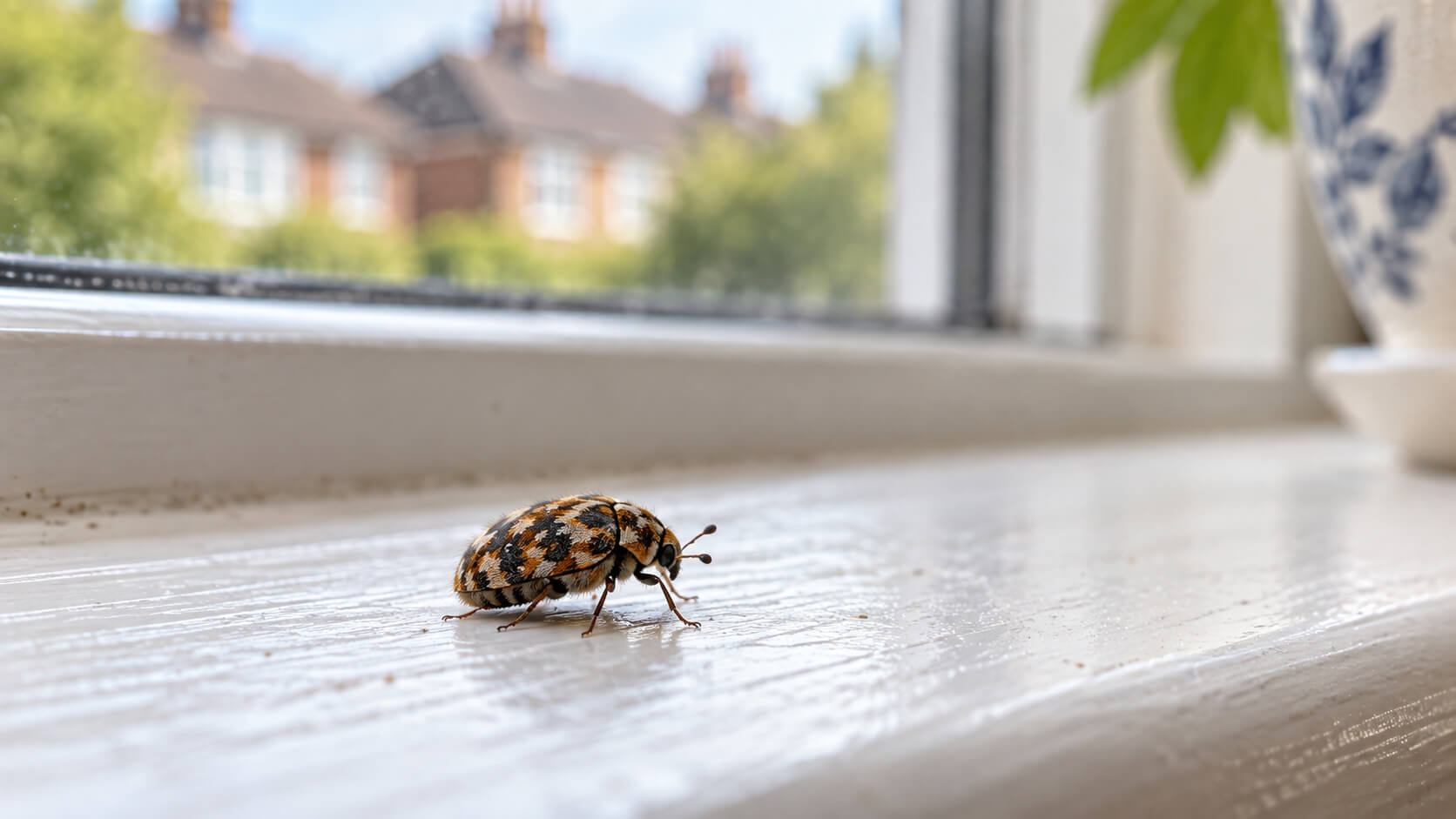
Carpet beetles are small household beetles found in UK homes, where adults may appear near windows and larvae can develop in quiet areas containing suitable animal-based materials.
Several species occur in Britain, including varied, two-spotted or fur, and brown carpet beetles. This page explains how to identify them, why they enter homes and where they may be found.
Carpet Beetle Pest Control
- Same-day bookings available
- Flexible appointment times
- Inspection option if you are unsure whether carpet beetles are present
- Get a quote by describing what you have seen, without needing to identify the species yourself
- Pay us by Card, PayPal, Google Pay, Apple Pay or Pay on-site



Who will come to my home?
A certified pest control technician from our vetted network, on the day and time you choose. You get a confirmation by email as soon as you book.
Is the treatment safe for children and pets?
Yes. Technicians use HSE-approved products and methods: tamper-resistant bait stations for rodents, and sprays or gels that are safe for children and pets once dry. You are told before the visit if a room needs to stay clear for a few hours.
What if the pests come back?
Follow-up visits are included where the treatment lists them, so if activity continues after the first visit, the next one is already covered at no extra charge. The price you see is the full price for the whole treatment cycle.
Do I need to prepare anything or be at home?
Someone needs to be at the property to let the technician in. Preparation is minimal and depends on the pest; the technician confirms anything needed by SMS and email after you book.
Do I pay now?
No. You see the price, then pick a date and time. Payment is only confirmed at checkout, and cancellation is free.
Is the £50 inspection fee deducted from the treatment?
Yes. If you are not sure what the pest is, you can book a £50 inspection visit. The technician identifies the pest and quotes the treatment on site, and if you go ahead the £50 is deducted from that treatment price.
Recently booked jobs


Carpet Beetle Identification in UK Homes
Carpet beetles are small household beetles whose adults and immature stages look and behave very differently. Adults of several species may be noticed around homes, while the immature stage is associated with feeding on suitable animal-based materials.
The term “carpet beetle” covers more than one species, so identification should use a combination of size, body shape, colour and markings rather than a single feature.
What Do Carpet Beetles Look Like?
Adult carpet beetles are generally small and oval or rounded, but their appearance varies considerably between species. Some have a mottled pattern of pale, orange and black scales, while others are dark brown or black and more elongated.
The immature stage looks very different from the adult. Carpet beetle larvae are usually hairy or bristly and can be easier to confuse with other small household insects if only a brief glimpse is available.
Types of Carpet Beetles Found in the UK
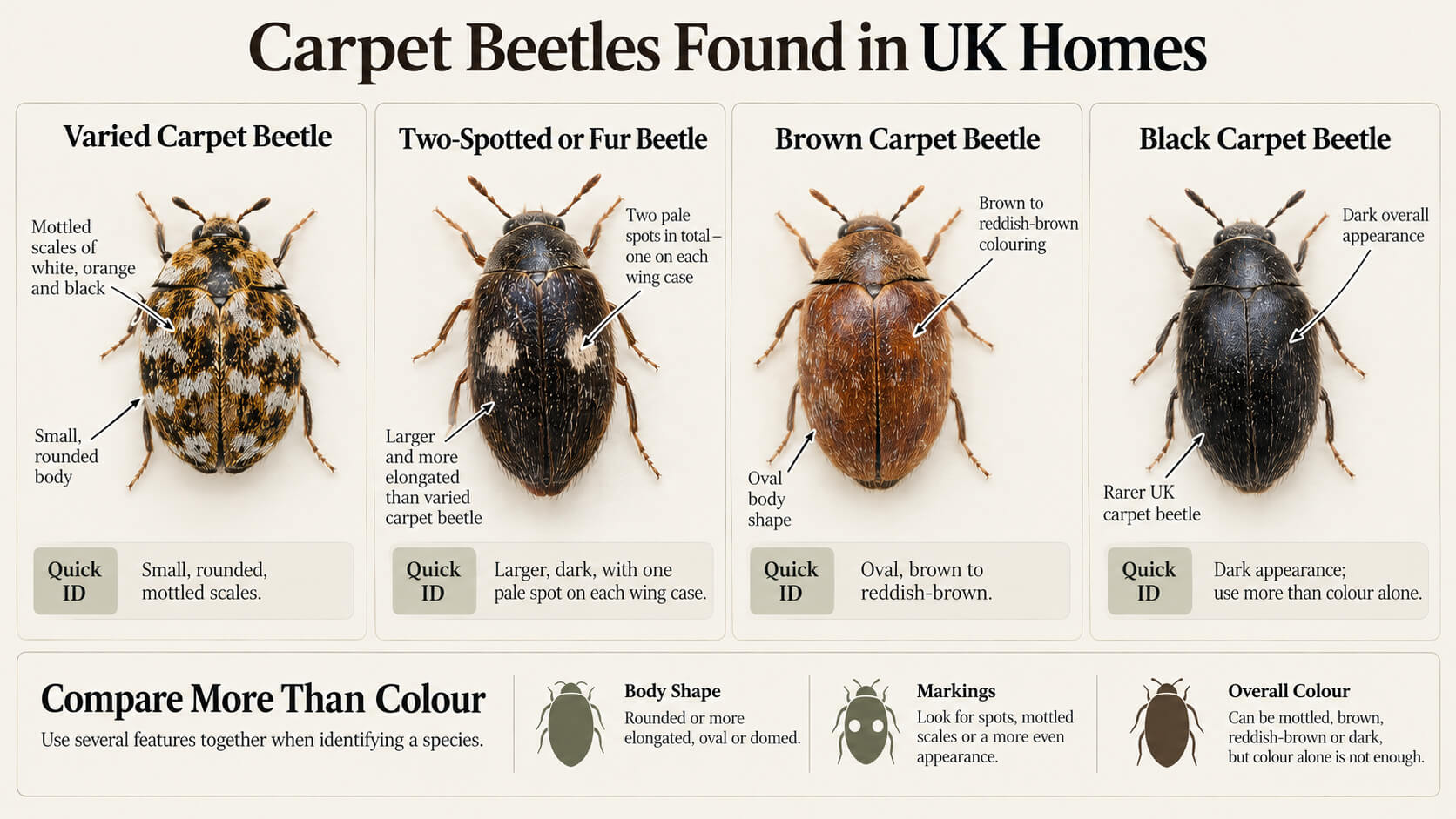
Several carpet beetle species are found in the UK, with the varied, two-spotted or fur, and brown carpet beetles among the main household species described by the Natural History Museum. Their appearance and distribution differ, which makes species-level identification useful when enough detail is visible.
Varied Carpet Beetle
The varied carpet beetle is a small, rounded species with white, golden-yellow and black scales that form a mottled pattern of white, orange and black patches. It is a long-established British species and is commonly associated with homes and collections containing natural fibres or other suitable larval food.
Two-Spotted or Fur Beetle
The two-spotted carpet beetle, also known as the fur beetle, is larger and more elongated than the varied carpet beetle. Adults are very dark brown to black and have a pale spot on each wing case. The species is also associated with bird nests and animal-based materials.
Brown Carpet Beetle
The brown carpet beetle is an introduced species that is now established in Britain. Adults are oval and generally brown to reddish-brown, and the species is particularly associated with heated buildings and dry animal material that can support development.
Black Carpet Beetle
The black carpet beetle is a less prominent species in UK household guidance but is also recognised by British pest-control references. A dark beetle should not be identified as this species from colour alone, because other carpet beetles can also appear very dark.
For closer identification of the immature stage, including the hairy “woolly bear” appearance, use our guide to carpet beetle larvae.
Why Carpet Beetles Appear in UK Homes
Carpet beetles appear indoors when adults enter buildings or when eggs and larvae develop close to a suitable food source. The place where an adult is eventually seen may therefore be different from the area where development is occurring.
Suitable sources can include animal-based textiles, accumulated fluff, feathers, hair, dead insects and material associated with bird nests. Lofts, roof spaces and undisturbed areas can therefore be relevant when tracing where activity originated.
What Causes Carpet Beetles?
Carpet beetles are usually associated with the availability of suitable larval food rather than with carpets alone. Females place eggs close to material that can support developing larvae, so wool, fur, feathers, skins, dead insects and similar dry animal material can all be relevant.
This is why activity can occur in a property even when most floor coverings are synthetic. The important factor is whether another suitable food source is available nearby.
Where Do Carpet Beetles Come From?
Carpet beetles can come from both outdoor and indoor sources. Flying adults may enter buildings, while some species naturally develop in bird nests and can move from roof or eaves areas into occupied parts of a property.
Activity may also begin around stored natural-fibre items or undisturbed accumulations of fluff, hair, feathers and dead insects. Identifying the likely source is therefore more useful than assuming the insects originated from the visible carpet.
Where Carpet Beetles Are Found Indoors
Adult carpet beetles are often noticed near windows, while larvae are more likely to remain in quieter areas where food is available. Potential locations include carpet edges, areas beneath furniture, floorboard gaps, wardrobes, airing cupboards, loft spaces and places where organic debris accumulates.
Repeated adult sightings together with shed skins, droppings or textile damage can provide more useful evidence of indoor activity. Those diagnostic clues are covered separately in our guide to the signs of carpet beetles.
Carpet Beetle Behaviour and Food Sources
Adult carpet beetles and their immature stages have different feeding habits and occupy different parts of the household environment. Adults of common species may fly and feed outdoors, while larvae remain closer to the dry materials they use as food.
This distinction explains why adults can be visible in bright parts of a room even when the immature stage is hidden elsewhere. If your concern is whether carpet beetles bite or whether a skin reaction may be confused with another household pest, see our do carpet beetles bite? guide.
Do Carpet Beetles Fly?
Yes, adult carpet beetles can fly. Varied carpet beetle adults are often found around windows trying to move towards the outside, while two-spotted carpet beetles also fly readily in warm conditions.
Because adults are mobile, finding one near a window does not by itself prove that the breeding source is in the same room. The source may be elsewhere in the property or around a nearby nesting or feeding site.
Carpet Beetle Food Sources
The larvae mainly depend on dry materials of animal origin. Depending on the species, these can include wool, fur, feathers, skins, leather, silk, hair and dried insects.
For the varied carpet beetle, entirely synthetic fabric is not a normal food source. Synthetic carpets can still be present in a property with carpet beetle activity when suitable animal material or organic debris has accumulated nearby.
Materials Affected by Carpet Beetles
The larval stage, rather than the adult beetle, is responsible for damage to suitable natural materials. Items containing wool, fur, feathers, silk, skins or related animal-based material can be affected when the immature stage has access to them.
Visible material damage is evidence of activity, not a reliable species identifier. Species-level identification should rely more on adult body shape, colour and markings, while infestation evidence remains covered in the dedicated signs guide.
If carpet beetle activity has been identified and you need professional control rather than further identification guidance, check our carpet beetle pest control options and availability.
Frequently Asked Questions


Adult carpet beetles are only a few millimetres long, but size varies by species. The varied carpet beetle is about 1.5–3.5mm long, the brown carpet beetle about 2–5mm, and the two-spotted carpet beetle about 4.5–6mm. Shape, colour and markings should therefore be checked alongside size.
Yes, a carpet beetle can be found on or near a mattress, but that does not mean the mattress is the source. Adults can fly, while larvae develop where suitable animal-based material is available, such as wool, feathers, hair or accumulated debris. The wider room and nearby materials should therefore be considered rather than judging from one sighting.
Yes, carpet beetles can occur around upholstered furniture when suitable natural fibres or animal-based material are present. Larvae may find food in wool-based upholstery, hair, feathers, dead insects or accumulated fluff, while adults can move elsewhere in the room. The presence of furniture alone does not mean it is the source.
Yes, several carpet beetle species are established in Britain, although their distribution varies. The varied carpet beetle is a long-established common household pest, while the two-spotted or fur beetle is also well established in the UK. The brown carpet beetle is an introduced species that has become established in Britain.