


Carpet Beetle Larvae in UK Homes
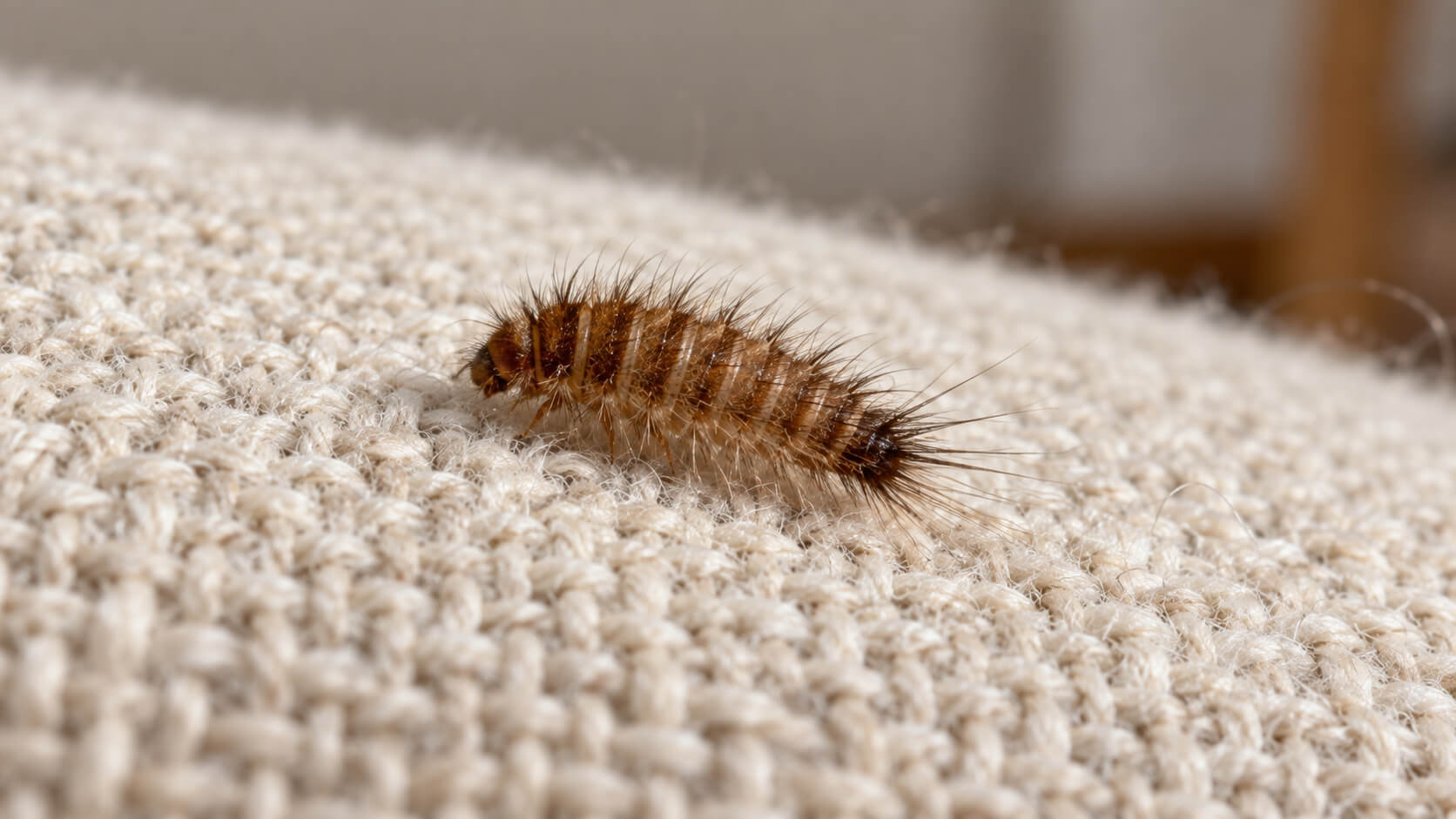
Carpet beetle larvae found in UK homes are the hairy immature stage often called woolly bears. Their colour, shape and size can vary by species and growth stage, and they moult as they develop before pupating.
This guide explains larval identification, carpet beetle eggs and pupae, and how the life cycle progresses from egg to adult.
Carpet Beetle Larvae: Key Features
- Larvae look very different from adult carpet beetles
- Varied carpet beetle larvae are hairy and commonly called woolly bears
- Larval shape, banding and hair tufts can differ between species
- Eggs are laid on or near materials that can support developing larvae
- Larvae moult as they grow before entering the pupal stage



Who will come to my home?
A certified pest control technician from our vetted network, on the day and time you choose. You get a confirmation by email as soon as you book.
Is the treatment safe for children and pets?
Yes. Technicians use HSE-approved products and methods: tamper-resistant bait stations for rodents, and sprays or gels that are safe for children and pets once dry. You are told before the visit if a room needs to stay clear for a few hours.
What if the pests come back?
Follow-up visits are included where the treatment lists them, so if activity continues after the first visit, the next one is already covered at no extra charge. The price you see is the full price for the whole treatment cycle.
Do I need to prepare anything or be at home?
Someone needs to be at the property to let the technician in. Preparation is minimal and depends on the pest; the technician confirms anything needed by SMS and email after you book.
Do I pay now?
No. You see the price, then pick a date and time. Payment is only confirmed at checkout, and cancellation is free.
Is the £50 inspection fee deducted from the treatment?
Yes. If you are not sure what the pest is, you can book a £50 inspection visit. The technician identifies the pest and quotes the treatment on site, and if you go ahead the £50 is deducted from that treatment price.
Recently booked jobs


Carpet Beetle Larvae Identification
Carpet beetle larvae are small, hairy immature beetles that look very different from the adults they eventually become. Their colour, body shape, banding and hair arrangement can vary between species and also change as the larva grows.
In UK homes, larvae may be found in quiet areas close to suitable animal-based material or organic debris. Identification is strongest when several features are considered together rather than relying on colour or size alone.
What Do Carpet Beetle Larvae Look Like?
Carpet beetle larvae usually have elongated or tapered bodies covered with hairs or bristles. Depending on the species, they may appear light brown, golden-brown or much darker, with visible body segments, bands or tufts of longer hairs towards the rear.
Size also varies. Natural History Museum guidance describes varied carpet beetle larvae at about 4–4.5mm, two-spotted carpet beetle larvae reaching about 6.5mm and brown carpet beetle larvae reaching about 8mm when fully developed.
Woolly Bear Carpet Beetle Larvae
The name “woolly bear” is commonly used for carpet beetle larvae because their bodies are covered in hairs. Varied carpet beetle larvae have particularly noticeable backward-pointing tufts on the last abdominal segments, which can help distinguish them from some other small household insects.
As larvae grow, they moult and leave empty cast skins behind. A cast skin is different from a live larva; if you are assessing shed skins, droppings or material damage as evidence of activity, see our guide to the signs of carpet beetles.
How Larval Appearance Varies by Species
Larval appearance differs between carpet beetle species, so not every larva will look like the familiar rounded woolly bear. Varied carpet beetle larvae are hairy and relatively compact, while larvae of two-spotted and brown carpet beetles are more elongated and taper towards the rear with prominent hair tufts.
Black carpet beetle larvae can also be darker and more tapered, but colour alone is not reliable for species identification. For the adult species, UK distribution and broader identification features, see our guide to carpet beetles in UK homes.
Carpet Beetle Eggs, Pupae and Life Cycle
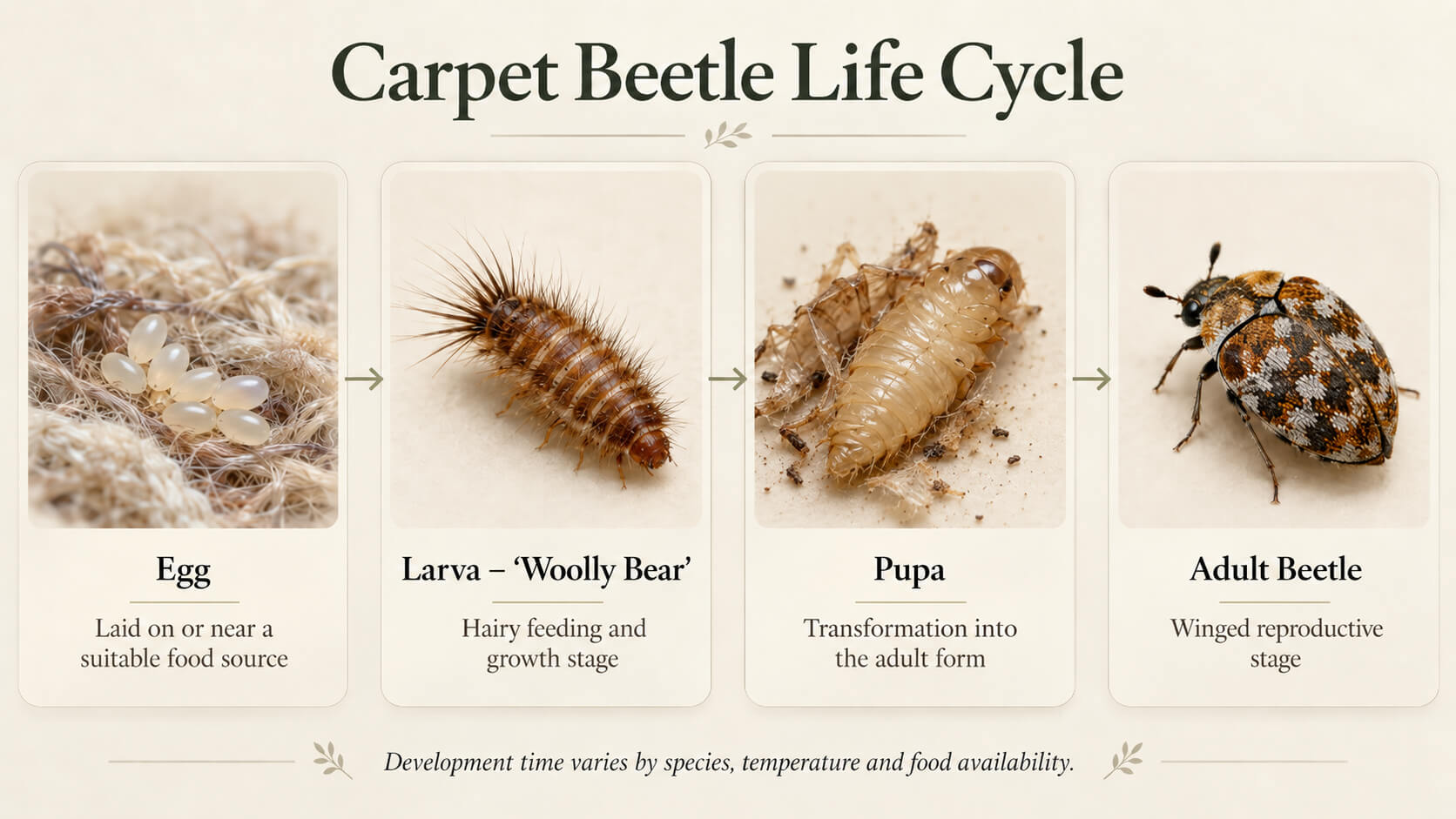
Carpet beetles develop through four stages: egg, larva, pupa and adult. The larval stage is usually the longest and is the stage associated with feeding, while the egg and pupal stages are part of the transition between generations.
Development time varies substantially by species, temperature and food availability, so one fixed timetable does not apply to every carpet beetle found indoors.
What Do Carpet Beetle Eggs Look Like?
Carpet beetle eggs are very small and pale, making them difficult to notice without close inspection. Females place them on or near materials that can support the larvae after hatching, including suitable natural-fibre or animal-based material.
Eggs may also be deposited in protected cracks, crevices or other sheltered areas close to a food source. Their small size means that finding larvae is often more practical for identification than trying to identify individual eggs.
Carpet Beetle Pupae
The pupal stage forms after a fully developed larva has completed its feeding and growth. During this stage the insect changes into its adult form and no longer resembles the active, hairy larva.
Pupation may occur in or close to the larval habitat, and the length of the pupal stage varies between species and conditions. The presence of a pupa therefore represents a developmental stage rather than a separate type of carpet beetle.
Carpet Beetle Life Cycle
The carpet beetle life cycle progresses from egg to larva, then pupa and finally adult. After hatching, larvae feed and moult repeatedly as they increase in size before reaching the pupal stage.
The time spent as a larva can vary considerably, and some UK species may take much longer to develop when food or temperature conditions are less favourable. Adults then emerge from the pupal stage and begin the reproductive cycle again.
Frequently Asked Questions


Carpet beetle larvae can crawl onto walls while moving away from a feeding area or searching for another sheltered location. Finding one on a wall does not necessarily mean the source is inside the wall, so nearby carpets, furniture, stored natural-fibre items and other quiet areas may still be relevant.
Yes, carpet beetle larvae can occasionally be found on or around a bed, but the bed itself may not be the source. Nearby feathers, hair, wool, natural-fibre furnishings or accumulated organic debris can provide suitable material, so the surrounding area should be considered rather than judging from one larva.
Yes, larvae can be present even when no adult carpet beetles are visible. The stages occupy different parts of the life cycle and larvae may remain hidden near food sources for long periods. Adults are more mobile, so the absence of visible adults does not rule out developing larvae indoors.
No, carpet beetle larvae cannot fly. They are the immature, wingless stage and move by crawling. Flight occurs only after the insect has completed the larval and pupal stages and emerged as an adult carpet beetle.