


How to Identify Squirrel Droppings
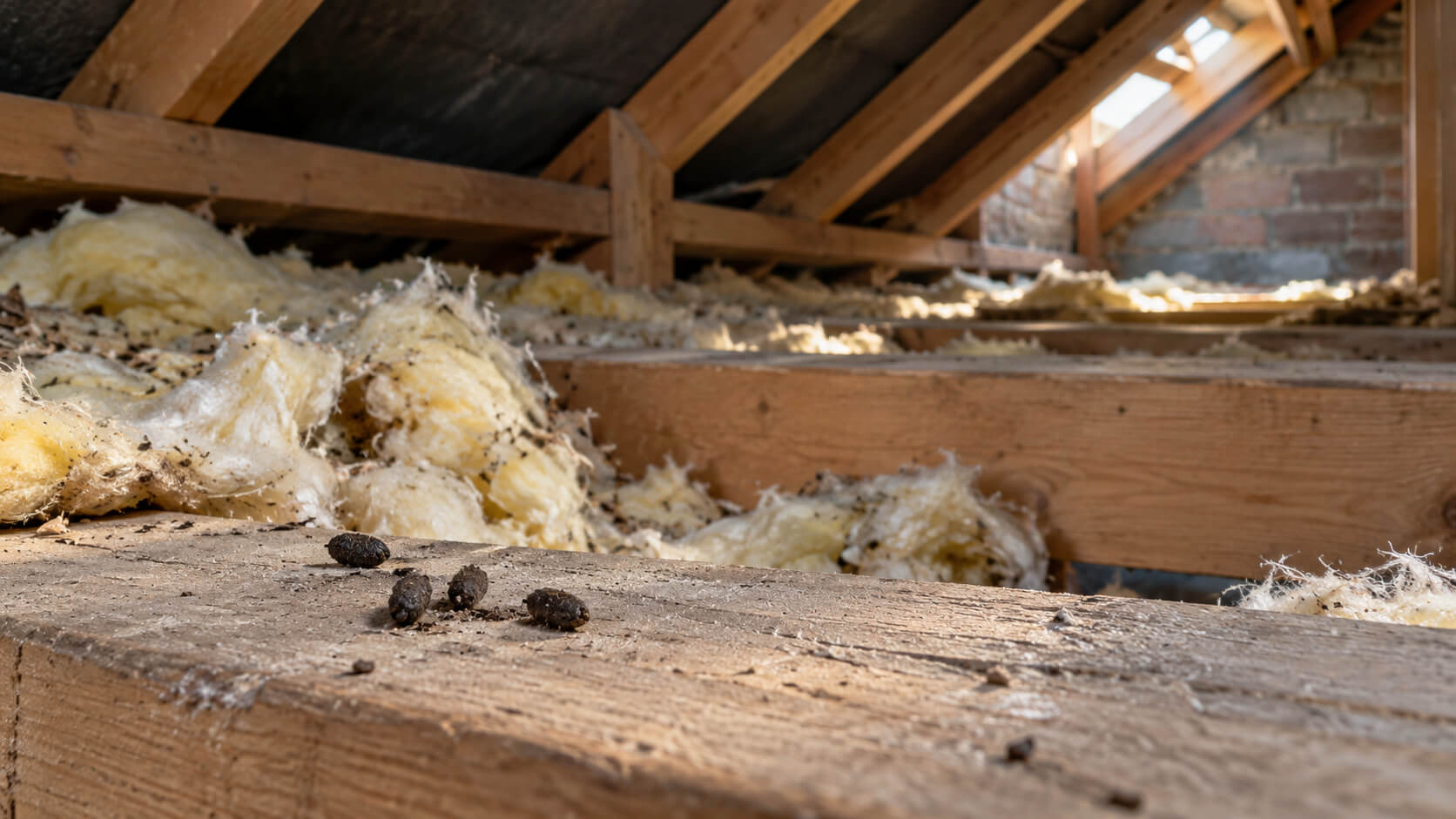
Squirrel droppings can be identified by their size, shape, appearance and the location where they are found. Squirrel poo can resemble the droppings of other rodents, so several clues should be considered together rather than relying on one feature alone.
This guide explains what squirrel droppings look like, common grey squirrel evidence, droppings found in lofts or attics, and the main identification differences to check.
Squirrel Droppings Identification Guide
- Identify Squirrel Droppings and Poo
- Compare Size, Shape and Appearance
- Recognise Grey Squirrel Evidence
- Check Droppings in Lofts and Attics
- Distinguish Them From Other Rodents



Who will come to my home?
A certified pest control technician from our vetted network, on the day and time you choose. You get a confirmation by email as soon as you book.
Is the treatment safe for children and pets?
Yes. Technicians use HSE-approved products and methods: tamper-resistant bait stations for rodents, and sprays or gels that are safe for children and pets once dry. You are told before the visit if a room needs to stay clear for a few hours.
What if the pests come back?
Follow-up visits are included where the treatment lists them, so if activity continues after the first visit, the next one is already covered at no extra charge. The price you see is the full price for the whole treatment cycle.
Do I need to prepare anything or be at home?
Someone needs to be at the property to let the technician in. Preparation is minimal and depends on the pest; the technician confirms anything needed by SMS and email after you book.
Do I pay now?
No. You see the price, then pick a date and time. Payment is only confirmed at checkout, and cancellation is free.
Is the £50 inspection fee deducted from the treatment?
Yes. If you are not sure what the pest is, you can book a £50 inspection visit. The technician identifies the pest and quotes the treatment on site, and if you go ahead the £50 is deducted from that treatment price.
Recently booked jobs



What Do Squirrel Droppings Look Like?
Squirrel droppings are usually small, dark pellets that can be identified by comparing their size, shape, colour and where they are found. Their appearance can vary, so squirrel poo in the UK should not be identified from a single feature alone.
Squirrel droppings in the UK can resemble the droppings of other rodents. Squirrel poo, squirrel poop, scat or faeces should therefore be compared with nearby evidence such as noises, nesting material, gnawing or damage rather than identified from appearance alone. For UK squirrel droppings identification, several matching clues are more reliable than one pellet viewed in isolation.
Squirrel Droppings Pictures: What Size and Shape Are Typical?
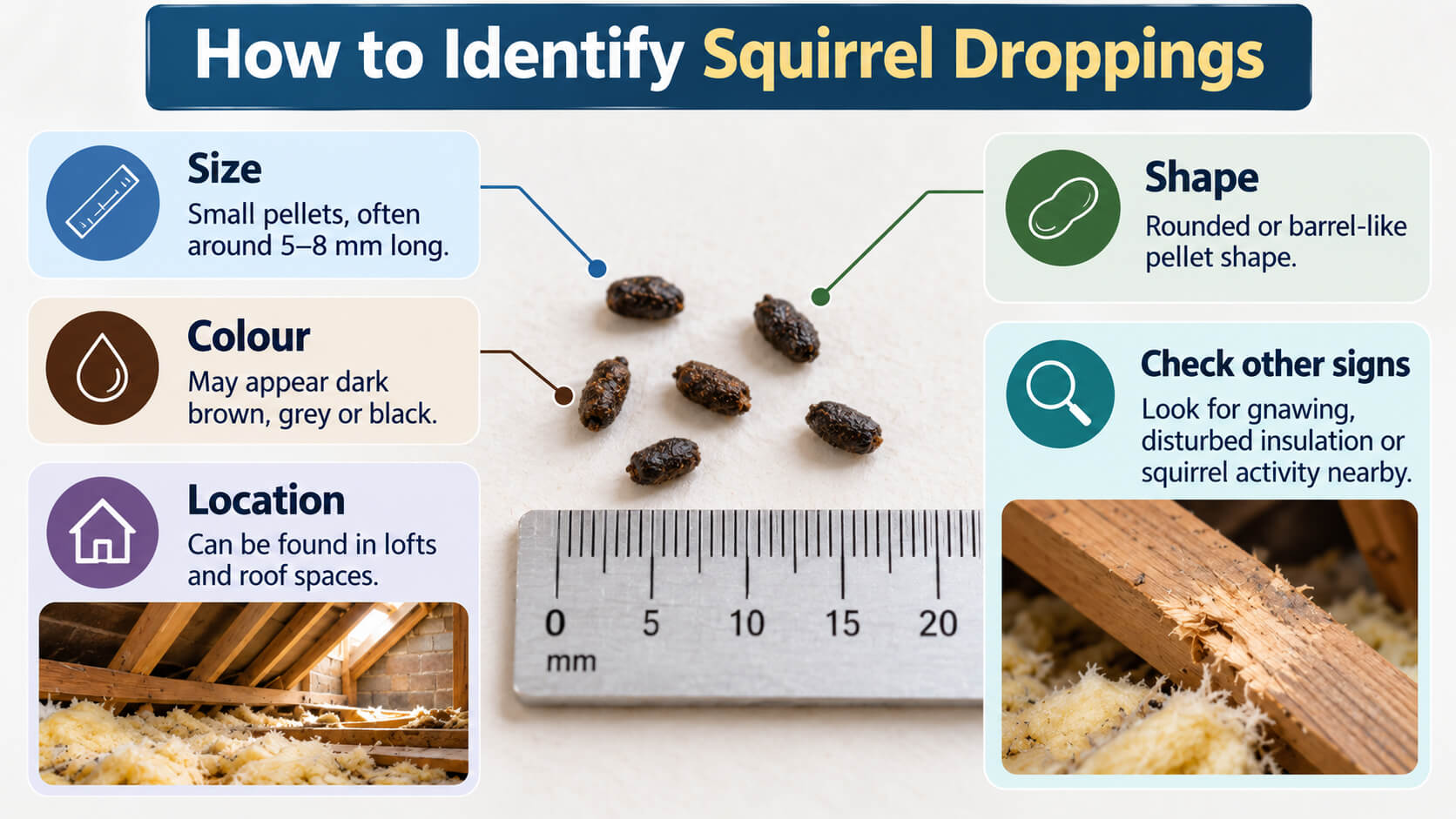
Squirrel droppings are typically small, rounded pellets measuring around 0.5–0.8 cm long and approximately 0.5 cm thick. Squirrel droppings size can vary considerably, so measurements should be treated as an identification clue rather than an exact test.
Squirrel poo may appear dark grey, brown or black, and colour can vary with diet. Squirrel droppings pictures can help with comparison, but shape, dimensions, location and other evidence should be considered together rather than relying on colour or one visual feature alone.
What Do Grey Squirrel Droppings Look Like?
Grey squirrel droppings can be dark grey or black and usually have a small, rounded pellet-like appearance. Diet can influence colour and other characteristics, so individual droppings do not always look identical.
Red squirrel droppings should not be distinguished from grey squirrel droppings by appearance alone. UK mammal guidance describes squirrel droppings generally rather than giving each species a distinct diagnostic pattern, so species identification should also consider the animal itself. This avoids assuming that pellet colour or size can identify the squirrel species. For body size, coat, ear tufts and tail differences, see our guide to red and grey squirrel identification.
Squirrel Droppings in a Loft or Attic
Squirrel droppings may be found in lofts and roof spaces where squirrels have been active. Squirrel droppings in an attic or loft are more useful for identification when they appear alongside disturbed insulation, gnawing, nesting material or repeated movement in the same part of the roof space.
Finding squirrel droppings in a loft does not prove that squirrels are still occupying the property. Compare the pellets with other evidence of squirrels in a loft or attic, such as recent noises, gnawing or disturbed insulation. Animal faeces should not be handled directly simply for identification.
How to Avoid Misidentifying Squirrel Droppings
Squirrel droppings can be confused with other rodent droppings, so identification should use several features rather than one measurement. Size, shape, location and other signs of animal activity can all help narrow down the likely source.
Rat vs Squirrel Droppings
Rat and squirrel droppings can look similar, which makes identification from droppings alone difficult. BPCA guidance describes squirrel droppings as barrel-shaped and notes that they may be mistaken for rat droppings.
The difference between rat and squirrel droppings can be subtle, so surrounding evidence is important. When deciding between rat or squirrel droppings, compare the pellets with daytime movement, disturbed insulation, gnawing and roof-space activity rather than relying on appearance alone.
Squirrel Droppings vs Mouse Droppings
Mouse droppings are generally smaller than squirrel droppings and are commonly described as small, rice-shaped pellets. BPCA guidance describes typical mouse droppings as around 5 mm long, while squirrel droppings are generally larger.
Size should still not be used as the only test because published measurements can vary and individual pellets may not be typical. Compare shape, location and other nearby evidence before deciding whether droppings are more likely to come from a squirrel or a mouse.
Frequently Asked Questions


Animal droppings should be treated cautiously and should not be touched directly. UK wildlife guidance warns that animal poo can contain harmful microorganisms. For identification, look at visible features such as size, shape and colour without handling the droppings with bare hands.
Squirrel droppings may be less noticeable because they are small and can be left in sheltered or less visible locations. Their dark pellet-like appearance can also make them difficult to spot among soil, insulation or other debris. Finding no obvious droppings does not rule out squirrel activity.
Droppings alone are not a reliable way to distinguish a red squirrel from a grey squirrel. UK mammal identification guidance describes squirrel droppings generally, so species identification should also consider the animal's appearance, location and other field signs.
No, finding droppings does not by itself prove that squirrels are currently occupying the loft. Look for additional evidence such as recent noises, disturbed insulation, gnawing or repeated activity around the roof space before drawing a conclusion.
Yes, a clear photograph can help when comparing the size and appearance of possible squirrel droppings. The Mammal Society recommends including an object of known size, such as a coin or standard pen, in a photograph when a ruler is not available. Avoid touching the droppings directly.