


Rat vs Mouse: How to Tell the Difference
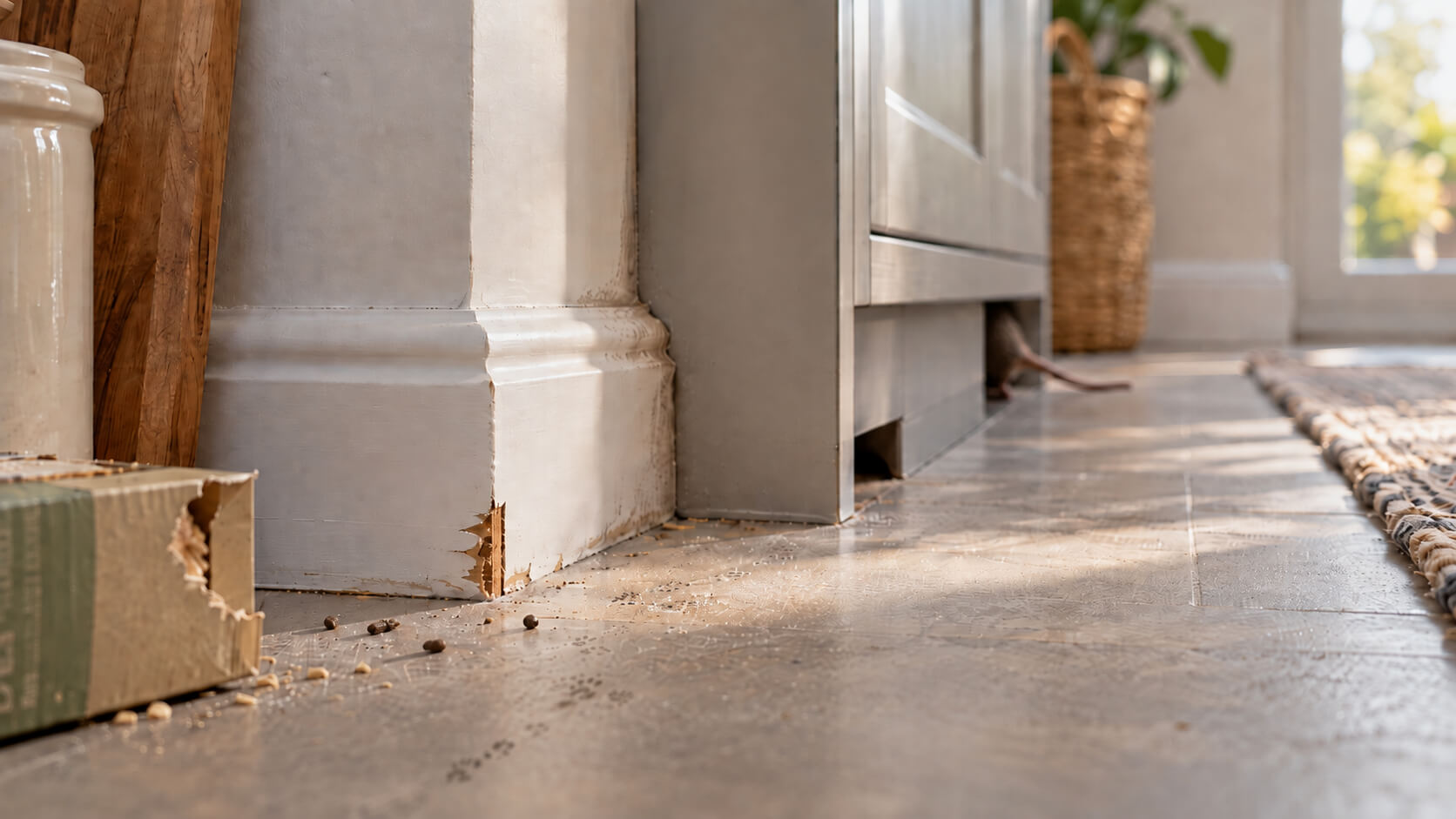
Rat vs mouse identification is easier when you compare several signs rather than relying on one clue alone. Droppings, body size, gnaw marks, tracks, nesting evidence and the noises you hear can all help distinguish rats from mice. This guide explains the key differences and the signs to check if you are unsure which rodent may be present in your home.
Rat & Mouse Pest Control
- Same-day bookings available
- Flexible appointment times
- Tamper-resistant bait stations used for rat and mouse treatments
- Treatment matched to the level of rodent activity
- Pay us by Card, PayPal, Google Pay, Apple Pay or Pay on-site



Who will come to my home?
A certified pest control technician from our vetted network, on the day and time you choose. You get a confirmation by email as soon as you book.
Is the treatment safe for children and pets?
Yes. Technicians use HSE-approved products and methods: tamper-resistant bait stations for rodents, and sprays or gels that are safe for children and pets once dry. You are told before the visit if a room needs to stay clear for a few hours.
What if the pests come back?
Follow-up visits are included where the treatment lists them, so if activity continues after the first visit, the next one is already covered at no extra charge. The price you see is the full price for the whole treatment cycle.
Do I need to prepare anything or be at home?
Someone needs to be at the property to let the technician in. Preparation is minimal and depends on the pest; the technician confirms anything needed by SMS and email after you book.
Do I pay now?
No. You see the price, then pick a date and time. Payment is only confirmed at checkout, and cancellation is free.
Is the £50 inspection fee deducted from the treatment?
Yes. If you are not sure what the pest is, you can book a £50 inspection visit. The technician identifies the pest and quotes the treatment on site, and if you go ahead the £50 is deducted from that treatment price.
Recently booked jobs


Rat vs Mouse: Key Differences
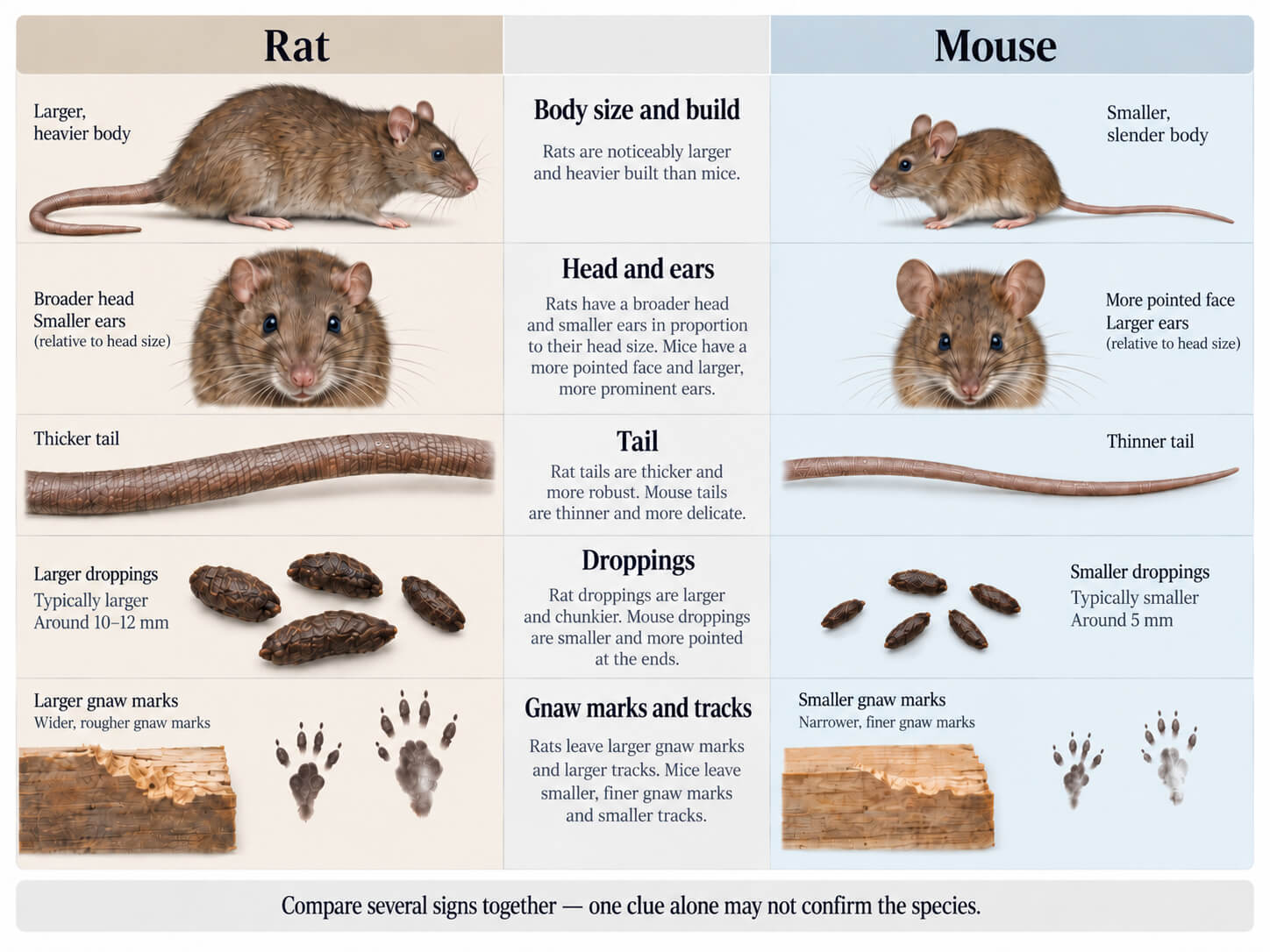
Rats and mice can leave similar signs, so it is more reliable to compare several clues than to identify a rodent from one sign alone. Rats are generally larger and more heavily built than mice, while mice have smaller bodies, proportionally larger ears and thinner tails. Droppings, body shape, tracks, gnawing and other evidence around the property can all help with identification.
In UK homes, a quick sighting may not always be enough to tell rats and mice apart, particularly when comparing a young rat with an adult mouse. Looking at several physical signs together usually gives a clearer indication.
Rat and Mouse Body Features
The table below compares the main physical and evidence-based differences between rats and mice. Use these features together, including body size, head shape, ears, tail, droppings and gnawing, rather than relying on a single characteristic for identification.
| Feature | Rat | Mouse |
|---|---|---|
| Overall build | Larger, heavier and more robust | Smaller and more slender |
| Head and snout | Broader head with a blunter snout | Smaller head with a more pointed snout |
| Ears | Smaller in proportion to the head | Larger and more prominent in proportion to the head |
| Tail | Thicker and generally shorter relative to the body | Thinner and proportionally longer |
| Droppings | Typically larger | Typically smaller |
| Gnawing | Can leave larger, more substantial gnaw marks | Usually leaves smaller gnaw marks |
Why One Sign Is Not Enough
A single feature should not be treated as definite proof. Young rats can sometimes be confused with mice, which is why size, droppings and other signs should be considered together.
Rat vs Mouse Droppings: How to Tell the Difference
Rat vs mouse droppings differ most noticeably in size, but droppings alone do not always provide a definite identification. Mouse droppings are usually much smaller, while rat droppings are typically larger and more substantial.
Rat vs Mouse Droppings: Size and Shape
UK pest guidance commonly describes mouse droppings as being only a few millimetres long and often similar to grains of rice. Rat droppings are considerably larger. Exact size and shape can vary, however, and droppings from a very young rat may sometimes be confused with those of a mouse.
Use Other Signs Alongside Droppings
When comparing mouse vs rat droppings, look at the surrounding evidence as well. Tracks, gnaw marks, smear marks, nesting material and any animal you have actually seen can all help establish whether the activity is more likely to be from rats or mice.
The location of the droppings can also provide context. Rodent droppings may be found around corners, along edges, close to food or in sheltered areas that the animal regularly visits. The presence of droppings confirms rodent activity more readily than it confirms the exact species, so other signs should still be checked.
Rat and Mouse Signs in the House
Household rodent activity can leave several types of evidence, and the scale and combination of those signs can help distinguish rats from mice. Droppings, gnawing, tracks, smear marks, nesting material and noises are more useful when assessed together rather than treated as separate proof of one species.
Signs of Rats in the House
Signs of rats in the house can include larger droppings, gnawing damage, tracks, smear marks and scratching or movement from concealed parts of the property. Several signs appearing together provide stronger evidence than any one clue on its own.
Rat activity can leave visible damage where animals repeatedly travel or gnaw. Greasy smear marks may develop along frequently used routes, while tracks can sometimes be visible in dusty areas. Droppings may also appear along established routes or in places the animals regularly visit.
Noise is another possible clue. Signs of rats in the house at night can include scratching or movement when the property is otherwise quiet, particularly around concealed spaces. However, noises alone cannot reliably distinguish a rat from a mouse.
If you hear a scratching noise in walls, treat it as evidence of possible rodent activity rather than proof of a particular species. Compare the sound with droppings, tracks, gnaw marks and any other physical evidence you can find.
If you want to learn more about the species itself, including its typical size, habitat and behaviour in Britain, see our brown rat UK guide.
Signs of Mice in the House
Signs of mice in the house commonly include small droppings, gnaw marks, nesting material, smear marks and scratching noises. Mouse evidence is generally smaller in scale than comparable rat activity, which can help when several clues are considered together.
Common mice in house signs include small dark droppings in sheltered areas, damage caused by gnawing and nesting material gathered in quiet spaces. Repeated contact with surfaces can also leave darker smear marks along frequently used routes.
Mice may use small concealed spaces around a property, so evidence can sometimes be found before the animal itself is seen. A combination of small droppings, smaller-scale gnawing and other mouse-sized signs provides a stronger indication than scratching sounds alone.
As with rats, one sign is not necessarily conclusive. If the evidence could belong to either species, compare the size and shape of several clues before deciding which rodent is present.
For more detail about the species itself, including its size, habitat, lifespan and behaviour, see our house mouse UK guide.
Rat or Mouse in the House: What Should You Check?
If you are trying to work out whether you have a rat or mouse in the house, start by comparing the droppings, the size of any animal you have seen and the scale of the physical evidence. Then use tracks, gnaw marks, nesting signs and noises to support the identification.
- Check the droppings. Mouse droppings are normally much smaller than rat droppings. Compare several rather than relying on a single dropping.
- Consider the animal's size and build. Rats have a heavier build and proportionally smaller ears, while mice are smaller with relatively prominent ears and a more pointed face.
- Look at gnaw marks and damage. Larger, heavier damage may point towards rats, while smaller marks may be more consistent with mice.
- Look for tracks, smear marks and nesting evidence. These can confirm that rodents are travelling through or using a particular area.
- Use noises as supporting evidence. Scratching or movement can indicate rodent activity, but sound alone is not a reliable way to distinguish rats from mice.
A young rat vs mouse comparison can be particularly difficult because a juvenile rat is smaller than an adult rat. UK government rodent guidance notes that young rats can sometimes be confused with mice, so body proportions, droppings and other physical evidence should be considered together. See UK government rodent guidance .
If you have found clear signs of active rodent activity and need professional treatment, see our rat and mouse pest control options. The pest control page covers treatment, pricing and booking, while this guide is intended specifically to help with identification.
Frequently Asked Questions


Yes, a young rat can sometimes be mistaken for a mouse. Size alone is therefore not enough for reliable identification. Compare the animal's overall build with its droppings and other evidence such as tracks, gnawing and nesting signs. Very young rat droppings can also sometimes be confused with mouse droppings.
Yes, rat droppings are typically larger than mouse droppings. Mouse droppings are generally only a few millimetres long and often resemble grains of rice, while rat droppings are noticeably larger. Because size and shape can vary, compare droppings with tracks, gnawing and other evidence before identifying the rodent.
Noise can indicate rodent activity, but it usually cannot identify the species on its own. Scratching, movement or gnawing behind walls, beneath floors or in concealed spaces should be considered together with droppings, tracks, gnaw marks and other physical signs.
Look in sheltered areas and along places rodents may regularly travel. Depending on the property, evidence may appear around cupboards, corners, wall edges and other concealed spaces. Check for droppings, tracks, smear marks, gnawing and nesting material rather than relying on one sign alone.
Compare several physical signs before trying to identify the rodent from one clue. Dropping size, body proportions, tracks, gnaw marks and nesting evidence can all help. If the evidence remains unclear, professional identification is more reliable than guessing from a single dropping or noise.
Rats and mice can leave similar signs, but the size and scale of the evidence are usually different. Both may leave droppings, gnaw marks, tracks and scratching noises, but rat evidence is generally larger and more substantial. Compare several signs together rather than relying on one clue alone.