


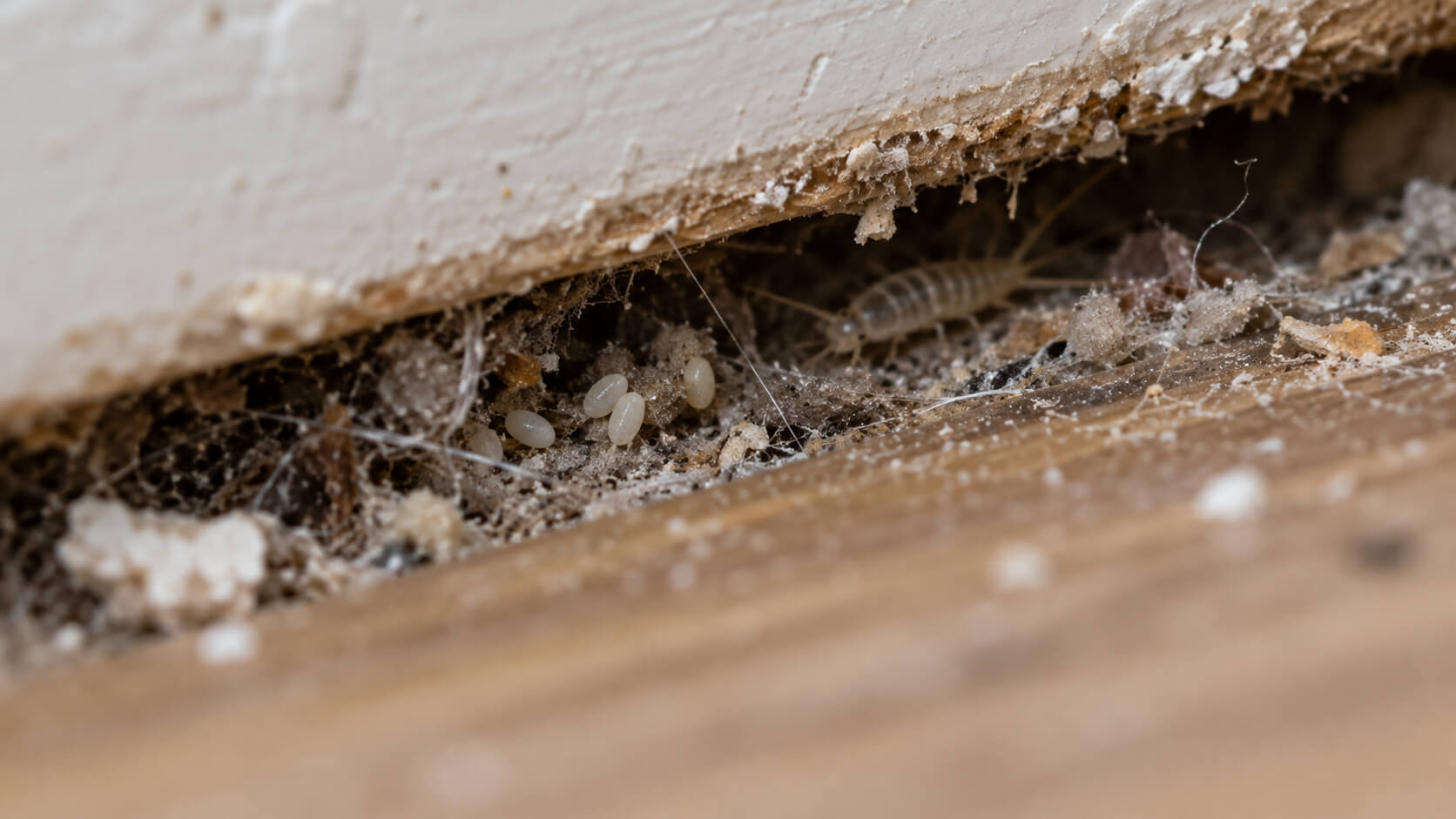
Silverfish eggs are tiny, pale eggs laid in protected cracks, gaps and other concealed areas. After hatching, young silverfish pass through a series of immature stages as they gradually develop the elongated body and silvery appearance associated with adults.
This guide explains what silverfish eggs look like, where they may be found, what people mean when searching for silverfish larvae, and how the silverfish life cycle develops from egg to adult.
Recently booked jobs


What Do Silverfish Eggs Look Like?
Silverfish eggs are tiny, pale and easy to overlook because they are usually laid in concealed places. Newly laid eggs are typically white or very pale and may become darker as they develop.
Because of their small size and pale colour, silverfish eggs can be difficult to identify with confidence on appearance alone. Their shape and colour should be considered alongside nearby evidence of silverfish activity, particularly the presence of young or adult insects in the same sheltered area.
Where Do Silverfish Lay Their Eggs?
Female silverfish lay their eggs in protected locations where they can remain relatively undisturbed. Cracks, crevices, gaps around skirting boards and other narrow sheltered spaces are typical examples.
Egg development does not follow one fixed timetable. Hatching may take roughly two to eight weeks, with temperature and humidity influencing how quickly the eggs develop.
Where Might Silverfish Eggs Be Found Indoors?
Silverfish eggs may be found wherever suitable concealed spaces are available. Possible locations include gaps near walls and skirting boards, cupboards, stored papers, cardboard, fabrics and other protected indoor areas.
Searches for silverfish eggs in beds, on clothes or on walls do not mean that exposed surfaces are preferred egg-laying sites. Nearby seams, folds, cracks and protected gaps are more likely places for eggs to remain hidden.
Do Silverfish Have Larvae?
People often search for “silverfish larvae”, but silverfish do not pass through a caterpillar-like larval stage or a pupal stage. Their development is gradual, with newly hatched silverfish already resembling small versions of the adult.
Searches for silverfish eggs and larvae usually refer to the eggs and the pale immature silverfish that hatch from them. These young stages are more accurately described as nymphs or immature silverfish and develop through repeated moults.
What Do Young Silverfish Look Like?
Newly hatched silverfish are very small and pale or whitish. As they grow and moult, they develop more of the scales and grey-silver appearance associated with mature insects, while retaining the same recognisable elongated body shape.
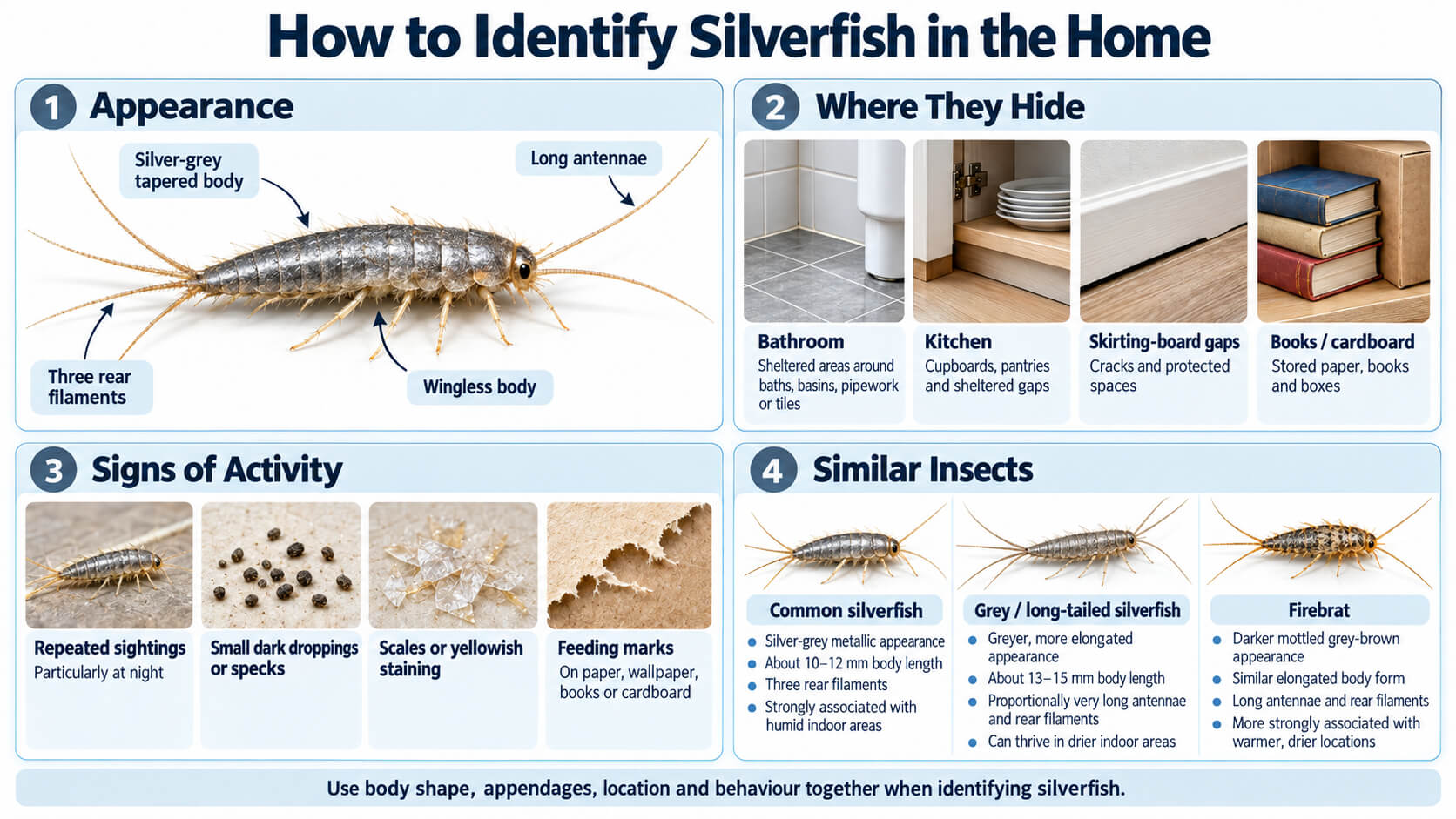
For the features used to recognise mature insects and distinguish them from common household lookalikes, see our guide to identifying silverfish in the home.
What Is the Silverfish Life Cycle?
The silverfish life cycle progresses from egg to immature silverfish and then to a sexually mature adult. There is no pupal stage between the young and adult forms, and silverfish continue developing through repeated moults.
This gradual type of development means that the main differences between young and mature silverfish are their size, colour, scale development and sexual maturity rather than a complete change in body form.
The stages below show how silverfish change in appearance as they develop from a concealed egg into a mature adult.
| Life Stage | What to Look For |
|---|---|
| Egg | Tiny and pale when newly laid, usually hidden in a protected crack or gap. |
| Young nymph | Very small, pale and already similar in body shape to an adult silverfish. |
| Later immature stage | Larger after successive moults, with scales and colour becoming more developed. |
| Adult | Sexually mature and fully scaled; adults can continue moulting after maturity. |
The change from young silverfish to adult is gradual rather than a dramatic metamorphosis. Each successive moult produces a larger and more developed insect until sexual maturity is reached.
From Egg to Young Silverfish
After an egg hatches, the young silverfish begins a series of moults. Early nymphs are pale and lack the fully developed scales seen on adults. With successive moults, they become larger and increasingly similar in appearance to mature silverfish.
The earliest immature stages can therefore be easy to miss, especially when they remain inside narrow cracks and sheltered gaps. Their pale appearance gradually changes through successive moults as the body becomes larger and more fully scaled.
How Do Silverfish Grow and Moult?
Immature silverfish moult repeatedly as they grow, and adults can continue moulting throughout their lives. This differs from many familiar household insects that stop moulting once they reach adulthood.
Each moult allows further growth and development of the body covering. Because silverfish can continue moulting as adults, finding shed material does not by itself indicate that only young silverfish are present.
How Do Silverfish Reproduce?
Silverfish reproduce sexually, with females laying eggs in concealed locations after courtship and sperm transfer. Egg production and development can vary with environmental conditions, including temperature, humidity and the availability of suitable shelter.
Once eggs are laid, successful development depends on the surrounding conditions remaining suitable. Sheltered locations help protect the eggs while temperature and humidity influence how quickly development proceeds.
How Long Do Silverfish Live?
The silverfish lifespan can extend for several years under suitable conditions. Authoritative extension guidance describes lifespans of roughly two to four years, although development and longevity vary with environmental conditions. Reaching maturity can take months or considerably longer when conditions are less favourable.
Several silverfish life stages can therefore be present in the same property at the same time. Their relatively long lifespan, gradual development and continued moulting after maturity can allow young and adult silverfish to overlap.
Sources: Oxford City Council - Silverfish; University of Florida IFAS - Silverfish Life Stages and Biology; University of California IPM - Silverfish and Firebrats; Penn State Extension - Silverfish and Firebrats.
Frequently Asked Questions


Silverfish eggs can potentially occur near beds when concealed cracks, seams or gaps provide suitable shelter. The exposed sleeping surface itself is not the important factor; protected spaces around the bed, skirting boards or nearby stored materials are more plausible places for eggs to remain hidden.
Silverfish eggs are tiny and pale, but appearance alone may not be enough for confident identification. Their small size and light colour make them easy to confuse with other particles, so nearby silverfish activity and the location where the object was found provide useful additional context.
Silverfish eggs may occur near clothes or walls when protected folds, seams, cracks or gaps are available. They are more likely to remain concealed than to be laid openly on an exposed fabric or wall surface.
No, silverfish eggs and the immature insects that hatch from them are different life stages. “Silverfish larvae” is a common search term, but young silverfish are more accurately described as nymphs or immature silverfish because they develop gradually without a caterpillar-like larval or pupal stage.