


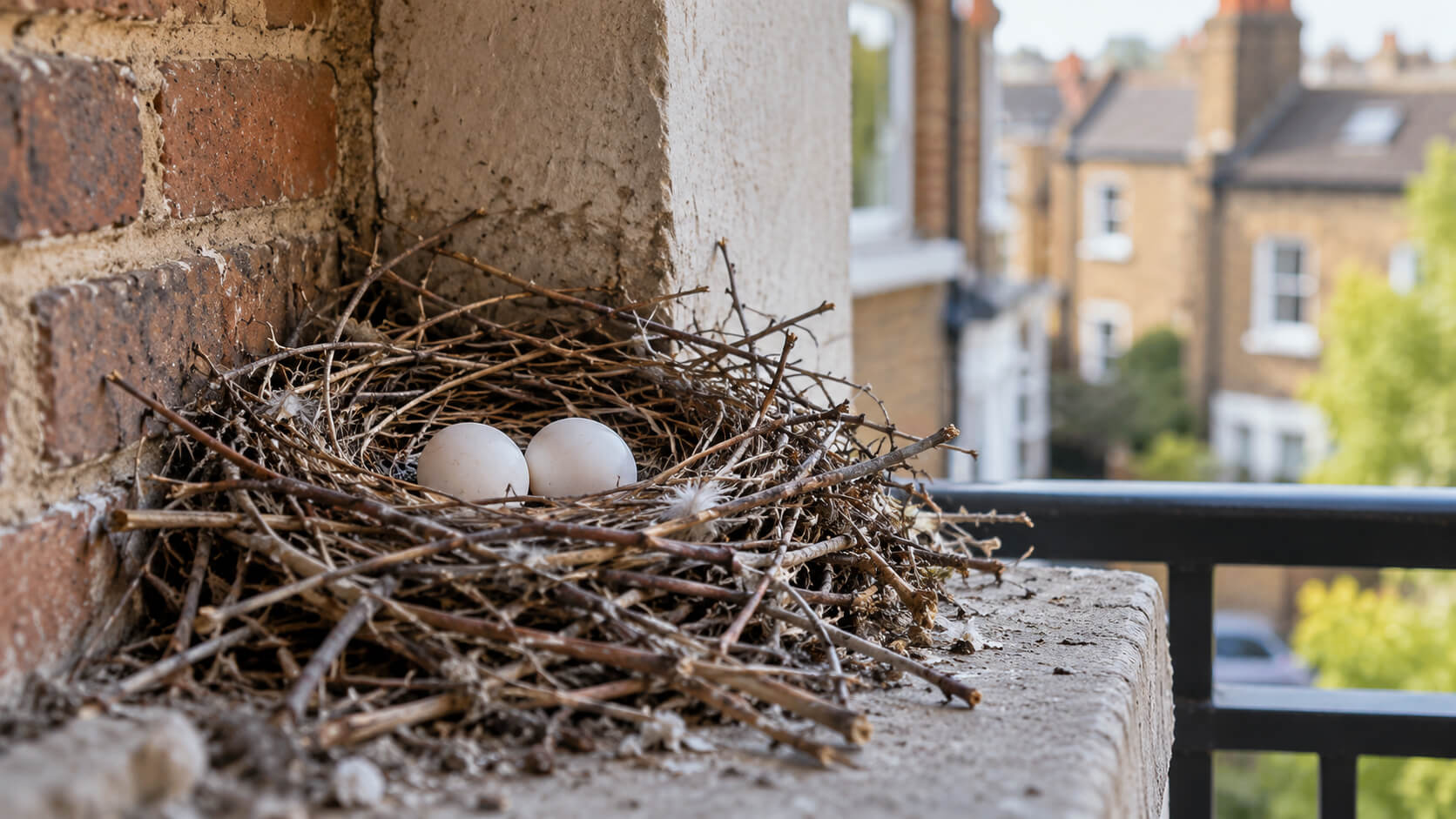
A pigeon nest is usually a loose, fairly flat platform of twigs and other plant material built in a sheltered or elevated place. Pigeons commonly lay two eggs, and the nest may remain occupied while the eggs are incubated and the young pigeons develop.
This guide covers pigeon nest identification, eggs, hatching, nesting season and early pigeon development.
Recently booked jobs

Pigeon Nest Appearance and Locations
Pigeon nests are usually simple platforms built in raised or sheltered places, and both their appearance and location can help with identification. The sections below explain what a pigeon nest looks like, where pigeons commonly build their nests and how roof, loft and eaves locations fit within pigeon nesting behaviour.
What Does a Pigeon Nest Look Like?
A pigeon nest is usually a simple, fairly flat platform made from loose twigs, sticks, leaves and other plant material. It can look much less structured than the deep cup-shaped nests associated with many smaller garden birds. As a nest is reused or occupied, additional material may accumulate around it.
The appearance alone is not always enough to identify the bird. Adult pigeons returning repeatedly to the same sheltered point, especially when combined with eggs or chicks, provide stronger evidence that the structure is an active pigeon nest.
Where Do Pigeons Build Their Nests?
Pigeons favour raised or sheltered nesting places that provide a stable platform. In built-up areas they may make a pigeon nest on a balcony, ledge or protected opening in a building, while a pigeon nest in a garden may be found in a tree or dense vegetation. Nests can therefore appear in both urban and greener residential settings.
The species using the nest can affect where it is found. If you are trying to identify the adult bird as well as the nest, see our guide to the types of pigeons in the UK.
Do Pigeons Nest in Roofs, Lofts and Eaves?
Yes. Pigeons can nest in roofs and other sheltered parts of buildings when they can access a stable, protected place for the nest. A pigeon nest in or around a roof may be found within a roof space, loft, eaves, soffits or another sheltered opening, while pigeons may also nest on protected parts of a roof or building ledge.
The location alone does not confirm that the nest belongs to a pigeon. Repeated adult pigeon activity around the same access point, together with nesting material, eggs or chicks, provides stronger evidence. Roof access can also vary between buildings, so a nest may be visible near the eaves or remain partly concealed within the roof structure.
Pigeon Eggs, Hatching and Nesting Season
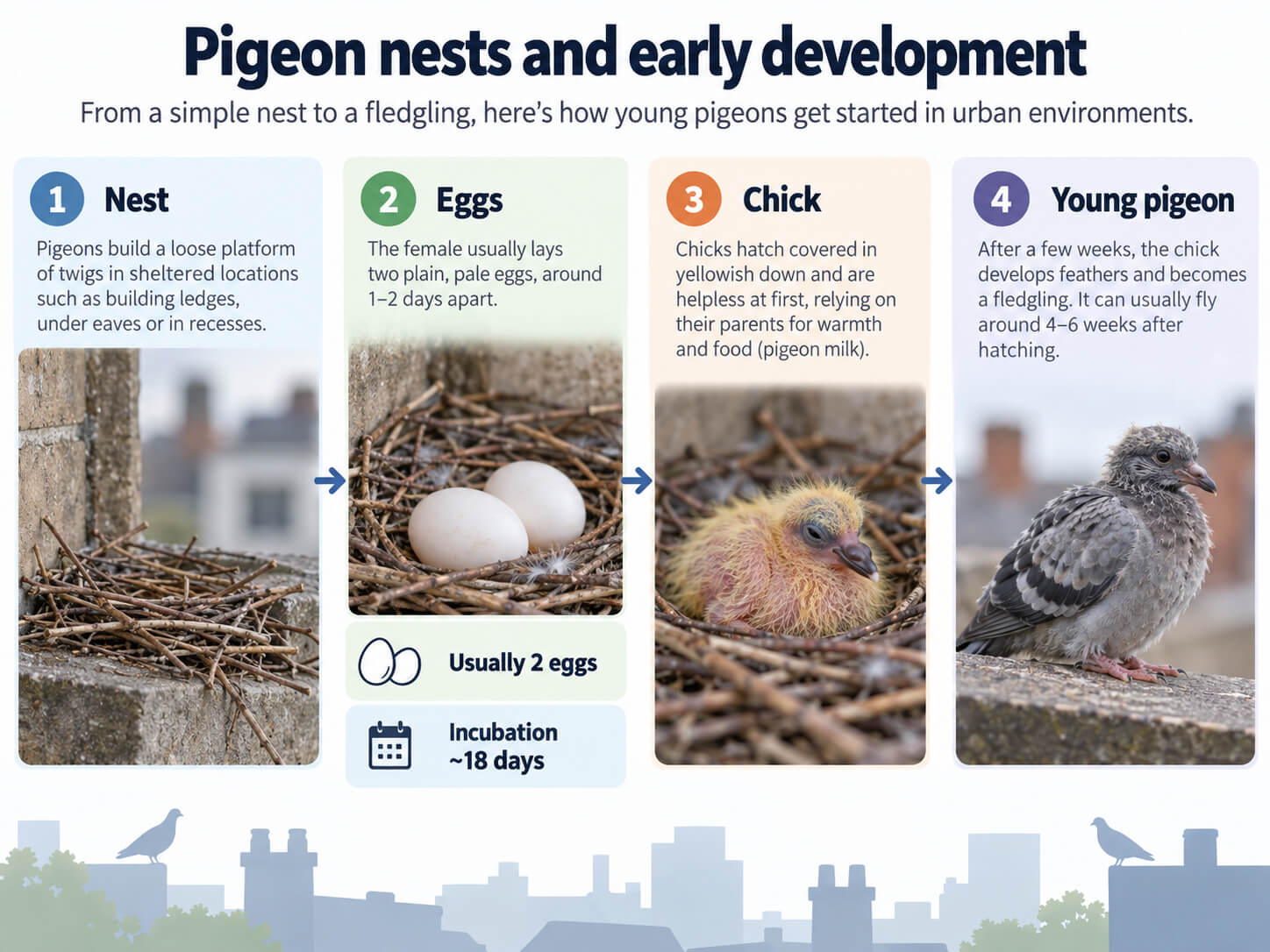
Pigeon eggs, incubation and nesting season are closely connected parts of the breeding cycle. Pigeons commonly lay two pale eggs, incubation typically lasts around 17 to 18 days depending on species, and breeding can extend beyond a short fixed season.
What Do Pigeon Eggs Look Like?
Pigeon eggs are generally plain and pale, with pigeons commonly laying two eggs in a nest. Woodpigeon eggs are pure white without markings. The Woodland Trust records typical woodpigeon eggs at approximately 4.1 × 2.9 cm, while BTO data also gives a typical measurement of 41 × 29 mm.
Size and appearance can vary between species, so an eggshell on its own should not automatically be treated as proof of a particular pigeon species.
How Long Do Pigeon Eggs Take to Hatch?
The pigeon egg incubation period is typically around 18 days before hatching. Both parents can take part in incubation. The RSPCA notes that pigeons usually lay two eggs, with the second commonly following within 24 to 48 hours of the first.
For woodpigeons specifically, BTO nest-recording data gives a typical hatching time of about 17 days, showing why timing can vary slightly between species.
When Is Pigeon Nesting Season in the UK?
Pigeons commonly breed during spring and summer, although nesting is not restricted to a short fixed season. Urban pigeons may breed throughout the year where food and suitable nesting sites remain available.
Wood Pigeon Nests and Eggs
A woodpigeon nest is typically a loose platform of large twigs and sticks, often positioned in the fork of a tree. The construction can be sparse enough for light to pass through it. Woodpigeons normally lay two smooth white eggs.
The wood pigeon nesting season can extend over a particularly long part of the year. Woodpigeons may nest outside the months normally associated with the main UK bird-nesting season, so calendar dates alone should not be used to decide whether a nest is active.
What Should You Do if You Find an Active Pigeon Nest?
A nest containing eggs or young should not simply be moved or destroyed. In England and Wales, the Wildlife and Countryside Act 1981 makes it an offence, subject to the Act’s exceptions and licensing provisions, to intentionally take, damage or destroy the nest of a wild bird while it is in use or being built, or to take or destroy its eggs.
Wildlife law differs in detail across UK jurisdictions, so the legal position should be checked for the location and circumstances before any action is taken around an active nest.
Pigeon Chicks, Young Pigeons and the Life Cycle
Pigeon development continues from egg to chick, fledgling and eventually adult bird. Young pigeons remain closely associated with the nest during their early development, while terms such as squab, fledgling and life cycle describe different stages of growth rather than how many years a pigeon lives.
Pigeon Chicks and Young Pigeons
A young pigeon is commonly referred to as a squab. Both parents help rear the chicks, including feeding them a nutrient-rich secretion often called crop milk during the earliest stage of development.
Young pigeons spend much of their earliest development around the nest, which is one reason they are seen less frequently than adult pigeons.
The Pigeon Life Cycle
The pigeon life cycle progresses from egg to chick, then to a young fledgling and eventually an adult bird. These stages describe pigeon development from hatching through to maturity.
This page covers developmental stages only; lifespan and how many years pigeons live belong to the separate lifespan topic.
Frequently Asked Questions


A young pigeon is commonly called a squab, while an older young bird that has left or is preparing to leave the nest is described as a fledgling. The term “young pigeon” is also widely used in everyday language.
You should not assume that an active pigeon nest can legally be moved. In England and Wales, wild-bird nests are protected while they are in use or being built, and eggs are also protected. Check the law and any applicable licensing requirements before taking action.
Destroying an active wild-bird nest can be an offence. Under the Wildlife and Countryside Act 1981, the protection applies to nests while they are in use or being built in England and Wales, subject to statutory exceptions and licensing provisions.
Pigeons can return repeatedly to the same nesting area. The RSPCA notes that they often reuse the same nesting spot, particularly where a location continues to provide shelter and access to food.
Yes. Balconies are among the sheltered raised locations pigeons may use for nesting in towns and cities. Other building sites can include ledges and openings that provide a stable, protected platform.