


Recognising Pigeon Droppings and When They Matter
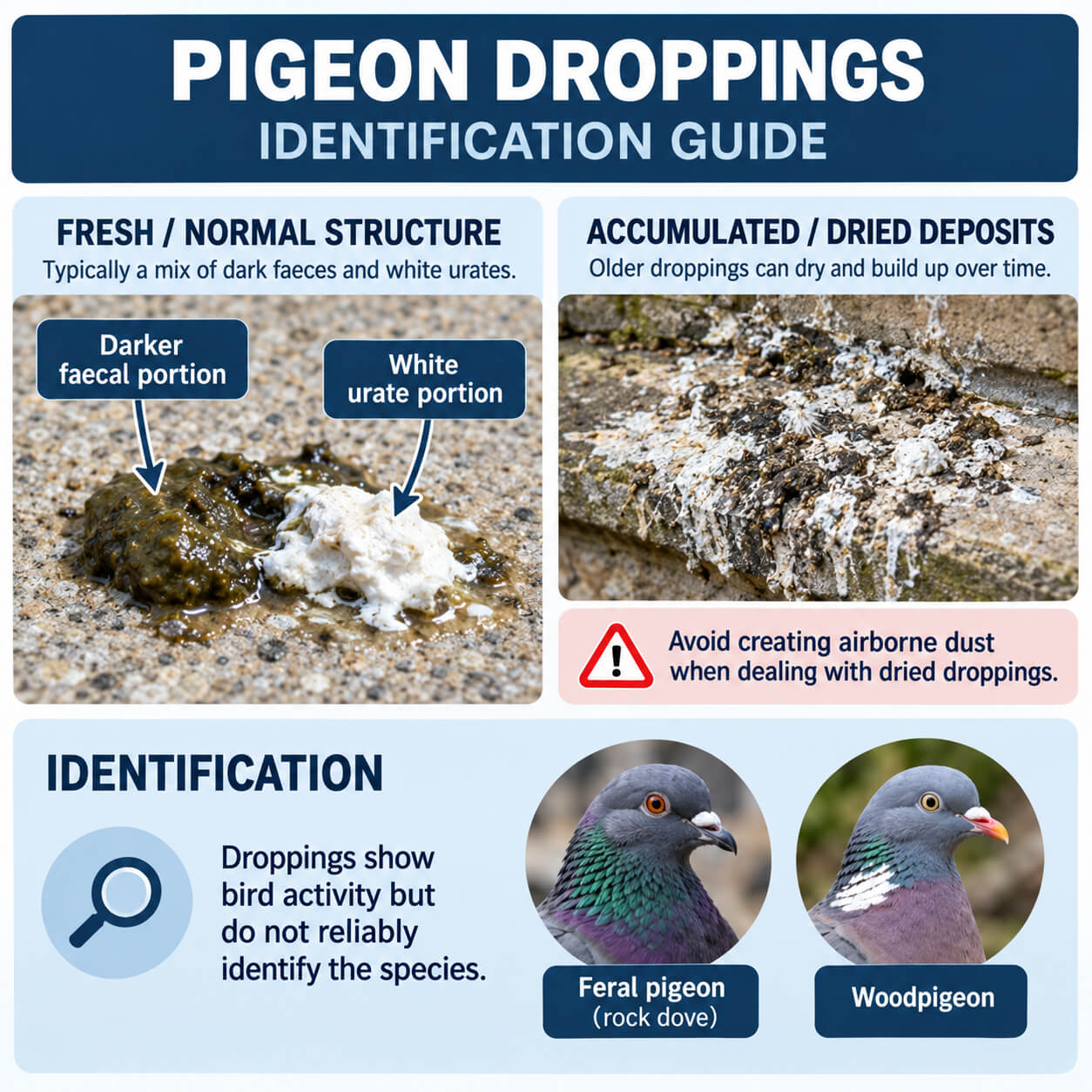
Pigeon droppings usually contain a darker greenish or brown faecal part together with a white urate portion. A small amount of pigeon poop does not automatically mean there is a serious health risk, but larger accumulations of dried bird droppings can require more care if dust or contaminated droplets may become airborne.
This guide explains identification, documented health risks and when pigeon droppings deserve greater caution.
Pigeon Droppings at a Glance
- Appearance: usually a darker faecal portion with a white urate section
- Identification: droppings alone may not reliably identify the exact pigeon species
- Health risk: exposure becomes more relevant where substantial dried droppings have accumulated
- Airborne dust: disturbing dried deposits can increase exposure to contaminated particles
- High-pressure washing: HSE guidance warns against methods that create contaminated airborne droplets



Who will come to my home?
A certified pest control technician from our vetted network, on the day and time you choose. You get a confirmation by email as soon as you book.
Is the treatment safe for children and pets?
Yes. Technicians use HSE-approved products and methods: tamper-resistant bait stations for rodents, and sprays or gels that are safe for children and pets once dry. You are told before the visit if a room needs to stay clear for a few hours.
What if the pests come back?
Follow-up visits are included where the treatment lists them, so if activity continues after the first visit, the next one is already covered at no extra charge. The price you see is the full price for the whole treatment cycle.
Do I need to prepare anything or be at home?
Someone needs to be at the property to let the technician in. Preparation is minimal and depends on the pest; the technician confirms anything needed by SMS and email after you book.
Do I pay now?
No. You see the price, then pick a date and time. Payment is only confirmed at checkout, and cancellation is free.
Is the £50 inspection fee deducted from the treatment?
Yes. If you are not sure what the pest is, you can book a £50 inspection visit. The technician identifies the pest and quotes the treatment on site, and if you go ahead the £50 is deducted from that treatment price.
Recently booked jobs

Pigeon Droppings: Appearance and Identification
Pigeon droppings can vary in colour, consistency and appearance, but they usually contain both a darker faecal portion and pale or white urates. Their appearance can help confirm bird activity, although droppings alone are not always reliable for identifying a particular pigeon species.
What Does Pigeon Poop Look Like?
Normal pigeon droppings typically contain a semi-solid greenish or brown faecal portion together with a white urate portion. Birds excrete urates as part of their waste, which explains the familiar white material seen alongside the darker part of the dropping.
Colour and consistency can vary, so a single dropping should not be used to diagnose the health of a bird or confidently identify a particular pigeon species. Repeated droppings around a ledge, balcony or regular roosting point are more useful as evidence of ongoing bird activity.
If you need to identify the bird rather than the droppings, use our guide to common UK pigeons.
Wood Pigeon Droppings: Appearance and Identification
Wood pigeon droppings have the same basic avian waste components: a darker faecal portion and pale or white urates. Appearance can change with diet, hydration and other factors, so droppings alone are not a reliable way to distinguish a woodpigeon from a feral pigeon.
Where species identification matters, visible features of the bird such as body size, neck markings and wing pattern provide much stronger clues than the appearance of a dropping.
Pigeon Droppings and Health Risks
Pigeon droppings can present different levels of health risk depending on the amount of contamination, whether the material is dry and whether it is disturbed. The sections below explain the main exposure concerns, the infections associated with contaminated droppings and the situations in which greater care may be needed.
Is Pigeon Poop Toxic or Dangerous to Humans?
Pigeon poop is not best described as inherently “toxic”, but contaminated bird droppings can present a health risk in some circumstances. The HSE identifies inhalation of dust or water droplets containing contaminated bird droppings as a possible route of exposure to microorganisms that can cause illness.
The level of risk depends heavily on the circumstances. HSE guidance highlights work involving significant contamination, such as refurbishment, maintenance or demolition, rather than suggesting that every small pigeon dropping creates the same level of danger.
Diseases Associated With Pigeon Droppings
UK health guidance identifies psittacosis and Salmonella among the infections that can be associated with contaminated bird droppings. Psittacosis is caused by the bacterium Chlamydia psittaci and can affect pigeons as well as other birds.
The UK Health Security Agency states that human infection with psittacosis occurs mainly through inhalation of infected respiratory particles or dust contaminated with bird faeces or respiratory secretions. Human cases are uncommon, but infection can cause a respiratory illness and, in some cases, pneumonia.
Risks From Disturbing Dried Pigeon Droppings
Dried pigeon droppings become more relevant from an exposure perspective when they are disturbed and contaminated material becomes airborne. This is why HSE guidance focuses on preventing dust and aerosols during work involving accumulated bird droppings.
HSE specifically advises against high-pressure washing in these circumstances because it can create contaminated airborne droplets. Its occupational guidance also emphasises hygiene, appropriate protective clothing and respiratory protection where work may generate dust or aerosols.
When Pigeon Droppings Pose a Greater Health Risk
The health risk from pigeon droppings is greater when large amounts of dried material are accumulated in an enclosed or frequently disturbed area. HSE identifies significant contamination and activities capable of generating dust or aerosols as the more important exposure scenarios.
People with weakened immune systems require particular care: HSE occupational guidance states that they should not directly undertake tasks involving bird droppings. Anyone who becomes unwell after relevant bird or droppings exposure should seek appropriate medical advice rather than trying to diagnose the illness from the droppings themselves.
Large Accumulations of Pigeon Droppings
A substantial build-up of dried pigeon droppings should not be disturbed in a way that sends dust or contaminated droplets into the air. HSE guidance for contaminated work areas focuses on controlling exposure rather than simply treating the material like ordinary household dirt.
This page does not provide a step-by-step pigeon-dropping cleaning procedure. The appropriate approach depends on the amount of contamination, where it is located and whether the work could generate airborne material.
Frequently Asked Questions


The white part is mainly urate, a form in which birds excrete nitrogenous waste. It is passed alongside the darker faecal material, which is why pigeon droppings usually contain both pale and darker components.
It is normally called pigeon droppings or bird droppings. The word “guano” is also used in health and workplace guidance when referring to accumulated bird droppings.
Yes, contaminated bird droppings can be involved in transmission of psittacosis. UKHSA states that infection can occur through inhaling dust contaminated with faeces or respiratory secretions from infected birds.
Dried accumulated droppings can create an exposure issue when they are disturbed and generate contaminated dust. This is why HSE guidance focuses on preventing airborne dust and aerosols during work involving bird droppings.
Droppings alone are not a reliable way to identify a woodpigeon. Pigeon droppings share the same basic faecal and urate components, while the bird’s size, neck markings and wing pattern provide more useful species-identification clues.