


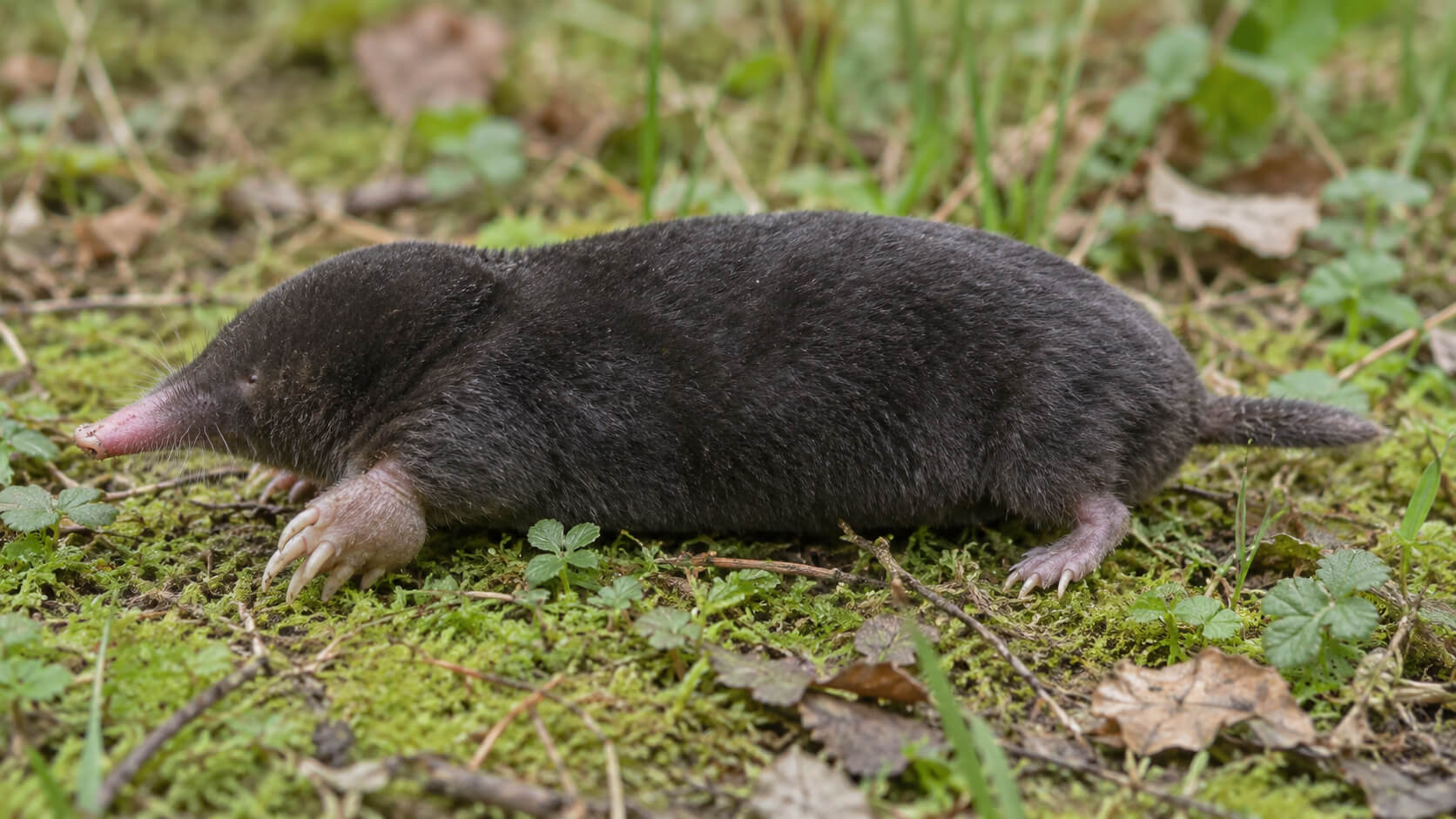
Moles in the UK are found across mainland Britain, where the mole species is the European mole (Talpa europaea); it is not present in Ireland.
This guide explains how British moles are identified, how big they grow, where they live, how long they survive and when they breed.
Recently booked jobs


What Mole Species Lives in the UK?
The mole species found across mainland Britain is the European mole (Talpa europaea). It is Britain's familiar burrowing mole and the animal responsible for the molehills and underground tunnel systems seen across many rural and residential landscapes.
The European mole is adapted almost completely to life below ground. Its compact cylindrical body, powerful forelimbs and sensitive snout allow it to move through soil efficiently, while its dense fur can lie in different directions as the animal travels backwards or forwards through narrow tunnels.
Is the European Mole the British Mole?
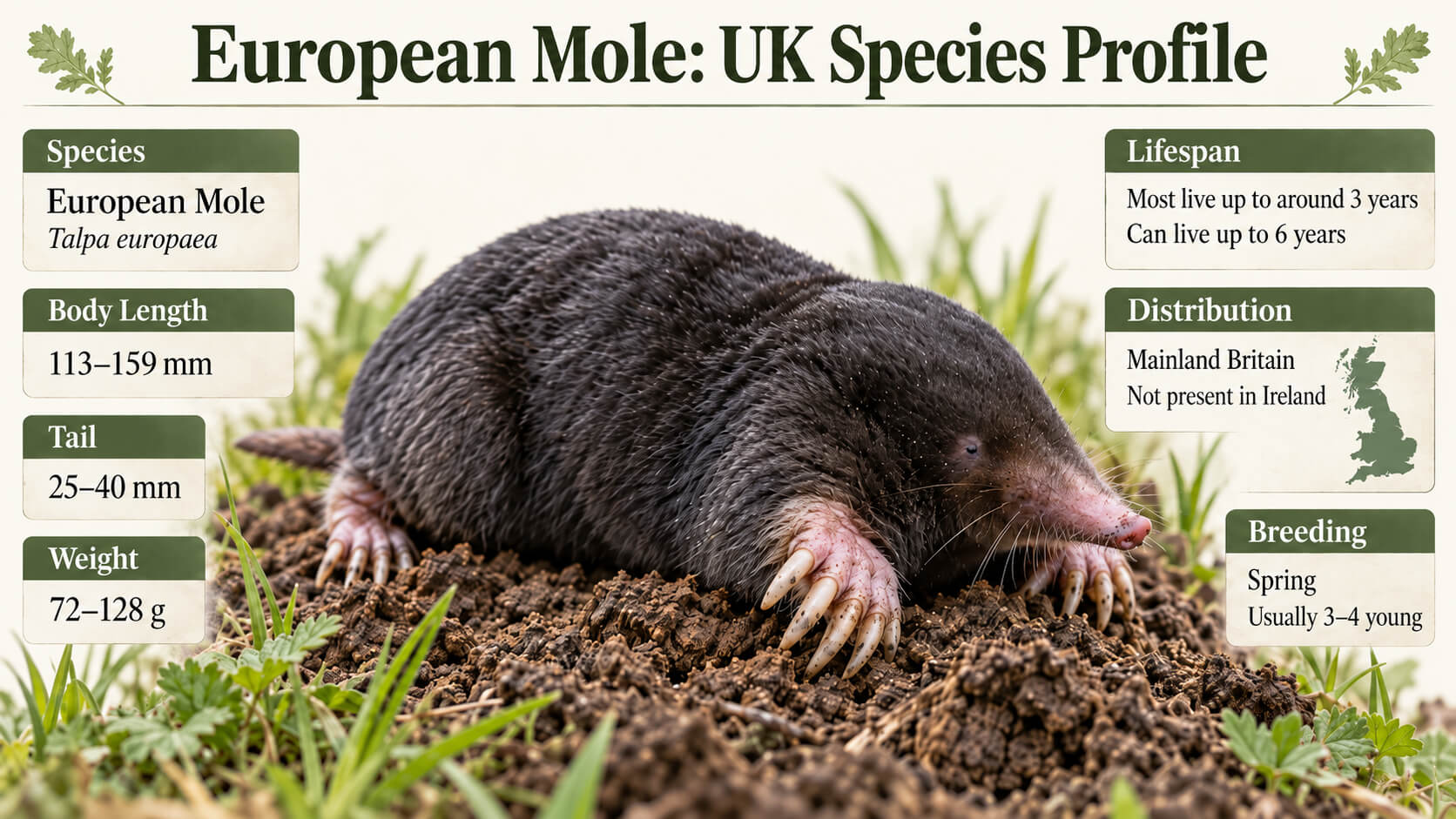
Yes. When people refer to a British mole, they are normally referring to the European mole. Its scientific name is Talpa europaea, and it is widespread across mainland Britain. European moles are not present in Ireland, so their UK distribution does not extend into Northern Ireland.
The term “British mole” is therefore a common descriptive name rather than a separate species. The same European mole occurs more widely across parts of continental Europe.
What Does a European Mole Look Like?
European moles have short velvety dark fur, a pointed pink snout, very small eyes and broad spade-like front feet. The forefeet are particularly distinctive because they are enlarged for digging and carry strong claws.
The ears are not externally visible, helping give the head a smooth profile. The tail is short, while the body itself is compact and cylindrical. These features make the European mole highly specialised for a subterranean lifestyle rather than regular movement above ground.
How Big Are Moles in the UK?
Adult European moles in Britain typically measure about 113–159 mm in body length. Their relatively small size can be surprising given the amount of soil disturbance one animal can create while maintaining an underground tunnel system.
Body size varies between individuals, and males are generally larger than females. The tail adds roughly another 25–40 mm.
What Size and Weight Is a European Mole?
European moles typically weigh around 72–128 g. Their build is dominated by the shoulders and broad front limbs, which provide the strength needed to push through compact soil.
Size alone is not normally how a mole is identified in the field because the animal itself is rarely seen. The combination of dark velvety fur, a pointed fleshy snout, tiny eyes and unusually broad digging forefeet provides a much stronger identification profile.
Where Are Moles Found in the UK?
European moles are widespread throughout mainland Britain but are not present in Ireland. They occur wherever suitable soil and underground prey make tunnelling possible, although their distribution is not completely uniform across every habitat.
This distinction matters when discussing “moles in the UK”: they occur widely in England, Scotland and Wales, but not in Northern Ireland.
What Habitats Do European Moles Live In?
European moles occur in gardens, grassland, mixed woodland, farmland, upland areas and other places where soil is deep enough for tunnelling. They are less common where ground conditions or food availability make underground life unsuitable.
Gardens can provide useful habitat where soil supports earthworms and other invertebrates. If you are trying to understand how to identify mole activity in a garden, molehills, raised ridges and disturbed ground are normally more useful than trying to see the animal itself.
Most of a mole's life is spent beneath the surface in permanent and semi-permanent tunnels, so its geographical presence is often recognised through field signs rather than direct sightings.
How Long Do Moles Live?
Most European moles do not live beyond about three years, although individuals can survive for as long as six years. Survival is affected by predation, accidents and human activity, especially when moles travel above ground.
Their solitary and territorial lifestyle means that adults usually occupy their own tunnel systems outside the breeding season. A long-used network may nevertheless be occupied by different moles over time.
When Do Moles Breed?
European moles breed in spring. During the breeding period, males extend their normal ranges while searching for females. Females raise their young in nest chambers within the tunnel system.
A typical litter contains three or four young. The pups are born without fur, begin growing fur after about two weeks and are weaned at around four to five weeks. They begin leaving the nest soon afterwards and normally disperse from their mother's range at roughly five to six weeks of age.
Young moles become sexually mature by the following spring, beginning the next generation of Britain's European mole population.
Frequently Asked Questions


Moles do not have specific species protection in the UK. However, animal-welfare legislation still applies, so their lack of specific protected status should not be interpreted as allowing any method of control or treatment.
Yes, the European mole (Talpa europaea) is a native British mammal. It is widespread across mainland Britain and is adapted to living mainly underground in habitats where suitable soil and prey are available.
No, European moles are not present in Northern Ireland. They occur throughout mainland Britain but are absent from Ireland, so their UK distribution is limited to Great Britain.
European moles are widespread across mainland Britain. They occur in many suitable habitats, including grassland, farmland, woodland and gardens, although exact abundance can be difficult to judge because most of their lives are spent underground.