


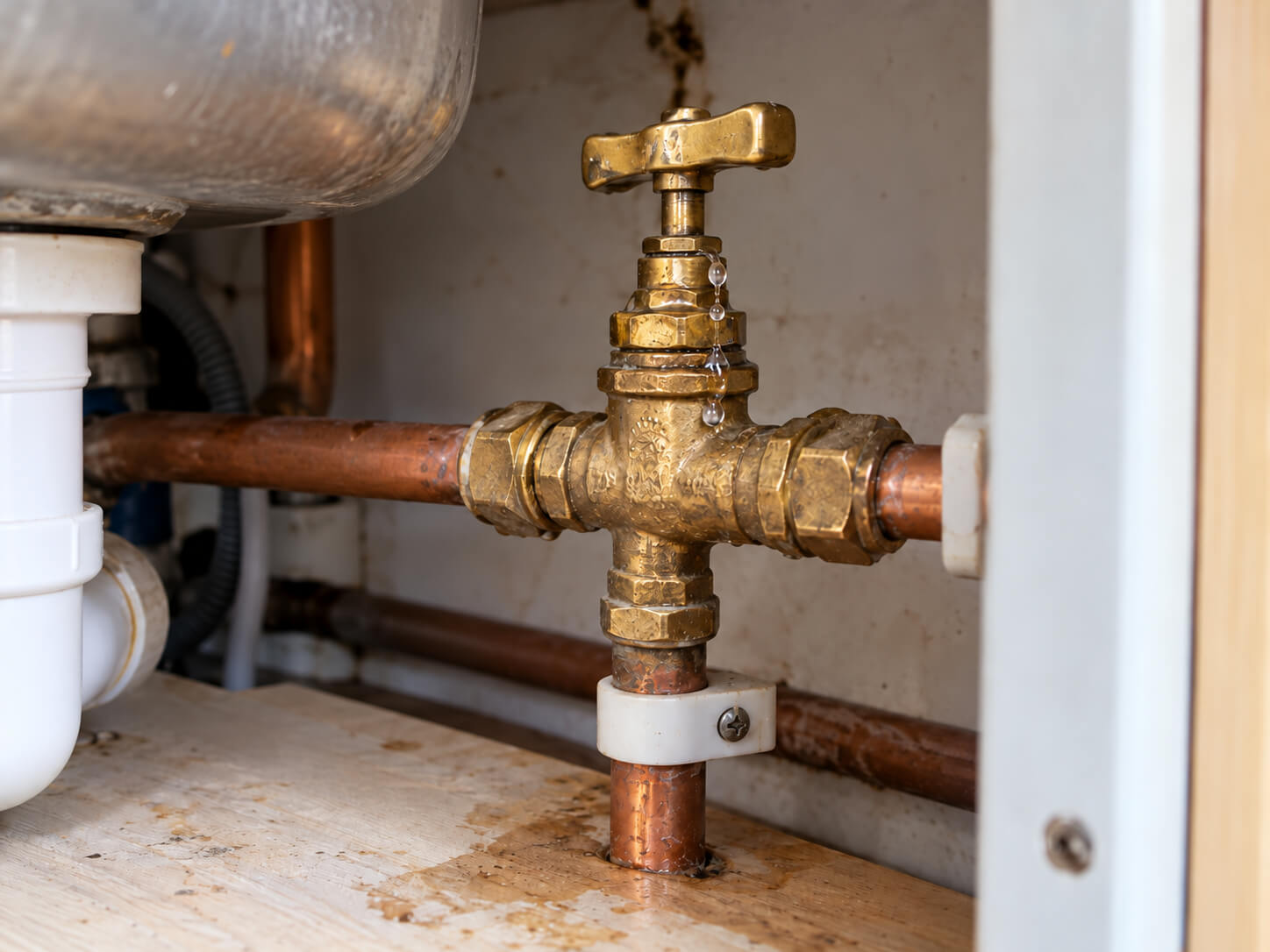
A leaking stopcock usually means water is escaping from the spindle, gland nut, valve body or a connection beside the valve. A stopcock can also become stiff or seized, or turn without fully shutting off the incoming water supply.
This guide explains how to identify where the leak is starting, what different stopcock faults can indicate, and which checks can be made safely without forcing the valve or dismantling pressurised pipework.
Recently booked jobs



Why Is My Stopcock Leaking?
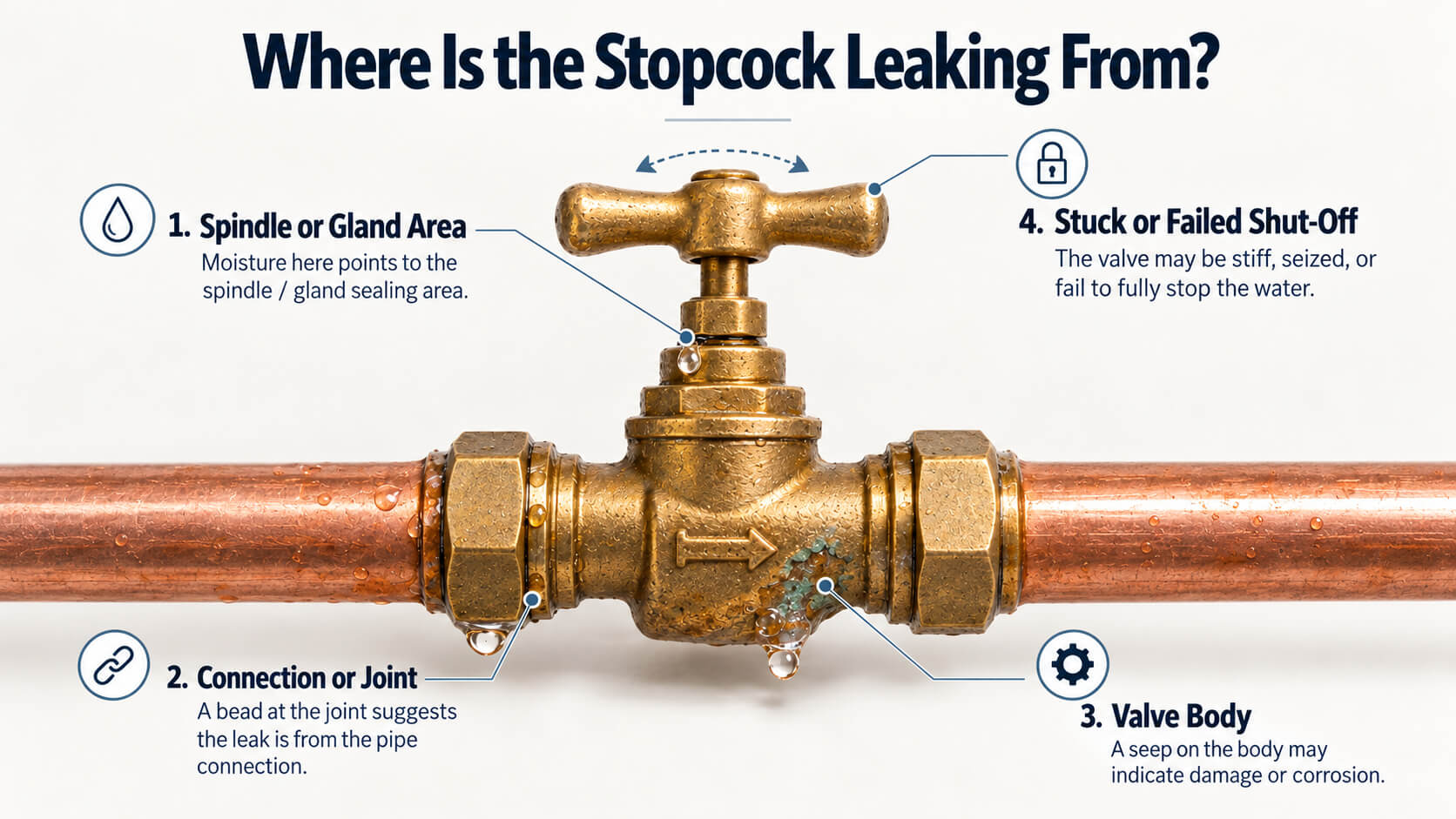
A leaking stopcock usually means water is escaping from the spindle, gland area, valve body or one of the connections immediately beside the valve. The first useful check is to dry the stopcock and nearby pipework, then watch for the first point where fresh moisture appears.
Where the water starts matters more than where it eventually drips or collects. A small leak can travel along the valve or pipe before falling, so moisture underneath the stopcock does not always mean the bottom connection is the source.
Water Leaking From the Spindle or Gland Nut
If water appears around the spindle where the handle enters the stopcock, the gland area is a likely source. The seal around the spindle can deteriorate with age or begin to weep after the valve has been operated, particularly if the stopcock has not been turned for a long time.
A stop tap leaking from the handle or spindle may only produce a small amount of water at first. Dry the area and check whether fresh moisture forms around the spindle while the valve is stationary or while it is being turned. Do not force the handle or overtighten the gland area if the valve feels stiff or corroded.
Water Leaking From a Connection Beside the Stopcock
If fresh water first appears around a nut or pipe connection next to the stopcock, the leak may be coming from the connection rather than from the valve mechanism itself. Compression joints and seals can begin to weep, and water can then run along the pipe or valve body before dripping lower down.
Check both sides of the stopcock carefully after drying them. If the first moisture clearly appears farther along the pipe rather than at the stopcock connection, the problem may belong to the surrounding pipework rather than the valve itself.
Water Leaking From the Valve Body
Water appearing directly from the body of the stopcock can indicate deterioration, corrosion or damage to the valve itself. This is different from a small leak around the spindle or a nearby connection because the body of the fitting may no longer be sound.
Do not try to compensate for a damaged valve body by applying extra force to the handle or surrounding fittings. If the metal appears heavily corroded, cracked or weakened, avoid disturbing it unnecessarily because movement can make an existing leak worse.
What If the Stopcock Is Stuck or Won't Turn?
A stuck stopcock may have seized because it has not been operated for a long time, or because corrosion and wear are restricting the mechanism. A valve that is unusually stiff, completely jammed or difficult to move should not be forced.
Use only normal hand pressure when checking whether the stopcock moves. Excessive force can damage the handle, spindle or valve body, especially on an older fitting. If the stopcock is seized, the important diagnosis is that reliable isolation of the incoming water supply may no longer be available when it is needed.
What If the Stopcock Turns but Does Not Shut the Water Off?
If the stopcock turns normally but the water continues to flow, the fault may be inside the valve rather than with the handle itself. Wear to the washer or internal mechanism can prevent the valve from closing properly even though the spindle still moves.
Do not keep tightening the stopcock harder in an attempt to force a complete shut-off. Close it using normal pressure and check a cold tap to see whether the incoming supply reduces and stops. If water continues to flow normally, the stopcock may no longer be isolating the supply effectively.
A stopcock that will not shut the water off is particularly important to identify before another plumbing problem occurs, because the valve is intended to provide a way to isolate the incoming supply.
What Can You Check Safely?
Safe checks should focus on locating the first fresh moisture, observing how the stopcock behaves and avoiding unnecessary force. You do not need to dismantle the valve to establish whether the problem is around the spindle, a connection, the valve body or the shut-off mechanism.
- Dry the valve and nearby pipework before looking for fresh water
- Check the spindle, gland area, valve body and both nearby connections
- Notice whether the leak appears when the stopcock is open, closed or being turned
- Check whether the handle moves with normal pressure without forcing it
- Confirm whether closing the stopcock actually reduces and stops the incoming water
- Avoid disturbing badly corroded, cracked or fragile-looking fittings
If the valve you are checking is outside the property boundary or near the water meter, do not assume it is the same as the internal household stopcock. External stop taps may be controlled by the local water supplier and can have different responsibility and access rules.
Frequently Asked Questions About a Leaking Stopcock


A leaking stopcock is not always an immediate emergency, but it should not be ignored. The stopcock controls the incoming water supply, so a worsening leak, visible damage or a valve that no longer shuts the water off can become more serious. If water is escaping rapidly or cannot be controlled, the situation needs urgent attention.
A stopcock can still leak when closed if water is escaping around the spindle, gland seal, valve body or a nearby connection. Closing the valve reduces or stops water passing through it, but it does not necessarily remove pressure from every part of the fitting. Dry the area first and check where fresh moisture appears.
A stopcock that leaks while open may have a worn seal around the spindle or gland area, or a problem at one of the valve connections. The leak can sometimes become more noticeable after the valve has been moved. Avoid forcing or repeatedly operating a stiff stopcock while trying to identify the source.
Condensation usually forms as a light film of moisture over a cold pipe or valve, while a leak tends to reappear from one specific point. Dry the stopcock and surrounding pipework completely, then watch where moisture first returns. Water repeatedly forming around the spindle, gland nut, valve body or a connection is more consistent with a leak than general surface condensation.