


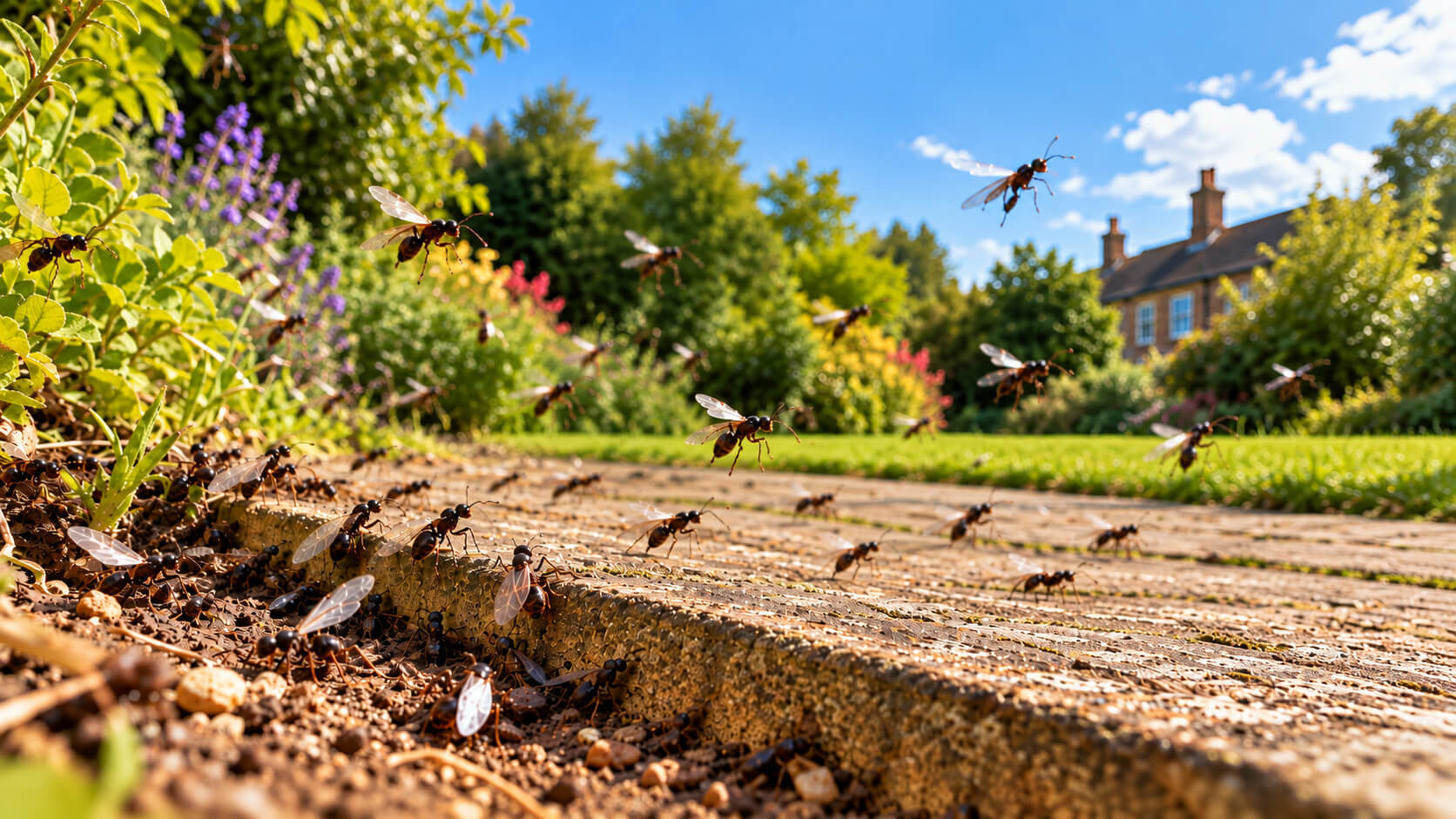
Flying ants are winged reproductive ants that leave established colonies to mate and disperse, often appearing in large numbers during warm summer weather. In the UK, these seasonal swarms are commonly associated with Flying Ant Day, although there is no single national date. This guide explains what flying ants are, when they appear, why swarms form and whether they can bite or sting.
Recently booked jobs


Flying Ants and Winged Reproductive Ants
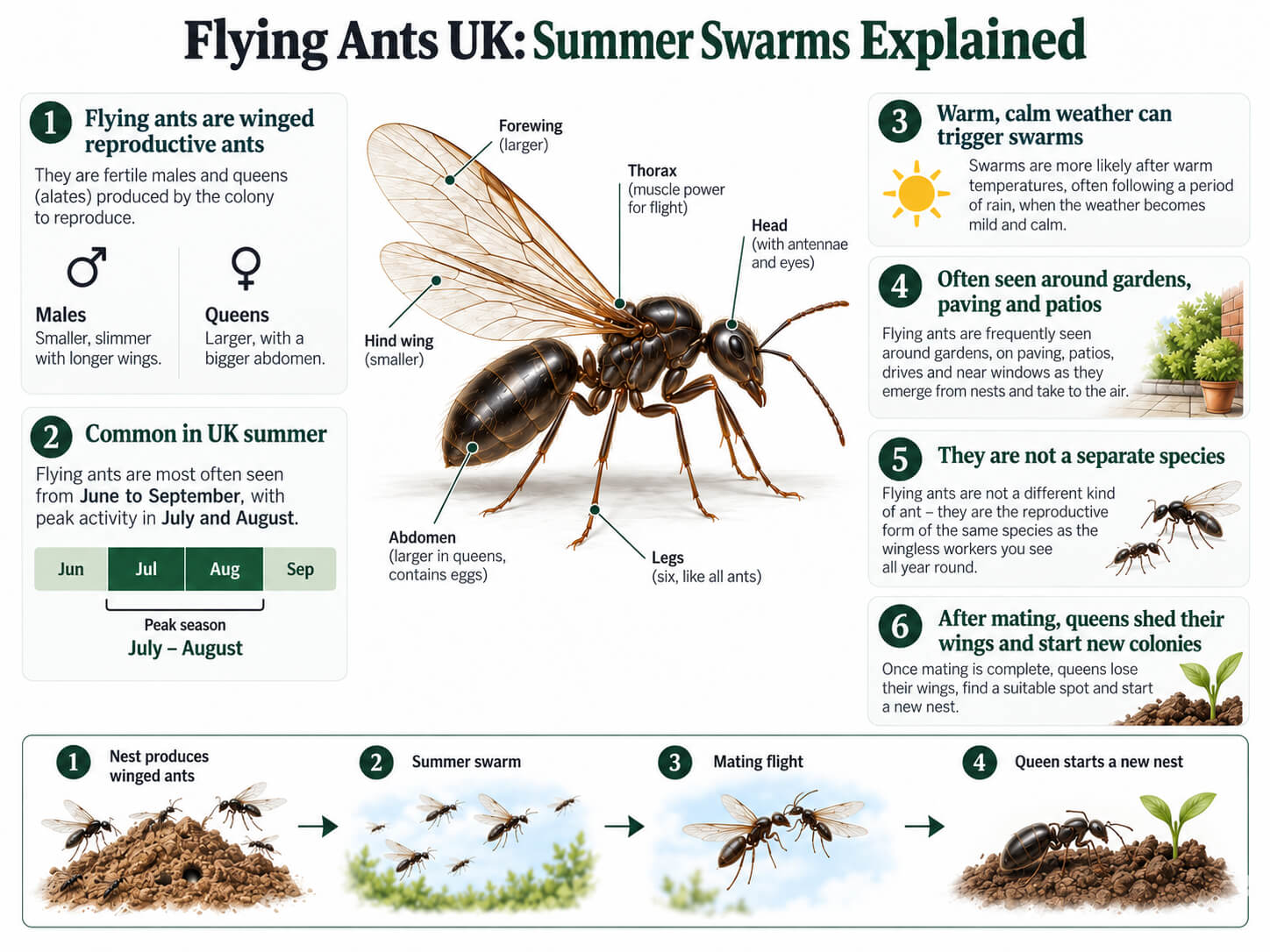
Flying ants are winged reproductive ants that leave established colonies to mate and disperse. They are often called alates and are not a separate species. In the UK, many of the large summer swarms seen around homes, gardens and pavements involve black garden ants (Lasius niger), although other ant species can also produce winged males and queens.
What Do Flying Ants Look Like?
Winged ants can look quite different from the small worker ants normally seen foraging on the ground. Queens are generally larger than males, while both reproductive forms have wings during this short stage. Because several British species can produce flying adults, the species involved depends on the habitat and location. For a broader comparison, see our guide to types of ants in the UK.
Flying Ants in the House
Flying ants can sometimes be found inside houses during the UK swarming season. Individual ants may enter through open windows or doors while large numbers are active outside, so one or two indoor sightings do not necessarily show that a colony is inside the building.
The pattern of activity is more informative than a single sighting. A brief appearance during a widespread outdoor swarm is different from repeated groups emerging from the same crack, wall edge or other part of a property. The important point for identification is to consider when the ants appeared, how many were seen and whether similar activity was visible outdoors at the same time.
Flying Ant Day in the UK
Flying Ant Day is not one fixed date across the UK. The term is commonly used for periods when large numbers of winged ants emerge from nests and take flight at around the same time. The most noticeable events often happen in July or August, but flying ants can be seen from June into early September depending on local weather and species.
Different parts of the country may experience swarms on different days, and several peaks can occur during the same summer. This is why “flying ant season” is often a more accurate description than a single national day. Warm, calm conditions are particularly favourable for these flights, so timing can shift from year to year.
In urban areas, swarming may sometimes be noticed earlier than in nearby rural locations because towns and cities tend to retain more heat. This helps explain why reports can vary considerably even within the same region.
Summer Flying Ant Swarms
A swarm of flying ants forms when reproductive males and queens from established colonies take to the air in large numbers. Swarming gives ants a better chance of finding mates from other colonies and helps young queens disperse beyond the nest where they developed. When many nearby colonies respond to similar weather conditions, the result can be a sudden and highly visible local swarm.
These events are usually brief compared with the rest of the year. The ants are focused on mating and dispersal rather than people, food or buildings. After the nuptial flight, males have completed their reproductive role, while mated queens lose their wings and search for suitable places to establish new colonies.
Why Flying Ants Suddenly Appear
Flying ants often seem to appear without warning because weather conditions can trigger many colonies to release their reproductive adults within a short period. Warm temperatures and relatively calm conditions favour flight, while local weather helps determine exactly when ants emerge in each area.
This synchronised behaviour explains why a garden, pavement or street can look normal and then contain large numbers of winged ants later the same day. Where flying ants come from is usually straightforward: they emerge from existing nests that have reached the stage where they can produce reproductive males and queens.
Can Flying Ants Bite or Sting?
The flying ants most commonly seen in UK summer swarms are not generally regarded as a significant biting or stinging risk to people. Many recorded swarms involve black garden ants, whose reproductive males and queens are primarily focused on mating and dispersal during their short winged phase.
However, “flying ant” describes a reproductive form rather than one species, so behaviour can vary. Some British red ants in the genus Myrmica can sting, and these ants can also produce winged reproductive adults. For that reason, whether a particular flying ant can bite or sting depends partly on the species involved rather than simply on the presence of wings.
Sources:
Frequently Asked Questions


Flying ants are mainly responding to suitable conditions for mating and dispersal rather than being attracted to people or buildings. Some winged ants can also be drawn towards artificial lights, particularly after dark, which can make them more noticeable around windows and indoor light sources.
Flying ants have the typical narrow ant waist and elbowed antennae, together with two pairs of wings. The front wings are generally larger than the rear pair. Their colour and size vary by species, and winged queens are often larger than males.
No, flying ants and winged termites are different insects. Flying ants usually have elbowed antennae, a clearly narrowed waist and front wings that are longer than the rear wings. Winged termites typically have straighter antennae, a broader waist and wings of more similar length.
Yes, gulls can feed on flying ants during large summer swarms. Flying-ant events create a temporary abundance of insects in the air, providing an easy seasonal food source for gulls and other birds such as swifts.
The diet depends on the ant species, but ants commonly feed on other small invertebrates and sugary substances such as honeydew. During a mating flight, however, winged males and queens are primarily focused on reproduction and dispersal rather than normal foraging activity.