


Regulatory Reform (Fire Safety) Order 2005 Explained

The Regulatory Reform (Fire Safety) Order 2005 sets out fire safety duties for relevant premises in England and Wales. It explains the legal scope of the Order and the precautions that responsible persons must manage.
This guide explains the Order as amended, including Article 9 fire risk assessments and changes effective from October 2023. It also distinguishes England-only regulations from newer Welsh legislation, with references to official sources.
Understanding the Fire Safety Order 2005
- Understand the Fire Safety Order 2005
- Check which premises the Order covers
- Learn about its key articles and legal duties
- Understand fire risk assessment obligations
- Explore the changes introduced since 2005
- Access current legislation and official guidance

What type of property requires a Fire Risk Assessment?


Recently booked jobs



The Regulatory Reform (Fire Safety) Order 2005: Scope and Purpose
The Regulatory Reform (Fire Safety) Order 2005 is the principal legal framework for general fire safety in relevant premises in England and Wales. It establishes duties intended to protect people from fire and identifies the precautions and management arrangements that may be necessary. The Order came into force in 2006 and has subsequently been amended.
Often called the Fire Safety Order, FSO or RRO, this legislation applies according to the nature and use of premises rather than simply whether a building is described as commercial or residential. The current requirements must be read alongside relevant amendments and additional regulations. This guide explains the legal framework; it does not replace the legislation or provide a property-specific assessment.
Which premises does the Order cover?
The Fire Safety Order generally covers workplaces and other relevant non-domestic premises, together with certain common parts of multi-occupied residential buildings. Its application depends on the legal definition of premises, their use and the activities taking place. It does not follow that every room within a residential building is subject to identical fire safety duties.
For example, workplaces and areas used in connection with business activities are commonly within scope. Communal corridors and stairways in relevant blocks of flats may also be covered. By contrast, an individual private dwelling occupied as a home is generally outside the Order's direct application, although the legislation contains important qualifications and other fire safety laws may remain relevant.
Commonly within scope
Workplaces, relevant non-domestic spaces and shared areas of certain multi-occupied residential buildings.
Generally outside direct scope
Individual private homes used solely as domestic premises, subject to statutory exceptions and other applicable legislation.
The distinction matters because the Order operates alongside other property, housing and building safety requirements. A change in use or management arrangements may affect which duties apply. The precise legal position should therefore be checked against the relevant premises and the current legislation.
What Articles 3 and 6 mean in practice
Article 3 defines the responsible person, while Article 6 helps establish the premises to which the Fire Safety Order applies. These provisions are important when interpreting the rest of the legislation. They do not create a single universal rule that every building owner has identical duties in every part of a property.
For workplaces, Article 3 generally identifies the employer where the workplace is under their control. In other relevant premises, the position can depend on business activities, occupation, ownership and control. Article 6 sets out the application of the Order, including exclusions and qualifications. Where several parties control different aspects of a building, the duties imposed by the Order must be considered in their proper legal context.
Legal distinction: The meaning of a responsible person under Article 3 is not identical to the practical question of who arranges an assessor's appointment. The Order must be interpreted according to the duties and control established for the premises.
Fire Safety Duties Under the Order
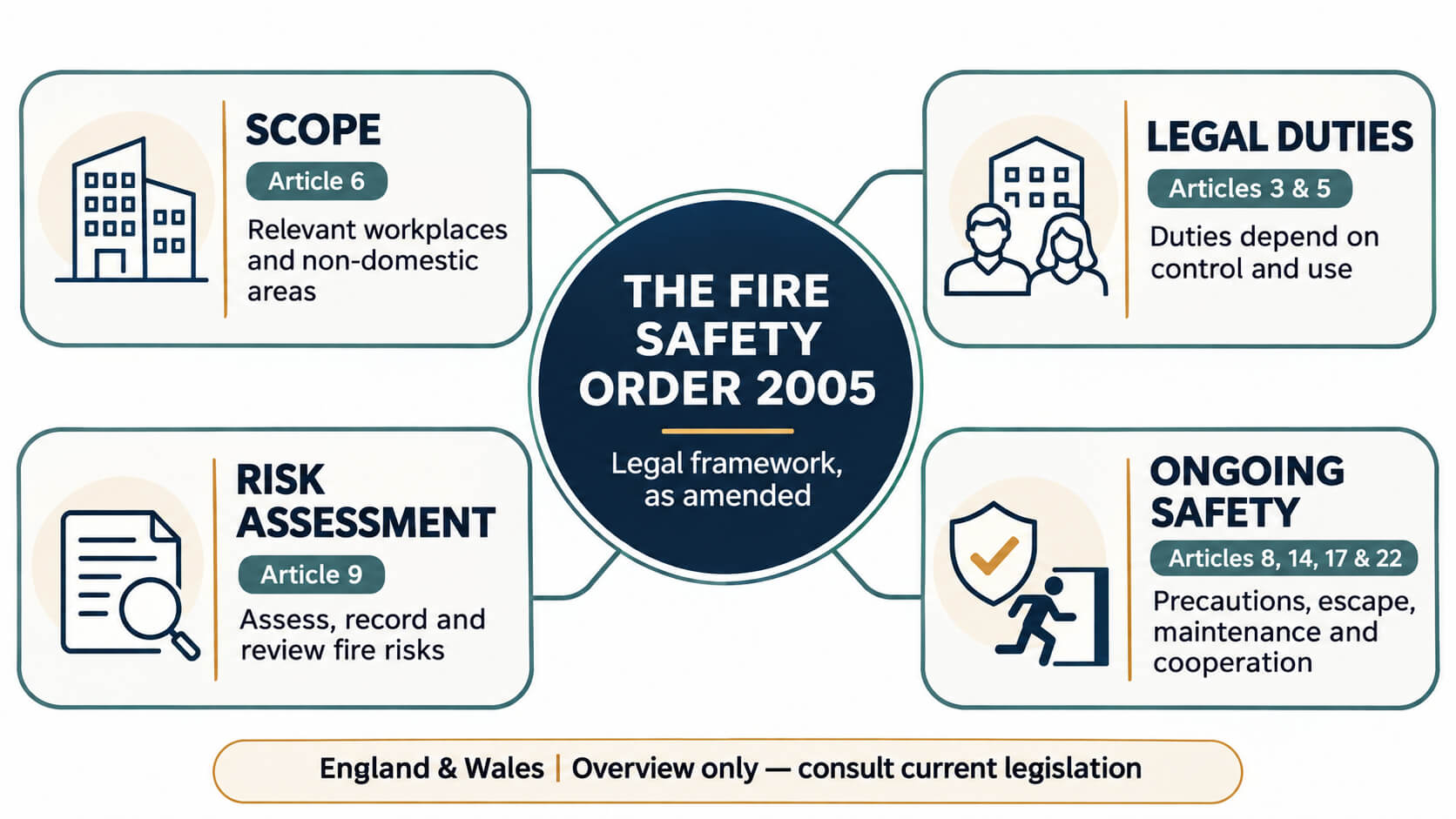
The Fire Safety Order places duties on relevant persons to assess fire risks and maintain appropriate general fire precautions. It addresses more than the preparation of an assessment document. The legal framework also covers prevention, escape arrangements, maintenance, emergency planning and cooperation where duties are shared.
The following article references provide a structured overview of the legislation. They are not a substitute for reading the applicable statutory text, and individual obligations must be considered alongside the nature, use and risks of the premises.
Article 9: assessment and recording
Article 9 requires a suitable and sufficient assessment of risks to relevant persons so that the necessary general fire precautions can be identified. The assessment must be kept under review, particularly when circumstances indicate that it may no longer be suitable or when significant changes affect the premises. The legislation does not impose one universal review interval for every building.
Changes effective from 1 October 2023 strengthened the recording requirements. Responsible persons covered by the Order must record the assessment in full, rather than only its significant findings. The previous limitations associated with employee numbers and certain other circumstances were removed. Records should reflect the assessment undertaken and be kept appropriately up to date.
- Establish the legal scope. Determine which premises and relevant persons are covered.
- Assess the risks. Ensure the assessment is suitable and sufficient for the premises.
- Record the assessment. Keep a full written record in accordance with the amended requirements.
- Review when necessary. Revisit the assessment regularly and when relevant changes or new information require it.
This is a summary of Article 9's practical framework, not a replacement for an assessment or an exhaustive list of all duties under the Order. A particular premises may also be subject to more specific legislation or guidance.
Precautions, maintenance and cooperation under the Order
Articles 8, 11, 14 and 17 address important aspects of preventing fire, managing precautions, maintaining equipment and providing suitable escape arrangements. Other provisions cover matters such as emergency procedures, information, training and cooperation. Whether particular precautions are necessary depends on the statutory requirements and the circumstances of the premises.
The Order should therefore be understood as a continuing system of fire safety responsibilities, not a one-off paperwork exercise. A completed assessment may inform decisions, but the relevant duties also extend to the arrangements used to manage safety after the assessment has been carried out. Our fire safety log book guide explains how routine checks, maintenance records and corrective actions can be organised.
The table below provides a practical Fire Safety Order 2005 summary of selected articles, showing how the legislation addresses general precautions, risk assessment, maintenance and cooperation. It is not an exhaustive statement of the legal requirements.
| Article | Main subject | Why it matters |
|---|---|---|
| Article 8 | General fire precautions | Requires appropriate precautions for the safety of relevant persons. |
| Article 9 | Risk assessment | Provides the legal basis for assessing and reviewing relevant fire risks. |
| Article 11 | Fire safety arrangements | Addresses the management and recording of preventive and protective measures. |
| Article 14 | Emergency routes and exits | Addresses the suitability and availability of escape arrangements. |
| Article 17 | Maintenance | Requires relevant fire safety facilities and equipment to be maintained appropriately. |
| Article 22 | Cooperation and coordination | Addresses cooperation where different parties share fire safety duties. |
These are selected provisions rather than the complete text of the Order. The precise legal duty, exceptions and qualifying conditions must be checked in the current statutory version.
How the Fire Safety Order Has Changed Since 2005
The Fire Safety Order remains in force, but later legislation has clarified its application and strengthened several fire safety duties. Reading only the original 2005 version can therefore give an incomplete picture of the requirements applying today. The amendments also need to be distinguished from separate regulations and legislation.
Some changes took effect in 2021 or 2023, while other provisions introduced by subsequent legislation have different commencement arrangements. In particular, England and Wales should not be treated as though every related building safety rule applies in exactly the same way.
Key changes introduced in 2021, 2022 and 2023
The Fire Safety Act 2021 clarified the application of the Order to important parts of buildings containing two or more domestic premises. This includes the structure, external walls and relevant entrance doors between individual flats and common parts. The clarification is important for interpreting the assessment duties applying to such buildings, but it does not mean that every separate dwelling is treated as ordinary non-domestic premises.
Section 156 of the Building Safety Act 2022 amended the Order, with key changes taking effect on 1 October 2023. These strengthened the requirements for recording assessments, documenting fire safety arrangements, identifying people who assist with assessments and sharing relevant information where duties or management arrangements overlap.
Fire Safety Order
The Order was made in 2005 and came into force in 2006.
Fire Safety Act
Clarified the scope of the Order for specified parts of multi-occupied residential buildings.
Section 156 changes
Strengthened recording and information-sharing duties from 1 October 2023.
The Fire Safety (England) Regulations 2022 also introduced additional requirements for certain residential buildings from 23 January 2023. Despite their title, these Regulations apply in England only. Their scope and specific duties should not be confused with the general application of the Fire Safety Order across England and Wales.
Current Fire Safety Legislation in England and Wales
The Regulatory Reform (Fire Safety) Order 2005 remains the principal general fire safety framework for relevant premises in England and Wales, as amended by subsequent legislation. England is the main focus of this guide, while differences affecting Wales are identified separately. Scotland and Northern Ireland operate under different fire safety legislation.
The Fire Safety Act 2021 clarified the application of the Order to the structure, external walls and relevant flat entrance doors of buildings containing two or more domestic premises. The relevant provisions took effect in Wales on 1 October 2021 and in England on 16 May 2022.
In England, the Fire Safety (England) Regulations 2022 took effect on 23 January 2023, introducing additional requirements for certain multi-occupied residential buildings. Key changes made by Section 156 of the Building Safety Act 2022 took effect on 1 October 2023, strengthening the recording of fire risk assessments and fire safety arrangements, alongside relevant information-sharing duties.
England — Residential Evacuation Plans: The Fire Safety (Residential Evacuation Plans) (England) Regulations 2025 took effect on 6 April 2026. They introduce additional duties for responsible persons in specified residential buildings, including measures relating to residents who may have difficulty evacuating without assistance, person-centred fire risk assessments and building emergency evacuation plans.
These requirements apply only to buildings meeting the statutory criteria. They do not introduce a universal residential evacuation plan requirement for every property.
Wales: The Fire Safety Order also applies in Wales, but the Fire Safety (England) Regulations 2022 and the Residential Evacuation Plans Regulations 2025 apply in England only. The Building Safety (Wales) Act 2026 introduces a separate framework for regulated residential buildings, with provisions subject to their respective commencement arrangements.
Scotland and Northern Ireland: The Fire Safety Order 2005 does not apply in these jurisdictions. Scotland principally uses the Fire (Scotland) Act 2005 and Fire Safety (Scotland) Regulations 2006. Northern Ireland uses the Fire and Rescue Services (Northern Ireland) Order 2006 and Fire Safety Regulations (Northern Ireland) 2010.
For any premises, applicable duties must be checked against the relevant jurisdiction, building type, legislation in force and official guidance. This legal overview does not establish whether a particular property complies with fire safety law.
For those who need a professional assessment of relevant premises, MyConstructor provides a way to compare fire risk assessment services and available assessors. Check the service scope, prices and appointment options on the main booking page.
Official legislation and guidance
Fire Safety Order 2005 — Revised Legislation Home Office — Section 156 Guidance Fire Safety (England) Regulations 2022 Welsh Government — Building Safety (Wales) Act 2026
Legal information reviewed on 4 November 2026. This guide provides general information and is not legal advice. Check current legislation and commencement notices for changes.
Fire Safety Order 2005 FAQs


The Regulatory Reform (Fire Safety) Order 2005 establishes the main general fire safety duties for relevant premises in England and Wales. It covers matters including risk assessment, general fire precautions, emergency arrangements and ongoing fire safety management. The Order came into force in 2006 and has been amended by later legislation.
Yes, the Fire Safety Order 2005 remains in force, subject to amendments and provisions that have commenced. Important later changes include those introduced through the Fire Safety Act 2021 and Section 156 of the Building Safety Act 2022. Check the revised legislation for the current text and any outstanding changes.
Article 9 requires a suitable and sufficient assessment of fire risks to relevant persons so the necessary general fire precautions can be identified. The assessment must be reviewed regularly and when significant changes or other relevant circumstances require it. Amendments effective from October 2023 require responsible persons covered by the Order to record the assessment in full.
Section 156 of the Building Safety Act 2022 introduced stronger recording, information-sharing and cooperation requirements from 1 October 2023. Responsible persons covered by the Fire Safety Order must record their full fire risk assessments and fire safety arrangements, including where the previous employee-count threshold would not have required the same records.
No, the Regulatory Reform (Fire Safety) Order 2005 applies to England and Wales, not Scotland or Northern Ireland. Those jurisdictions have different fire safety legislation. Even within England and Wales, certain additional regulations and later building safety provisions apply differently, so the location and type of premises must be considered.