


Fire Risk Assessment

A fire risk assessment is an on-site assessment of a property’s fire risks, considering hazards, people at risk, escape routes and how the premises are used. The service is suitable for landlords, businesses, managing agents and others responsible for premises.
After the visit, a written fire risk assessment report can set out the findings and recommended actions.
Compare Fire Risk Assessors and Book Online
- Compare UK fire risk assessors
- View available prices before booking
- Check customer reviews
- Choose an appointment time that suits you
- Same-day appointments may be available
- Card, PayPal, Google Pay, Apple Pay or on-site

What type of property requires a Fire Risk Assessment?



Recently booked jobs

Fire Risk Assessment Services
A professional fire risk assessment service helps identify potential fire hazards, assess who may be at risk and review whether the existing fire safety arrangements are suitable for the premises.
A fire risk assessment service will normally include preparation before the appointment, an on-site inspection of the agreed areas and a written fire risk assessment report explaining the findings and any recommended actions.
The scope of a fire risk assessment will depend on the property type, size, layout, occupancy and day-to-day use. Escape routes, shared areas, storage, equipment and the activities carried out within the premises can all affect what needs to be examined.
Fire risk assessments can apply to workplaces, commercial premises, HMOs, blocks of flats and other multi-occupied residential buildings with shared or communal areas. The exact requirements and assessment scope will depend on the type of premises and who has responsibility for fire safety.
What a Fire Risk Assessment Checks
A fire risk assessor will consider how a fire could start, who could be affected and whether the existing fire safety arrangements are suitable for the premises.
The exact scope will depend on the property and the fire risk assessment service agreed before the appointment. Areas and features considered during the assessment may include:
- potential ignition sources
- combustible or flammable materials
- people who may be at greater risk
- escape routes and final exits
- relevant fire doors and fire separation
- fire detection and warning arrangements
- emergency lighting and safety signage where relevant
- firefighting equipment
- housekeeping, storage and management arrangements
- sources of fuel and, where relevant, dangerous substances
- people who may need additional assistance in an emergency
- fire safety management and emergency arrangements
The assessment may also consider whether particular people could face additional difficulty in recognising a fire or evacuating safely. This can include disabled people, older people, young people, lone workers, visitors or anyone unfamiliar with the premises.
Where relevant, the assessor may also consider how fire safety measures are managed in practice, including maintenance arrangements, emergency procedures and whether important escape routes and fire safety equipment remain available and effective during normal use.
A fire risk assessment is not simply a check that individual fire safety items are present. The assessor should consider how the different features of the premises work together and whether they remain suitable for its normal use and occupancy.
For example, an ignition source may present a greater concern when it is close to combustible materials or an important escape route. Storage, alterations or changes in use may also reduce the effectiveness of corridors and other escape arrangements.
The findings should reflect the actual conditions within the premises rather than rely on a generic checklist.
The Fire Risk Assessment Process
Most professional fire risk assessments involve three main stages: preparation, an on-site inspection and a written report.
Before the appointment, the assessor will usually confirm the property details, the agreed scope of the fire risk assessment and any practical arrangements needed to access the areas being assessed.
During the inspection, the assessor will review the agreed areas and consider the fire hazards, people at risk, escape arrangements and existing fire safety measures. The premises should be assessed as they are normally occupied and used because everyday activities, storage and the movement of people can affect the overall fire risk.
After the inspection, the assessor will normally provide a written fire risk assessment report setting out the main findings, any recorded limitations and recommended actions. Priorities or suggested timescales may also be included where appropriate.
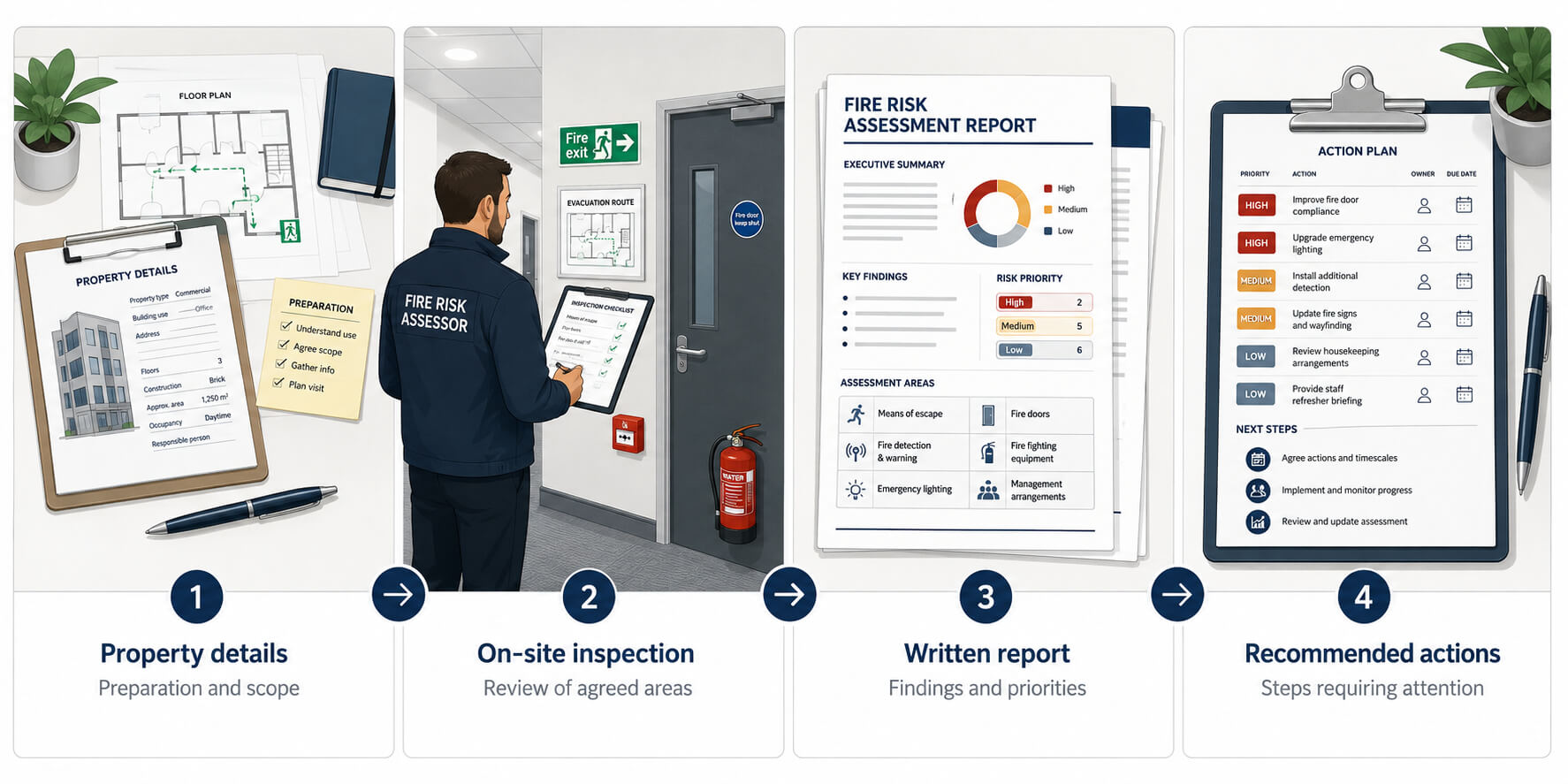
Within this process, a fire risk assessment will typically consider the main principles of identifying fire hazards, identifying people at risk, evaluating and reducing those risks, recording significant findings and keeping the assessment under review.
Preparing for a Fire Risk Assessment
Preparing for the appointment can help the fire risk assessor understand the premises and complete the agreed inspection more effectively.
Before the visit, provide accurate information about the property type, approximate size, number of floors, normal occupancy and any areas that may be difficult to access.
Where available, it may also be helpful to provide previous fire risk assessments, details of recent alterations and information about significant changes in how the premises are occupied or used.
Make sure the assessor can access the rooms, shared areas and other spaces included within the agreed scope. Locked rooms, restricted areas or missing information may limit what can be examined and should be recorded in the fire risk assessment report.
The premises should be assessed as they are normally used. Accurate information and suitable access are more useful than temporary changes made only for the inspection.
What a Fire Risk Assessment Report Includes
After the on-site inspection, the assessor will normally provide a written fire risk assessment report explaining the main findings and any actions that may require attention.
The format and level of detail can vary depending on the premises, the agreed scope and the assessor, but the report may include:
- details of the premises and the agreed assessment scope
- areas inspected and any access limitations
- identified fire hazards
- people who may be at risk
- observations about existing fire safety measures
- recommended actions
- priorities or suggested timescales where appropriate
- significant findings from the assessment
- measures recommended to remove or reduce identified risks
- fire safety management or emergency planning observations where relevant
Depending on the premises and assessment scope, the findings may also help inform a fire safety action plan. This can make it easier to identify which issues require attention, assign responsibility for completing actions and review progress over time.
A useful fire risk assessment report should clearly explain what was identified, why it matters and what action may be required.
Not every finding will have the same level of priority. The recommended response may depend on the likelihood of a fire occurring, the possible consequences, the people who could be affected and whether an important escape route or fire safety measure is involved.
Where rooms, shared areas or other relevant spaces cannot be inspected, the assessor may record this as a limitation within the report.
What Happens After a Fire Risk Assessment?
After receiving the fire risk assessment report, the person responsible for the premises should review the findings and consider any recommended actions. Some issues may be straightforward to address, while others may require further investigation, specialist advice or planned improvement work.
Recommended actions can relate to physical fire precautions, escape arrangements, fire detection, emergency lighting, housekeeping, management procedures, staff information or other measures identified during the assessment.
The report should not simply be filed away. Relevant findings and actions should be considered as part of the ongoing management of fire safety, and the assessment should be reviewed when significant changes occur or when it may no longer reflect the premises.
Fire Risk Assessment Cost
The cost of a fire risk assessment will depend on the property, the areas included in the inspection and the complexity of the agreed service. There is no single fixed fire risk assessment price that is suitable for every type of premises.
| Property Type | Indicative Starting Price | What May Affect the Price |
|---|---|---|
| Single Communal Area | From £100 | Location, access, property details and assessor availability |
| Two Communal Areas | From £150 | Number of areas, layout, access and location |
| Three Communal Areas | From £180 | Number of areas, layout, access and complexity |
| Studio Flat | From £75 | Property details, location, access and assessment scope |
| HMO or Rental Home – 1–3 Bedrooms | From £140 | Bedrooms, layout, shared areas, location and availability |
| HMO or Rental Home – 4–6 Bedrooms | From £175 | Bedrooms, occupancy, layout, shared areas and complexity |
| Commercial Property | From £190 | Floor area, property use, layout, complexity and location |
These prices are indicative starting prices and are not fixed UK-wide rates. The final fire risk assessment cost can vary depending on the property, location, assessment scope, appointment date and assessor availability. For current available prices, enter your property details and postcode in our Fire Risk Assessment Tool at the top of this page.
A smaller, straightforward property may require less assessment time than a larger or more complex building with several floors, shared areas, restricted access or more complicated occupancy arrangements. These factors can influence the final price.
Through MyConstructor, you can compare available fire risk assessment prices based on your property details, postcode and appointment requirements before booking.
When comparing available prices, check what is included within the service. The agreed inspection scope, relevant assessor experience and report deliverables should be considered alongside the headline price.
What Affects Fire Risk Assessment Prices?
Property size can influence fire risk assessment prices, but it is only one factor. Two buildings with a similar floor area may require different levels of work depending on their layout, use and complexity.
Factors that may affect the price include:
- property type
- overall size and number of floors
- layout and complexity
- number of areas included in the assessment
- occupancy and normal use
- shared or communal areas
- access requirements
- location and assessor availability
Properties with several separate areas, restricted spaces or more complex activities may require additional inspection time even when their overall floor area is relatively small.
The lowest available fire risk assessment price may not always represent the most suitable service. Check that the inspection scope and the assessor's relevant experience are appropriate for the type and complexity of the premises.
Getting an Accurate Fire Risk Assessment Quote
An accurate fire risk assessment quote depends on the information provided about the premises and the areas included within the inspection.
When requesting a quote, provide details such as the property type, approximate size, number of floors, normal use, number of communal areas and postcode.
Mention any restricted spaces, access difficulties or unusual features that may affect the inspection. Clear and accurate information helps define the likely scope of the fire risk assessment and allows available providers to offer a more relevant price.
When comparing quotes, consider what is included in the service as well as the price. Relevant experience, customer reviews, report deliverables and appointment availability may also influence which option is most suitable.
Compare Fire Risk Assessors
When choosing a fire risk assessor, their knowledge and experience should be appropriate for the type, use and complexity of the premises. An assessor who is suitable for a small, straightforward property may not necessarily have the experience required for a larger or more complex building.
Through MyConstructor, you can compare fire risk assessors by available prices, customer reviews, provider information and appointment availability before choosing the option that best suits your requirements.
Where this information is displayed, you can also review relevant qualifications, professional memberships, registrations, third-party certifications, insurance details and experience before booking.
Credentials and insurance arrangements vary between individual assessors and organisations and may not always be displayed on every profile. If specific qualifications, registrations, certifications or insurance arrangements are important to your requirements, confirm them directly with the provider before booking.
Choosing a Competent Fire Risk Assessor
A competent fire risk assessor should have knowledge and experience appropriate to the premises and the complexity of the fire risk assessment being carried out.
In England, fire risk assessors are not currently subject to a single mandatory training, qualification or certification framework. Relevant qualifications, professional memberships, registrations and third-party certifications can still provide useful evidence when assessing competence and experience.
When comparing fire risk assessment providers, consider the proposed inspection scope, relevant assessor experience, customer feedback, report deliverables, availability and price.
The lowest price is not always the most suitable option. Compare the information available for each provider and choose the fire risk assessor that best matches the property and required assessment scope.
Fire Risk Assessment Requirements and Responsibilities
Fire risk assessment requirements depend on the type and location of the premises and on who has responsibility or control over them.
For applicable workplaces and other non-domestic premises in England and Wales, responsibility will normally rest with the person or organisation that has control of the premises. This person is commonly known as the responsible person.
Businesses operating offices, shops, warehouses and other workplaces may have different fire risks depending on their activities, occupancy and building use. For information focused specifically on business premises, see our commercial fire risk assessment service.
The assessment should consider employees, occupants, visitors and other people who may be affected by a fire at the premises. Particular attention may be needed where someone could require additional assistance to evacuate safely.
Fire safety legislation and guidance differ across the UK, so the rules relevant to the location and type of premises should always be considered.
Who Needs a Fire Risk Assessment?
Fire risk assessments may be required for workplaces, commercial premises, HMOs, blocks of flats and other multi-occupied residential buildings with shared or communal areas.
The exact requirements can depend on the type of premises, how the building is occupied or used and who has responsibility for the relevant areas.
Houses in multiple occupation can involve several households sharing facilities, kitchens, corridors and escape routes. Where the property is used as shared accommodation, our HMO fire risk assessment page provides more specific information and booking options.
Who Is Responsible for a Fire Risk Assessment?
For business and other non-domestic premises in England and Wales, responsibility will normally rest with the person or organisation that has control of the premises.
Depending on the property, the responsible person may be an employer, owner, landlord, occupier, facilities manager, building manager or managing agent.
Where the Fire Safety Order applies, the responsible person must ensure that a suitable and sufficient fire risk assessment is carried out, recorded and reviewed.
For official guidance relevant to workplaces and non-domestic premises, refer to the UK Government fire safety guidance.
Where responsibility for a property or particular area is unclear, appropriate professional or regulatory advice should be obtained. The information on this page is general guidance and is not legal advice.
Who Can Carry Out a Fire Risk Assessment?
For straightforward premises, the responsible person may be able to carry out the fire risk assessment if they have sufficient knowledge and competence.
Where the responsible person does not have the necessary expertise or time, they will need to appoint a competent person to help with the fire risk assessment.
The level of knowledge and experience required will depend on the size, use and complexity of the premises and the fire risks involved.
How Often Should a Fire Risk Assessment Be Reviewed?
A fire risk assessment should be reviewed regularly and should remain suitable for the current layout, occupancy and use of the premises.
A fire risk assessment may need to be reviewed following significant changes such as:
- alterations or refurbishment
- changes in how the premises are used
- changes affecting escape routes
- significant changes in occupancy
- new equipment, processes or activities
- changes to storage arrangements
- a significant fire safety incident
A review may also be appropriate where the existing fire risk assessment no longer reflects the premises, where new hazards have been identified or where earlier recommended actions need to be reconsidered.
In blocks of flats and other residential buildings with shared common parts, changes to communal corridors, stairways, entrances, landings or escape arrangements may be particularly relevant. For guidance focused on these types of properties, see our landlord fire risk assessment page.
Book a Fire Risk Assessment Online
You can book a fire risk assessment online through MyConstructor by selecting the property type, preferred appointment date and postcode.
You can then compare available fire risk assessment prices, customer reviews, provider information and appointment options before choosing the service that best matches your requirements.
Booking online does not normally mean that the fire risk assessment itself is completed remotely. An on-site inspection will usually be required so that the assessor can examine the actual layout, occupancy, escape arrangements and fire safety measures within the premises.
Provide accurate information about the property and make sure the rooms, shared areas and other spaces included within the agreed scope will be accessible on the appointment date. This reduces the risk of relevant areas being excluded from the inspection.
Compare the available options and choose a fire risk assessment service that matches the property type, required inspection scope and your preferred appointment date.
Fire risk assessment FAQs


A fire risk assessment is a structured review of fire hazards, the people who may be at risk and the fire safety measures within the premises. It considers how a fire could start, how people could be affected and whether existing arrangements are suitable. A professional assessment will normally include an on-site inspection and a written report with findings and recommended actions.
For premises covered by fire safety legislation, a fire risk assessment is a legal requirement. In England and Wales, the responsible person for applicable workplaces, non-domestic premises and relevant common areas of multi-occupied residential buildings must ensure that a suitable and sufficient fire risk assessment is carried out and reviewed regularly. Different fire safety legislation applies in Scotland and Northern Ireland.
Fire risk assessments may be required for workplaces, commercial premises, HMOs and the common or shared areas of blocks of flats and other multi-occupied residential buildings. The exact requirements depend on the type and location of the premises, how it is occupied or used and who has responsibility for fire safety.
For applicable business and other non-domestic premises in England and Wales, the person or organisation with control of the premises is generally known as the responsible person. Depending on the premises, this may be an employer, owner, landlord, occupier, facilities manager, building manager or managing agent. Where there is more than one responsible person, they may need to cooperate and coordinate their fire safety arrangements.
For straightforward premises, the responsible person may be able to carry out the fire risk assessment if they have sufficient knowledge and competence. Where they do not have the necessary expertise or time, they will need to appoint a competent person to help with the assessment. The level of competence required will depend on the size, use and complexity of the premises.
A fire risk assessment will normally consider potential ignition sources, combustible materials, people at risk, escape routes, fire doors and separation, fire detection and warning arrangements, emergency lighting, firefighting equipment and relevant fire safety management arrangements. The exact scope will depend on the premises and the service agreed with the assessor.
A fire risk assessment report will usually record the assessment scope, areas inspected, identified fire hazards, people at risk, existing fire safety measures, significant findings, inspection limitations and recommended actions. Priorities or suggested timescales may also be included where appropriate.
The fire risk assessment cost can depend on the property type, size, number of floors, layout, use, shared or communal areas, access requirements, complexity, location and assessor availability. There is no single fixed price for every type of premises. Through MyConstructor, you can enter your property details and postcode to compare available fire risk assessment prices before booking.
A fire risk assessment should be reviewed regularly and whenever there is reason to believe it may no longer reflect the premises. A review may be needed following significant changes to the layout, occupancy, use, escape routes, equipment, processes or other factors that could affect fire risk. Fire safety legislation does not set one fixed review interval that applies to every premises.
There is no fixed duration for every fire risk assessment. The time required will depend on the size, layout, use and complexity of the premises, the number of areas included and any access requirements. A larger or more complex building will generally require more inspection time than smaller, straightforward premises.
Yes. You can book a fire risk assessment online through MyConstructor by entering your property details, preferred appointment date and postcode. You can compare available prices, customer reviews and appointment options before choosing a provider. The assessment itself will normally involve an on-site inspection of the premises.
To request a fire risk assessment quote, provide accurate information such as the property type, postcode, approximate size, number of floors, normal use and any shared or communal areas. Details of restricted spaces, access difficulties or unusual features can also help define the likely inspection scope and provide a more relevant price.