


Fire Risk Assessment Types 1–4 for Flats
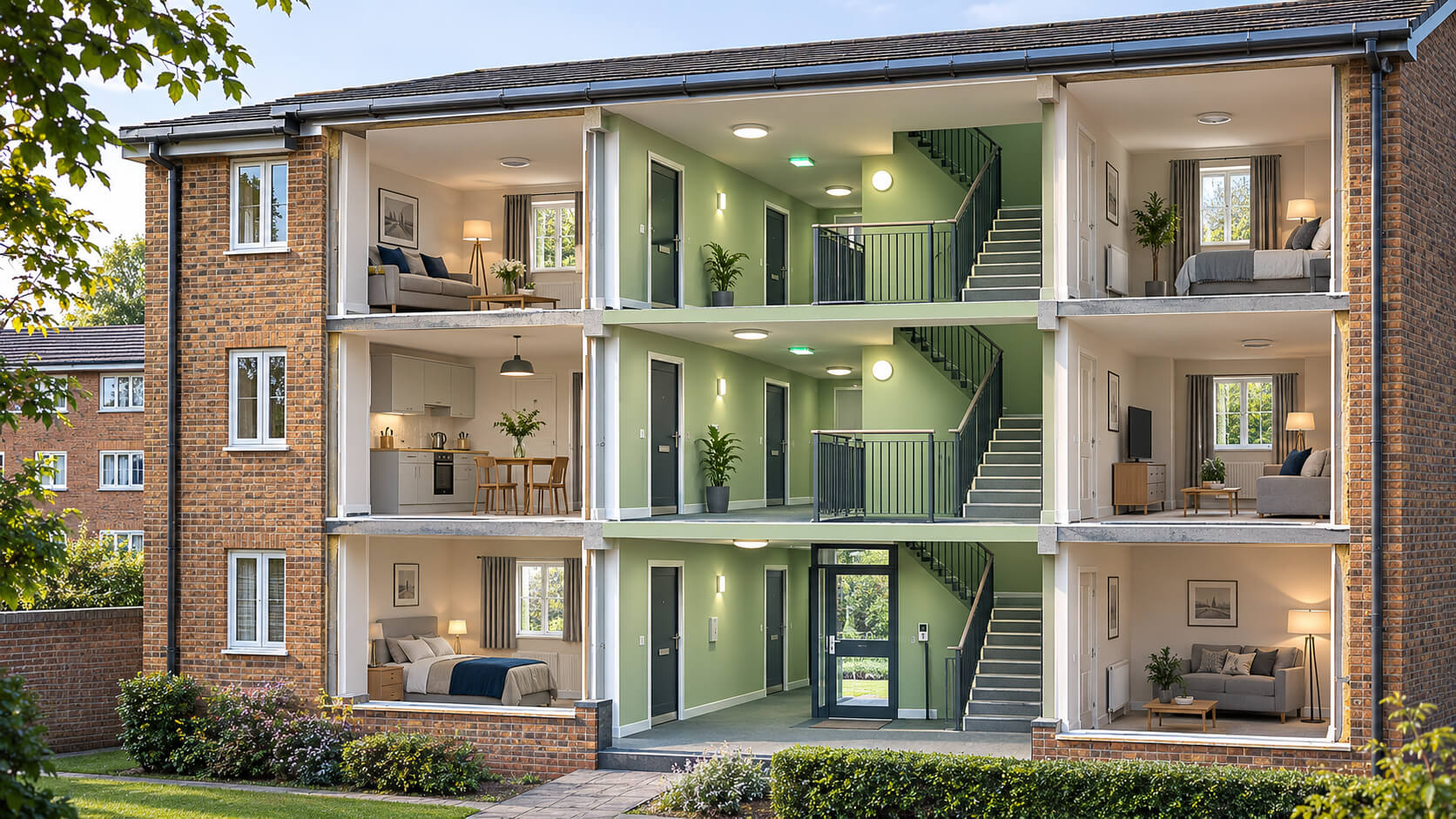
Fire risk assessment types 1–4 describe inspection scopes for flats and multi-occupied housing. They distinguish common parts, sampled dwellings and intrusive checks, helping landlords and managing agents compare options.
For available assessments, enter the postcode and property details, compare prices and dates, then book online. A suitably experienced assessor visits the agreed areas and provides a written report. Confirm specialist scope before booking. In England, responsible persons covered by the Fire Safety Order must record their assessments in full.
Understanding the four assessment types
- Compare Type 1, 2, 3 and 4 assessments
- Understand common parts and dwelling access
- See when intrusive checks may be needed
- Review a side-by-side comparison table
- Learn why the right scope depends on the building
- Read guidance before discussing assessment options

What type of property requires a Fire Risk Assessment?


Recently booked jobs


Fire risk assessment types 1–4 describe how much of a multi-occupied residential building is examined and whether intrusive investigation is involved. Type 1 focuses on common parts without opening up construction; Types 2, 3 and 4 extend the investigation in different ways. The categories help freeholders, landlords and managing agents understand the proposed assessment scope.
BS 9792:2025 sets out this framework for housing, including purpose-built and converted blocks of flats. It also covers certain other multi-occupied housing, so the four types are not exclusive to flats. They are descriptions of inspection scope, not four separate legal certificates or an automatic progression from basic to best.
What Are the Four Types of Fire Risk Assessment?
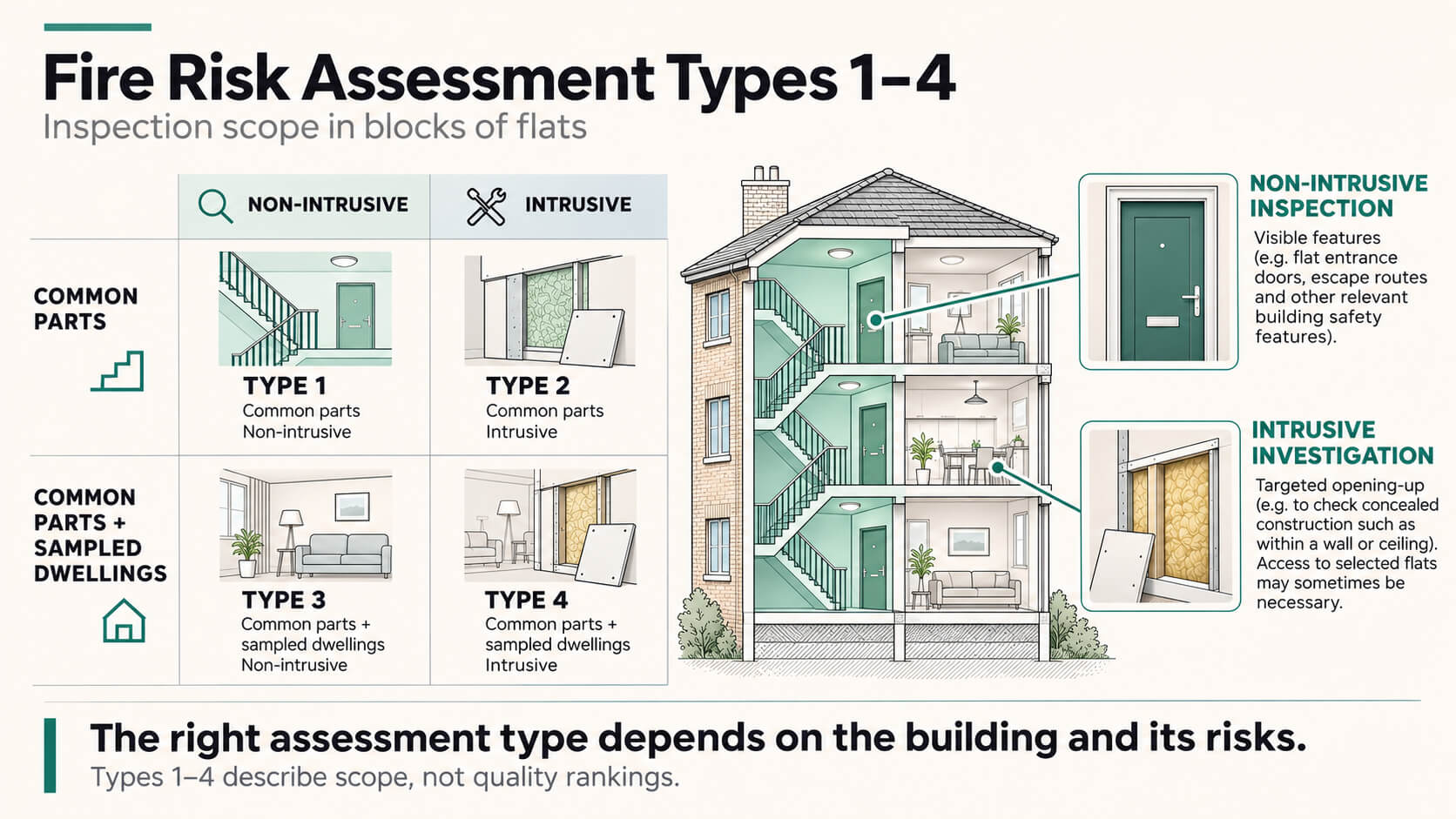
The four types differ in two respects: whether the assessment includes individual dwellings and whether construction is opened up for investigation. Non-intrusive inspections rely on accessible evidence, observations and relevant records. Intrusive work involves selected investigations into concealed construction and requires appropriate planning.
The table gives a quick comparison. A Type 1 assessment still considers features such as flat entrance doors, relevant separating construction and external walls; describing it as a common-parts assessment must not suggest that those issues can simply be ignored.
| Type | Inspection scope | Intrusive? |
|---|---|---|
| Type 1 | Common parts | No |
| Type 2 | Common parts, with targeted construction checks | Yes |
| Type 3 | Common parts and a sample of dwellings | No |
| Type 4 | Common parts and a sample of dwellings | Yes |
This is a summary rather than a substitute for a written assessment specification. Access arrangements, sampling, previous surveys and any areas that cannot be inspected should be agreed and recorded for the particular building.
Type 1: Common parts, non-intrusive
A Type 1 fire risk assessment is a non-intrusive review of the common parts and is generally sufficient where there is adequate evidence of the building's fire safety integrity. It considers shared escape routes, visible fire precautions and relevant separating construction. The assessor should examine at least a sample of flat entrance doors and consider the external walls. Unresolved concerns or missing evidence may justify further investigation.
Before the visit, provide previous assessments, available plans and fire door inspection records. Where relevant areas cannot be accessed, the assessor should record the limitation and explain whether further inspection or evidence is needed.
Type 2: Common parts, intrusive
A Type 2 fire risk assessment adds targeted intrusive checks where there is good reason to suspect serious defects in fire separation. A contractor may need to open selected parts of construction and reinstate them afterwards. Although the principal scope concerns common parts, access to a sample of flats may sometimes be needed to investigate separating elements. It is not a routine upgrade for every block.
Agree the suspected defect, sampling locations and who will arrange safe opening-up and reinstatement. The findings should indicate whether further investigation is justified, rather than treating a few exposed areas as proof about the entire block.
Type 3: Common parts and dwellings, non-intrusive
A Type 3 fire risk assessment extends a non-intrusive review into a sample of individual dwellings as well as the common parts. It may consider escape arrangements within flats, relevant detection and warning provisions, and alterations affecting fire safety. Residents' access and the responsibilities of different parties must be understood before visits are arranged. It does not involve opening up walls or ceilings.
Select flats to reflect relevant differences in layout or alterations, rather than assuming every dwelling is identical. Explain the planned inspection to residents and record access limitations that affect the conclusions.
Type 4: Common parts and dwellings, intrusive
A Type 4 fire risk assessment combines inspection of common parts and dwellings with intrusive investigations on a sampling basis. It can be appropriate in unusual circumstances involving serious uncertainty about the building's construction and potential fire spread between homes. Specialist planning, permission to access dwellings, competent contractors and making-good arrangements may be necessary. Its greater scope does not make it the default or legally mandatory choice.
Plan intrusive work around specific unresolved concerns, with permissions, competent contractors and reinstatement arrangements agreed in advance. The report should separate defects actually observed in sampled locations from assumptions about construction that remains concealed.
Which Fire Risk Assessment Type Does a Block of Flats Need?
The appropriate type depends on the building's construction, fire strategy, available records and any evidence of defects, rather than the number of flats alone. The responsible person should agree the intended type and scope with a competent assessor who understands the particular building.
Start by reviewing previous fire risk assessments, refurbishment records, compartmentation surveys and known concerns about doors, service penetrations or alterations. Where information is incomplete, the assessor should explain the significance of the uncertainty instead of automatically prescribing the most intrusive option.
When a Type 1 assessment may be sufficient
Type 1 may be sufficient when accessible observations and reliable building information allow the assessor to reach a suitable conclusion about fire risks. For example, a well-documented block with no significant concerns about compartmentation may not need destructive checks. Nevertheless, a non-intrusive assessment has limits: concealed defects cannot always be ruled out, and the report should record material uncertainties and recommended follow-up.
When further investigation may be needed
Further investigation may be justified when evidence points to serious hidden defects, inadequate fire separation or risks that cannot be evaluated from the common parts alone. A Type 2, 3 or 4 approach is chosen to answer a specific question about the building, not simply because it has more flats or is older. Opening-up works require suitable permissions, safety precautions and arrangements for reinstatement.
An ordinary housing FRA also differs from a specialist fire risk appraisal of external walls (FRAEW). Where the external wall system needs detailed investigation, separate expertise may be required. For information on arranging an assessment of shared residential areas, see our landlord fire risk assessment for flats and common parts page; confirm the exact type and scope before booking.
Official sources:
BSI: BS 9792:2025 LEASE: Types of FRA Home Office: Blocks of Flats
The four-type framework is technical guidance, not a separate set of statutory certificates. Fire safety duties and applicable guidance vary by premises and jurisdiction.
Frequently Asked Questions


No, fire safety law does not require every block of flats to have an assessment labelled Type 1. In England and Wales, the responsible person must ensure a suitable and sufficient assessment of the relevant premises and building elements. Type 1–4 describes the inspection scope, not four separate legal obligations. The appropriate type depends on the building and the evidence available.
Yes, a Type 1 assessment should consider relevant flat entrance doors because they help protect shared escape routes. This can involve examining a suitable sample of doors, noting visible defects and recording access or evidence limitations. It does not automatically include a full inspection of every flat interior or opening-up works.
No, Type 3 and Type 4 assessments are not automatically compulsory for every residential block. Type 3 extends non-intrusive inspection into a sample of dwellings, while Type 4 also includes intrusive investigation. The selection should follow the building's risks, records and unresolved concerns rather than an assumption that a higher type is always better.
No, a Type 4 housing fire risk assessment and an FRAEW have different purposes. Type 4 examines the relevant common parts and a sample of dwellings, including intrusive investigation. An FRAEW is a specialist appraisal of external wall construction and associated fire spread risks, generally using the PAS 9980 approach. A Type 4 assessment should not be presented as a substitute for a specialist FRAEW.