


Do Fire Extinguishers Expire?
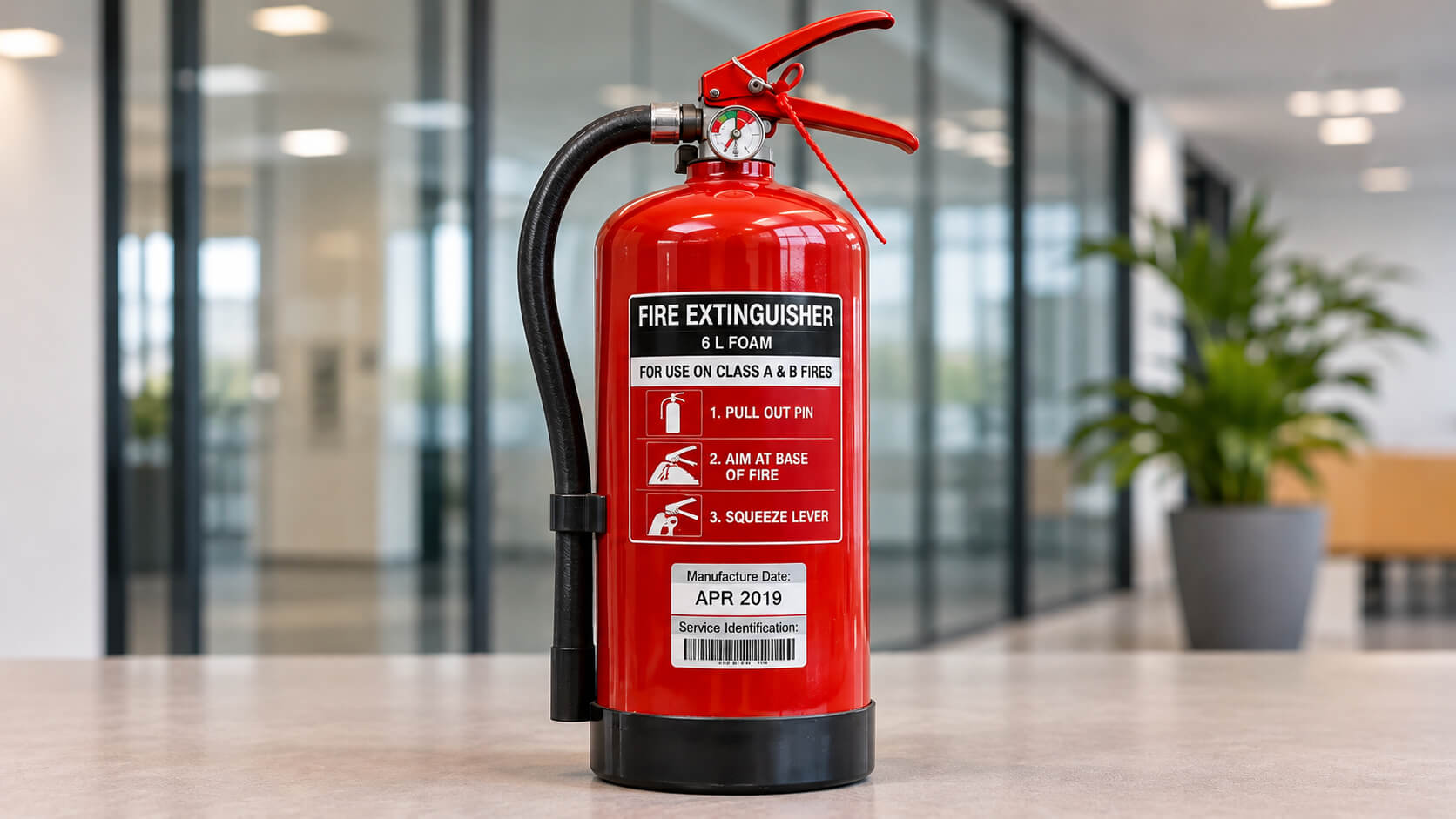
Fire extinguishers do not all share one fixed expiry date or maximum service life. Their continued suitability depends on the equipment, its condition, manufacturer guidance and appropriate maintenance history.
Learn how to interpret fire extinguisher expiry dates, manufacturing marks and service labels. Understand what affects lifespan, why an older extinguisher is not automatically expired and when competent specialist assessment is needed.
Fire Extinguisher Expiry Dates & Lifespan
- Understand whether fire extinguishers have expiry dates
- Identify manufacture dates and service labels
- Learn what affects the lifespan of an extinguisher
- Recognise when an older unit needs specialist assessment
- Find a professional visual check for existing extinguishers

Fire extinguisher check


Recently booked jobs



Fire Extinguisher Expiry Dates Explained
Fire extinguishers can become unsuitable for continued use, but there is no single expiry date that applies to every portable extinguisher in the UK. Equipment age matters, yet an older extinguisher is not automatically unusable solely because a particular number of years has passed. Its condition, design, maintenance history and manufacturer instructions must also be considered.
An expiry date, a manufacturing date and a service-due date are not necessarily the same thing. Confusing these markings can lead to incorrect assumptions about whether an extinguisher remains suitable. The Fire Industry Association notes that UK standards do not set one universal maximum service life for all extinguishers.
Do fire extinguishers have an expiry date?
Some extinguishers carry manufacturer-specific expiry or replacement information, while others have manufacture and maintenance dates instead. A printed date should be interpreted according to its label and the instructions for that particular model. It should not automatically be treated as the final day the equipment can be used.
A manufacturer's warranty period is not necessarily the same as the extinguisher's service life. A warranty describes the manufacturer's stated cover under particular conditions. Whether an extinguisher remains suitable for use is a separate fire safety question requiring consideration of its condition and relevant technical guidance.
Similarly, a date showing that servicing is due does not mean the equipment has reached a universal age limit. It means the relevant maintenance arrangements need attention. An overdue service should be addressed through a competent specialist rather than assumed to be resolved by a visual check alone.
How to find and read an extinguisher date
To understand a fire extinguisher expiry date, first identify what the printed, stamped or labelled date actually represents. Depending on the design, information may appear on a cylinder marking, product label, service label or associated maintenance record.
| Date or marking | What it usually indicates | What it does not automatically mean |
|---|---|---|
| Manufacture date | When the extinguisher or cylinder was manufactured | That the extinguisher expires on a fixed anniversary |
| Last service date | When a recorded maintenance visit took place | That the extinguisher is guaranteed to remain suitable indefinitely |
| Next service due | When a specified maintenance activity is expected | That the date is necessarily a manufacturer-set expiry date |
| Warranty period | The duration of the manufacturer's stated warranty cover | A universal safe working lifespan |
| Explicit expiry or replacement date | A model-specific instruction or limit, where provided | That the same limit applies to every other extinguisher |
CO2 extinguishers can have cylinder dates stamped into their metal body, commonly around the shoulder area. These markings can be relevant to specialist overhaul arrangements, but their interpretation depends on the cylinder and applicable requirements. A stamp should not be read as a simple consumer expiry label without checking the equipment information.
If the date cannot be located or the markings are unclear, consult the manufacturer's information and existing maintenance records. Do not remove parts, break seals or discharge an extinguisher in an attempt to establish its age.
How Long Do Fire Extinguishers Last?
The lifespan of a fire extinguisher depends on more than its manufacturing year. Two extinguishers of similar age may have different maintenance histories, environmental exposure, component availability and manufacturer requirements. Their suitability therefore cannot be established from age alone.
A newly installed fire extinguisher is not necessarily newly manufactured. Equipment may have been stored before being supplied or installed, so the purchase or installation date should not be used to estimate its actual age. When considering an extinguisher's lifespan, distinguish its manufacturing information from its installation and commissioning records, and follow the requirements applicable to that particular model.
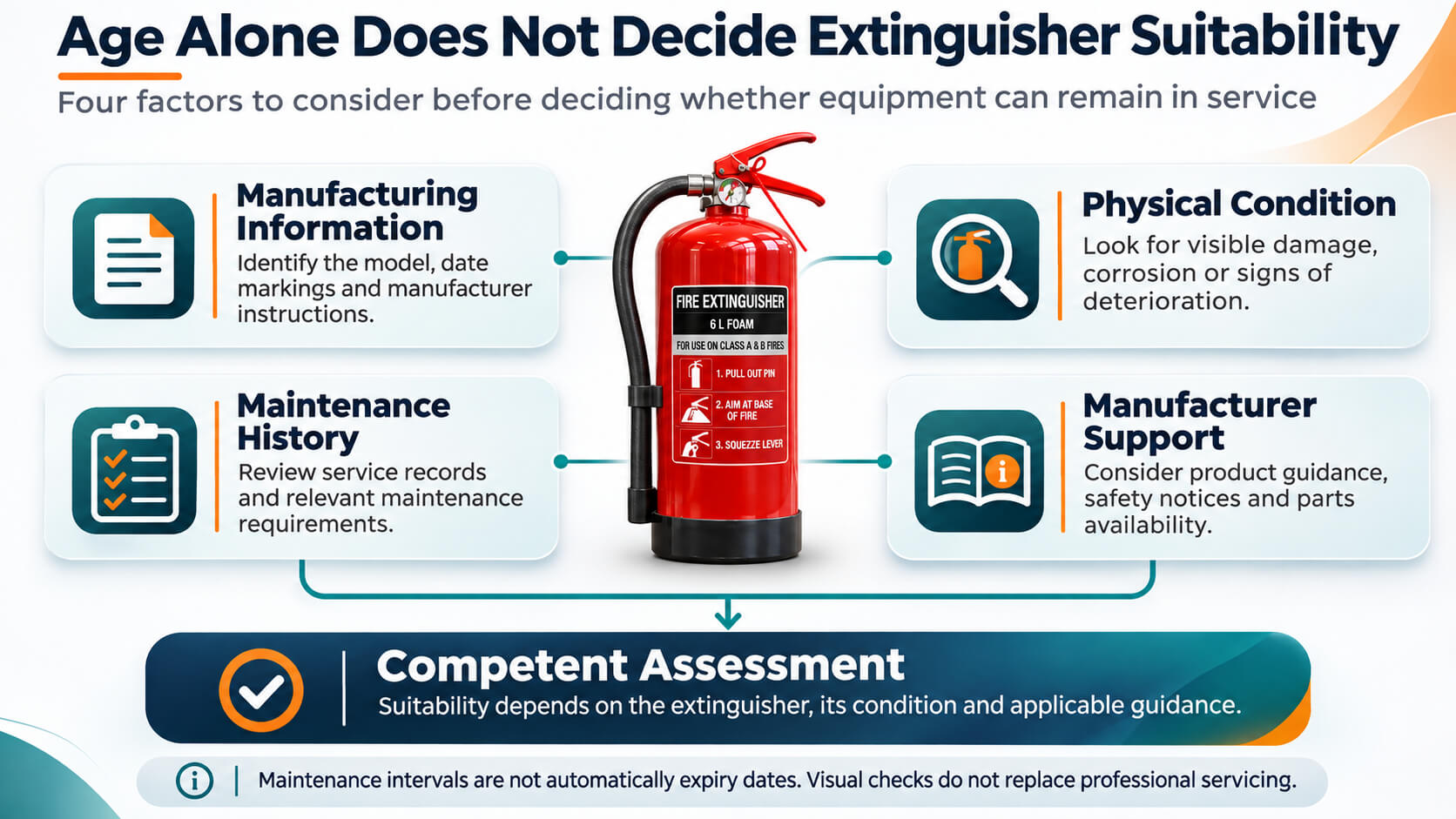
What affects an extinguisher's lifespan?
An extinguisher's continued suitability depends on its condition, maintenance and whether its design can still be supported safely. Age is one consideration, but the following factors can be equally important:
- Maintenance history: whether the required servicing and specialist maintenance have been carried out and appropriately recorded.
- Condition of the equipment: whether the cylinder and relevant components remain suitable, without defects that make continued use unsafe.
- Manufacturer support: whether relevant instructions, compatible parts and technical support remain available for the model.
- Storage and environment: whether moisture, corrosion, physical impact or other conditions may have affected the equipment.
- Product notices: whether any applicable manufacturer safety advisory or product recall affects the extinguisher.
Certain types of corrosion, dents, damaged linings or deterioration can mean an extinguisher should no longer remain in service. The Fire Industry Association also identifies situations where an extinguisher cannot be maintained because suitable components are unavailable. These decisions need appropriate technical assessment; they are not determined by a simple age calculation.
Some conventional extinguishers also require extended servicing or overhaul at particular intervals under BS 5306-3. Those are specialist maintenance milestones, not universal expiry dates. The requirements differ by extinguisher design, and an appropriate competent person should determine what applies.
When does an older extinguisher need specialist assessment?
An older fire extinguisher should be referred for competent assessment when its condition, records or manufacturer requirements raise concerns about continued suitability. This may include unclear manufacturing information, missing maintenance history, visible deterioration, an overdue specialist maintenance requirement or relevant product safety notices.
An apparently normal exterior does not prove that an extinguisher remains safe and effective internally. Equally, an older manufacturing date does not automatically establish that the unit has expired. The responsible person should obtain suitable technical advice before deciding whether equipment can remain in service or needs further action.
Where there is a suspected safety defect, record the concern, arrange appropriate precautions and seek specialist advice promptly. Do not attempt to dismantle, recharge or test-discharge a pressurised extinguisher to investigate its condition.
A visual inspection can help identify accessible external concerns, but it cannot certify an extinguisher's remaining lifespan. If you need a visual check of existing portable equipment, MyConstructor's Fire Extinguisher Inspection & Checks page lets you compare available professionals and inspection appointments.
The MyConstructor booking covers checks and inspection only. Technical servicing, internal testing, recharging, repairs, replacement and disposal are separate activities and are not included.
Technical guidance and sources:
FIA: Extinguisher Service Life BAFE: Maintenance Intervals BSI: BS 5306-3:2017 Fire & Rescue: Safe Disposal
UK standards do not prescribe one maximum service life for every portable fire extinguisher. Manufacturer requirements, equipment condition and competent assessment matter. Maintenance intervals are not automatically expiry dates. British Standards provide technical guidance rather than legislation.
Frequently Asked Questions


Yes, a pressure gauge within its indicated range does not prove that an extinguisher has met all relevant maintenance requirements or remains suitable for service. The gauge provides only limited information, and some types, including many CO2 extinguishers, do not have one. Check the applicable dates and records, and refer concerns for competent assessment.
Missing service records do not automatically establish that an extinguisher has expired, but they make its maintenance status uncertain. Identify the model and available date markings, check any building records and arrange competent advice about the equipment's continued suitability. Do not invent or backdate missing service information.
Some non-refillable or specialist extinguishers have manufacturer-specific lifespan, inspection or replacement instructions. Follow the documentation for the actual product instead of applying a general age limit intended for another extinguisher type. Do not attempt to refill a unit that is not designed for refilling; obtain suitable specialist advice where needed.
No, unwanted fire extinguishers should not be placed in ordinary household or commercial waste bins because they may contain pressurised substances. Check whether your local recycling facility accepts them or contact an appropriately licensed disposal provider. Do not dismantle or deliberately discharge the extinguisher yourself to prepare it for disposal. MyConstructor's visual-check booking does not include disposal.