


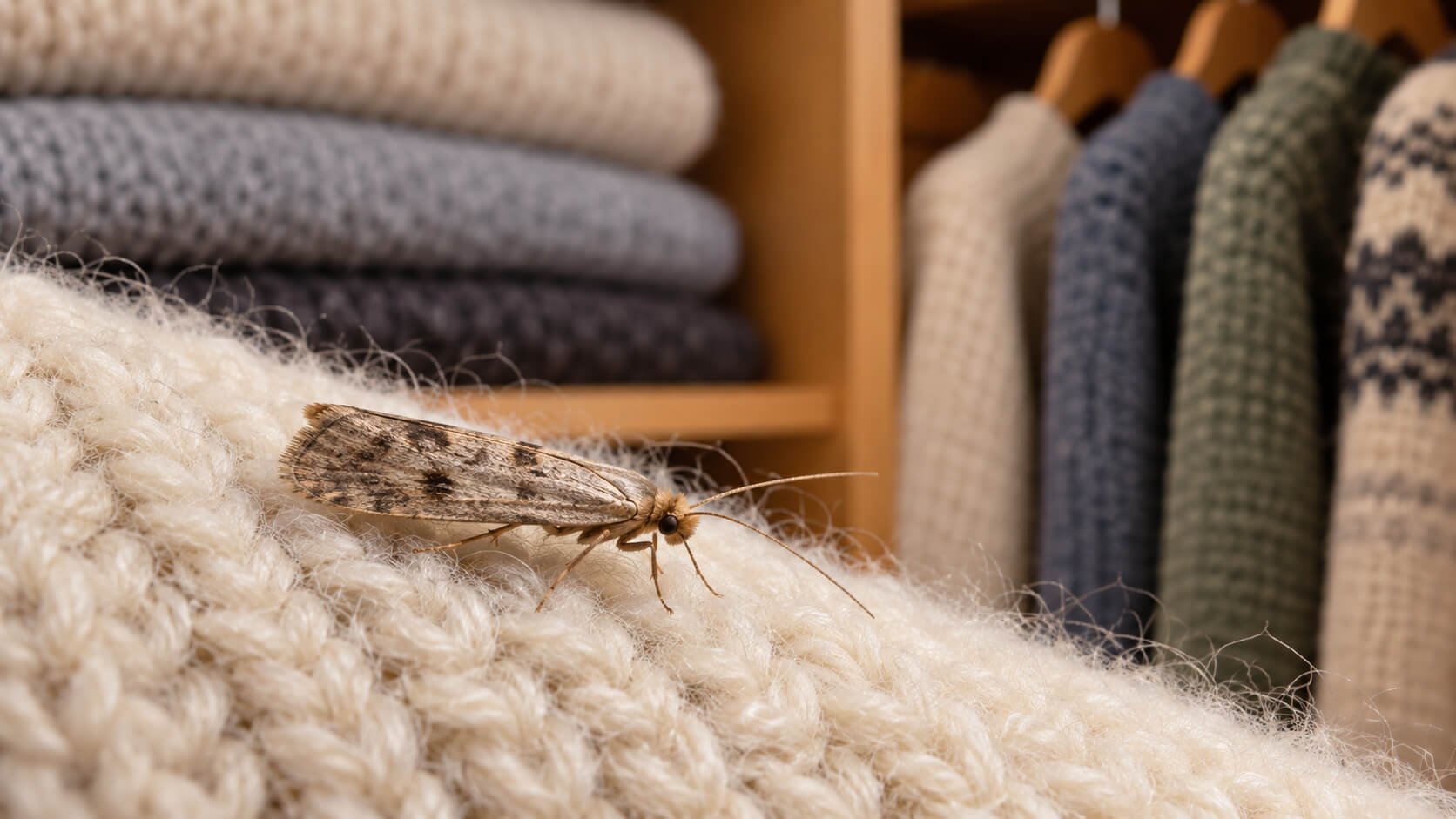
Clothes moths can be difficult to notice until larvae or fabric damage appear. This guide shows how to recognise the adults, larvae and eggs, and what signs to check on clothing and natural-fibre textiles.
It also explains how common clothes moths differ from case-bearing clothes moths.
Recently booked jobs


Clothes Moth Identification and Signs
Clothes moths can be identified by combining adult appearance with the signs left around clothing, stored textiles and other suitable natural fibres. The common clothes moth and case-bearing clothes moth have different identifying features, while larvae, silk, cases and fabric damage can provide additional evidence of activity.
What Do Clothes Moths Look Like?
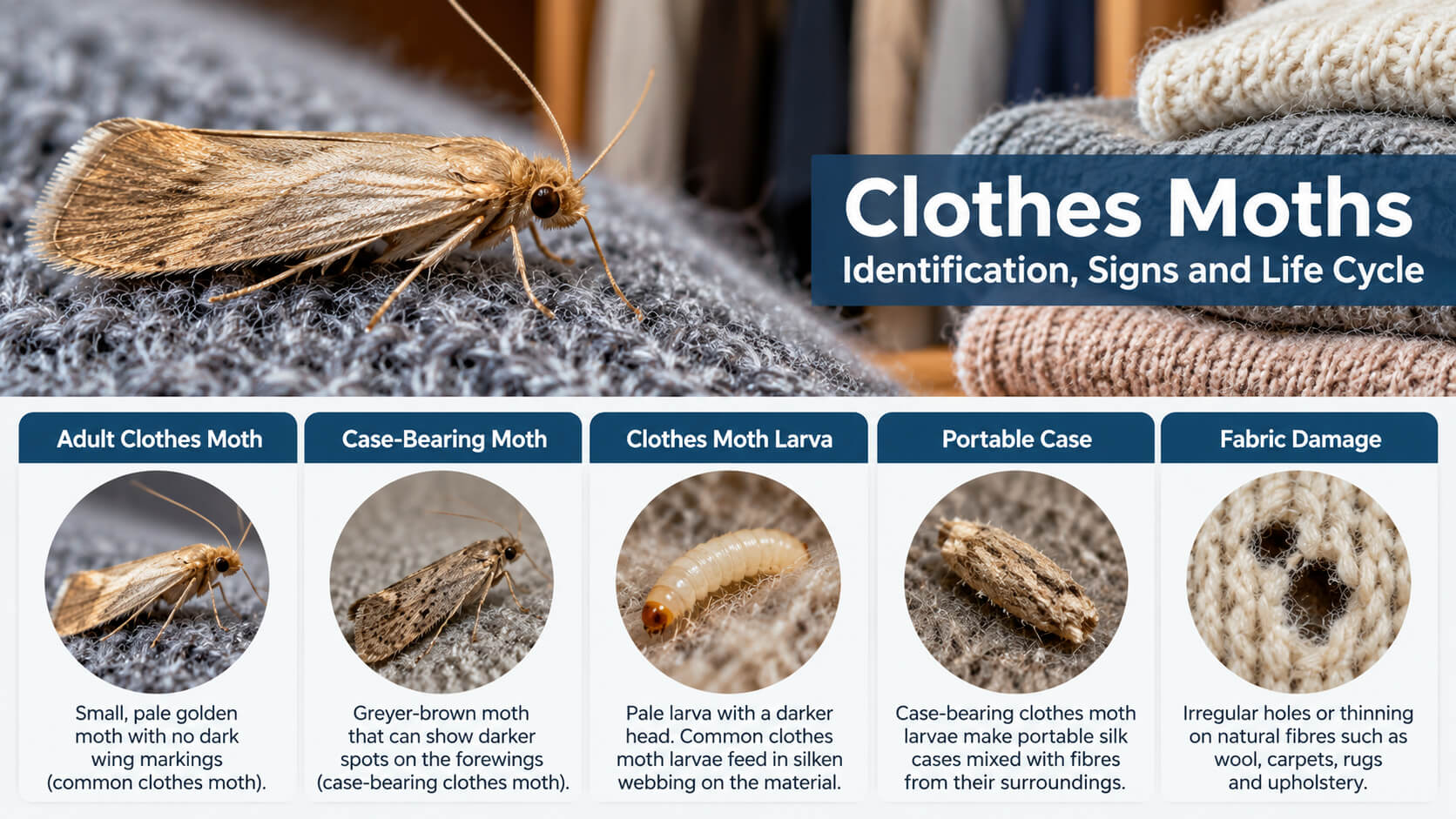
Clothes moths are small indoor moths that are usually identified by their colour, wing markings and where they are found. The common clothes moth has pale golden wings with no dark wing markings, while the case-bearing clothes moth is greyer-brown and can show darker spots on the forewings.
Adult clothes moths are often noticed around wardrobes, stored clothing, upholstery and other areas containing natural animal fibres. Appearance is useful, but the surrounding material and any signs left by larvae are often more reliable than colour alone. Older case-bearing adults may also lose some of their darker wing spots, so identification should not depend on one marking alone.
Common and Case-Bearing Clothes Moths
The two clothes moths most often associated with damage to natural fibres in UK homes are the common clothes moth and the case-bearing clothes moth. The common clothes moth is also known as the webbing clothes moth. Both species can occur indoors, but their larvae leave different identification clues.
Common clothes moth larvae feed from silken webbing or tunnels on the material. Case-bearing clothes moth larvae make portable silk cases mixed with fibres from their surroundings and carry these cases as they move and feed.
If the moth you are seeing does not match these clues, use our guide to common house moths to compare other household moth types before narrowing the identification further.
Signs of Clothes Moths
Signs of clothes moths are usually easier to spot on fabrics than on the adult moths themselves. Look for irregular damage or thinning on wool and other animal-based fibres, together with silk webbing, larval cases or activity in dark, undisturbed areas.
Clothes moth damage can appear on clothing, stored textiles, upholstery and other materials containing suitable animal-based fibres. The larvae cause the fabric damage; adult clothes moths do not feed on these materials. Check less disturbed areas such as folds, seams, wardrobe corners and stored items where activity can be easier to miss.
Finding several clues together is more useful than relying on a single hole or one adult moth. Repeated fabric damage, larvae, silk webbing or cases in the same area can provide stronger evidence of a clothes moth infestation.
Clothes Moth Larvae, Eggs and Life Cycle
Clothes moth larvae are the stage responsible for textile feeding and damage, while eggs, pupation and adult emergence form the other stages of the clothes moth life cycle. Larvae and the evidence they leave around suitable natural fibres are therefore particularly important when assessing clothes moth activity.
Clothes Moth Larvae and Eggs
Clothes moth larvae are the feeding stage responsible for textile damage, while clothes moth eggs are laid within or close to suitable natural fibres. Larvae are generally pale with a darker head, but a larva on its own can be difficult to identify confidently without considering the surrounding material and other evidence.
Clothes moth eggs are much less conspicuous than larvae and can be difficult to spot among fibres. For practical identification, visible larvae, silk, portable cases and fabric damage are usually easier clues to recognise than individual eggs.
Clothes Moth Life Cycle
In the clothes moth life cycle, eggs hatch into feeding larvae that develop before pupating and eventually emerging as adult moths. Most textile damage occurs while the moth is a larva, and development speed varies with temperature, food and other conditions.
Adult clothes moths do not feed on clothing or other textiles. Their role is primarily reproduction, which is why larvae and the evidence they leave around fabrics are particularly useful when assessing clothes moth activity.
Frequently Asked Questions


Yes, adult clothes moths can fly, although they are often seen crawling or scuttling across fabrics instead. The Natural History Museum notes that adults may move across textiles while searching for a mate, and English Heritage reports that common clothes moths tend to fly more when conditions are warm.
Clothes moths lay their eggs on or very close to materials that can feed the larvae after hatching. Typical locations include woollen clothing, stored textiles, fur, feathers and other animal-based natural fibres, especially in quieter areas where the material is left undisturbed.
Clothes moth larvae are mainly associated with natural fibres, particularly materials containing animal proteins such as keratin. Mixed-fibre items can still be affected where suitable natural material is present.
Clothes moths are associated mainly with natural animal fibres, while pantry moths are associated with stored food. Clothes moth larvae may be found around woollen clothing, stored textiles or upholstery, whereas Indian meal moth larvae develop in food products and may leave webbing in stored food. Where the moth is found is therefore an important identification clue.
Clothes moths are small moths, but their exact size depends on the species. The Natural History Museum gives a wingspan of about 12–17 mm for the common clothes moth and 9–16 mm for the case-bearing clothes moth. Size should still be used alongside wing colour, markings and location for identification.